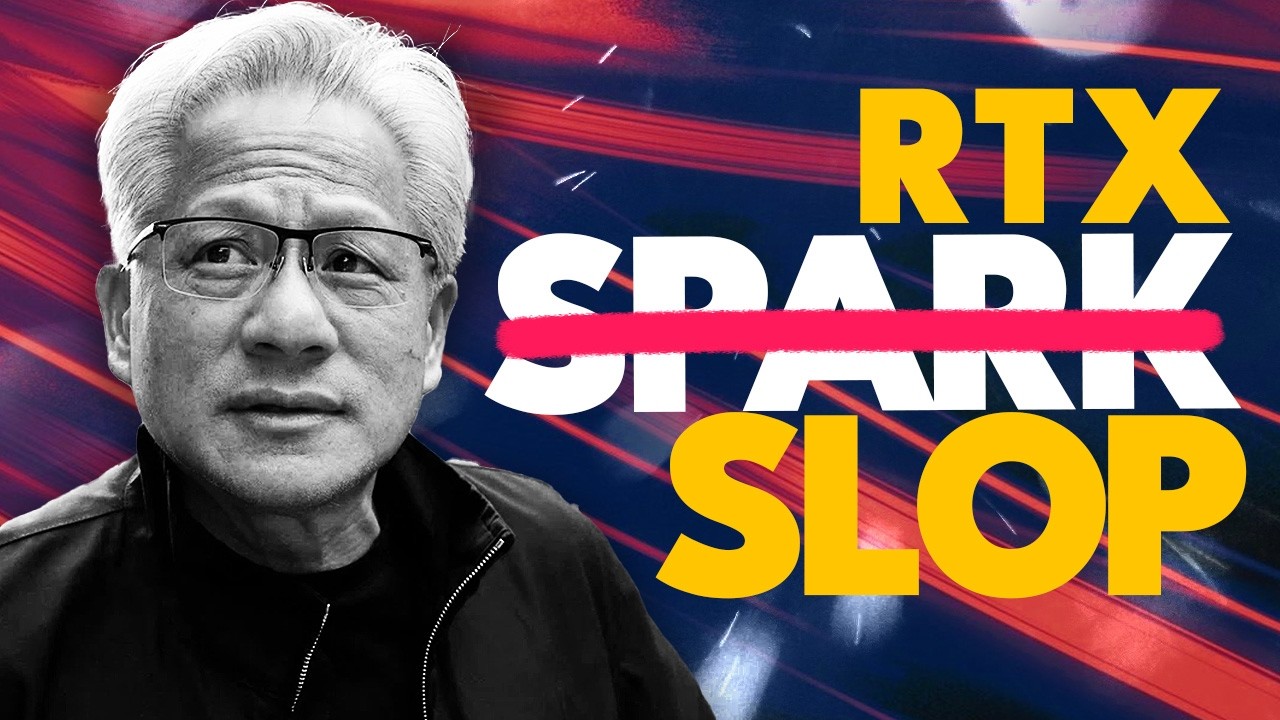
The video criticizes Nvidia’s newly announced RTX Spark, arguing that it is a fundamentally flawed product disconnected from consumer needs and unlikely to succeed in the market. The presenter highlights the irony of the AI industry’s “hallucinations,” where companies, CEOs, and investors are heavily investing in AI technologies that most consumers neither understand nor find useful. Nvidia’s CEO Jensen Huang envisions the RTX Spark as a revolutionary PC powered by autonomous AI agents running on Windows ARM, but the reality is that the general public is largely unaware of what AI agents are and skeptical about their practical value.
Technically, the RTX Spark is powered by a chip called the N1 and N1X, which combines a MediaTek 20-core ARM CPU and a Blackwell-based integrated GPU. However, the CPU is criticized as being an off-the-shelf design with no real Nvidia innovation, misleadingly branded as a “Grace CPU.” The integrated GPU, while capable, is not cutting-edge and relies on slower system memory rather than dedicated high-speed VRAM. This hardware setup, combined with Windows on ARM, results in a product that is underwhelming in performance and compatibility, especially when compared to existing alternatives that offer better specs and support.
The video also points out that Nvidia’s attempt to popularize AI agents through the RTX Spark is misguided. Most consumers do not understand or want to deal with the complexity of setting up and managing AI agents, and Nvidia offers no compelling innovation to simplify this process or demonstrate clear real-world benefits. The presenter suggests that Nvidia missed an opportunity to create a more user-friendly AI experience, such as preconfigured agents that actively assist users out of the box, akin to the AI depicted in the movie “Her.” Instead, the RTX Spark places the burden on users to figure out AI agents themselves, which is unlikely to gain mainstream adoption.
Price is another major concern, with the RTX Spark expected to cost upwards of $3,000 due to its high RAM requirements (up to 128 GB) necessary for AI workloads. This makes it prohibitively expensive for most consumers, especially when better-performing machines are available at lower prices. The video argues that Nvidia needed to either deliver top-tier specs comparable to the best CPUs and GPUs on the market or offer the RTX Spark at a significant discount to disrupt the PC market. As it stands, the product is overpriced, underpowered, and offers little innovation, making it a poor value proposition.
In conclusion, the video predicts that the RTX Spark will be a commercial failure and may contribute to bursting the current AI hype bubble by exposing the disconnect between AI industry promises and consumer realities. While Nvidia has the resources to eventually develop more compelling AI hardware, the RTX Spark is seen as a misstep that highlights how out of touch some AI companies are with market demands. The presenter hopes this failure will prompt investors and the industry to reassess the true value and potential of AI technologies in the near future.