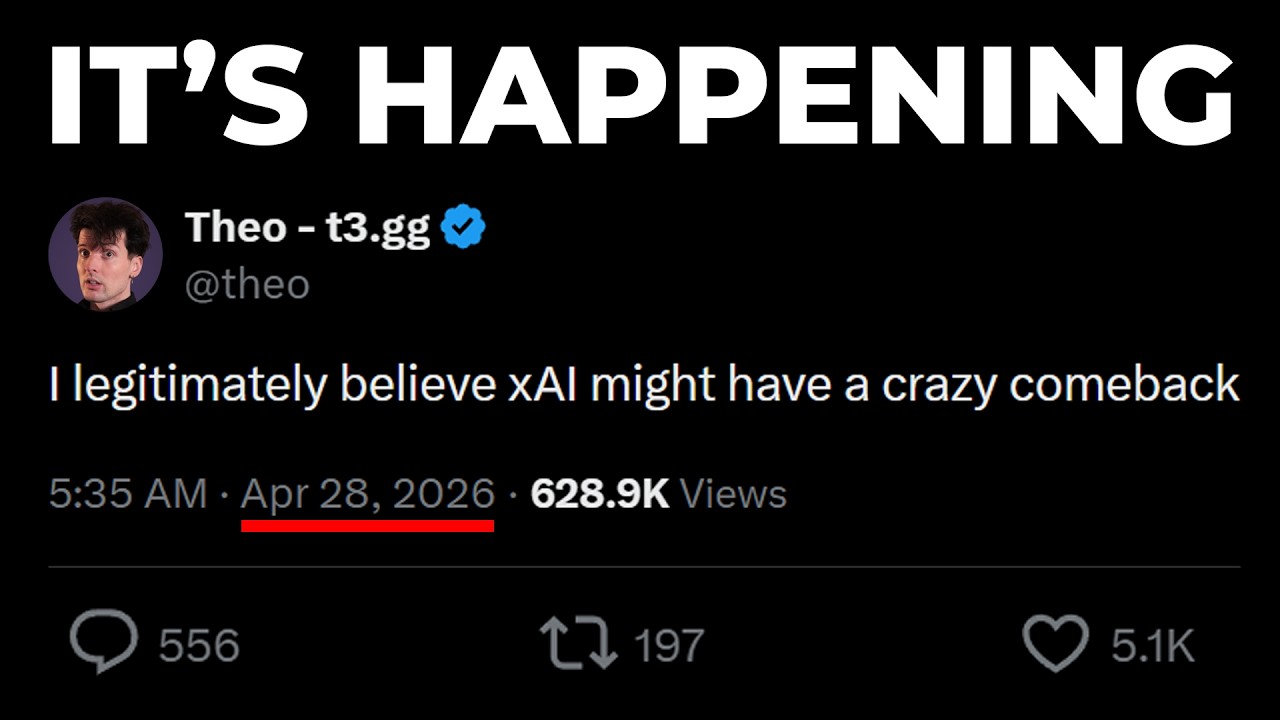
A new AI model called Grock 4.5, developed by SpaceX AI in partnership with Cursor, has recently been released, making bold claims about its performance and cost-efficiency in software development tasks. The creator of the video had early access to this model and was impressed by its capabilities, especially after seeing benchmark results that place Grock 4.5 close to top-tier models like GPT-5.5 and Fable 5, while outperforming others such as Opus 48. The model is noted for its novel features, high efficiency, and a competitive price point, especially with current discounts through platforms like Cursor.
Grock 4.5 was trained on extensive datasets covering coding, science, engineering, and math, using advanced Nvidia GPUs and sophisticated training techniques focused on data quality and domain relevance. It is a completely new base model with 1.5 trillion parameters, significantly larger than its predecessors. The training included a vast number of multi-step software engineering tasks, enabling the model to excel in complex reasoning and agentic tasks. Benchmarks show it performs exceptionally well in coding-related tasks, often using fewer tokens and running faster than competing models, making it both cost-effective and efficient.
Despite its strengths, Grock 4.5 is not without flaws. For example, it struggled with certain benchmarks like Skate Bench, where it was relatively expensive and scored lower than some competitors. Additionally, the model accidentally included an earlier snapshot of Cursor’s codebase in its training data, which affected the validity of some benchmark results. However, the developers were transparent about this issue and have removed the data from future versions. The pricing model is notably cheaper than competitors, with a base rate of $2 per million tokens in and $6 per million tokens out, though costs increase for contexts over 200,000 tokens.
In practical use, the video creator found Grock 4.5 to be highly effective for real-world coding tasks, including auditing and improving a cloud product. The model demonstrated strong capabilities in handling complex, multi-step tasks and was able to generate multiple pull requests and respond to code review comments efficiently. It was also surprisingly good at 3D modeling for game development, outperforming other models in creating 3D environments and assets, although some control issues remained. Overall, the model was pleasant to work with, fast, and cost-efficient, making it a strong candidate as a default coding assistant.
The video concludes by reflecting on the model’s place in the current AI landscape. While Grock 4.5 is impressive, it lacks some of the advanced orchestration and multi-agent capabilities seen in newer generation models like Fable and GPT-5.6. The creator likens Grock 4.5 to a highly polished product from an earlier generation, suggesting that SpaceX AI has made a remarkable leap forward but still has room to grow. The resurgence of SpaceX AI as a competitive player is seen as a positive development for the industry, promising faster, smarter, and more affordable AI tools for developers in the near future.