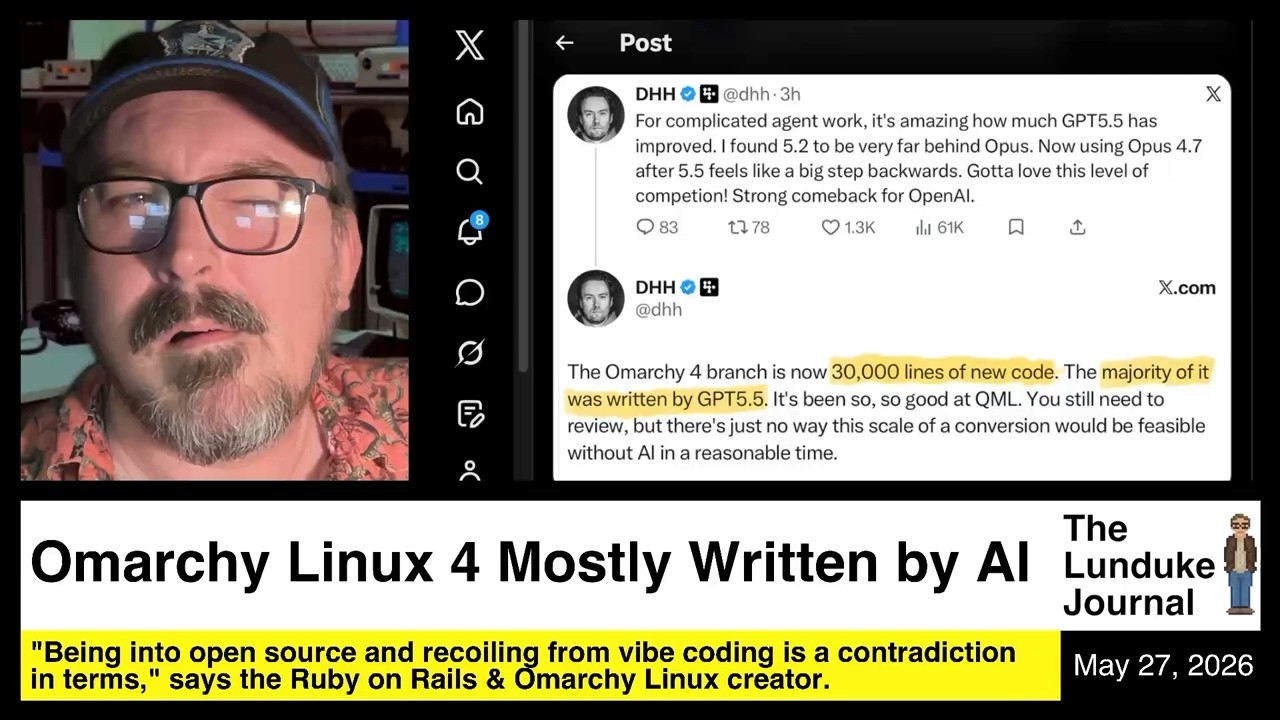
The video discusses the growing trend of AI-generated code within the Linux ecosystem, highlighting how numerous Linux projects, including the Linux kernel itself, are increasingly incorporating AI-assisted coding. Prominent figures and organizations in the Linux community, such as the Linux Foundation and Red Hat, are actively embracing AI tools, with Red Hat even incentivizing employees to use AI for Linux-related development. A notable example is Ultramarine Linux, whose upcoming release reportedly includes 30,000 lines of new code primarily written by GPT-5.5, showcasing the impressive capabilities of AI in handling complex coding tasks like QML.
DHH, the creator of Ultramarine Linux, emphasizes that AI’s proficiency stems from being trained on vast amounts of open-source code, including the entire Linux kernel. This extensive training enables AI to understand and generate code effectively, making software development more accessible and malleable. He argues that embracing AI-driven coding aligns with the core principles of open source—empowering many to modify and improve software freely. According to DHH, resisting AI-assisted coding contradicts the open-source ethos, which is fundamentally about openness and collaboration without barriers.
The presenter acknowledges the impressive advancements in AI coding, sharing a personal experiment where an AI generated a functional Lotus 1-2-3 style spreadsheet in ANSI C within an hour and a half. This demonstration underscores AI’s potential to accelerate software development and enable small teams to achieve significant results quickly. However, despite these positives, the presenter expresses skepticism and concern about the reliance on AI for large-scale code generation, particularly regarding the thoroughness of code reviews and the risk of introducing vulnerabilities or backdoors.
A major concern raised is the difficulty in fully reviewing and understanding vast amounts of AI-generated code. Given the sheer volume of contributions, it is unlikely that all code is meticulously examined by humans, increasing the risk of security flaws and licensing issues. The presenter warns of a potential future scenario where widespread AI-generated code could harbor numerous hidden backdoors, posing significant risks to software integrity. While AI tools might assist in code review, the current state of AI-assisted development introduces new challenges that the community must address.
In conclusion, the video highlights the undeniable shift toward AI-assisted coding in Linux and open-source projects, with major distributions and the kernel itself increasingly becoming “vibe coded.” While this trend offers exciting possibilities for rapid development and democratizing software creation, it also raises important questions about security, code quality, and the future role of human programmers. The presenter remains cautiously optimistic but urges vigilance and critical evaluation as the community navigates this transformative era in software development.