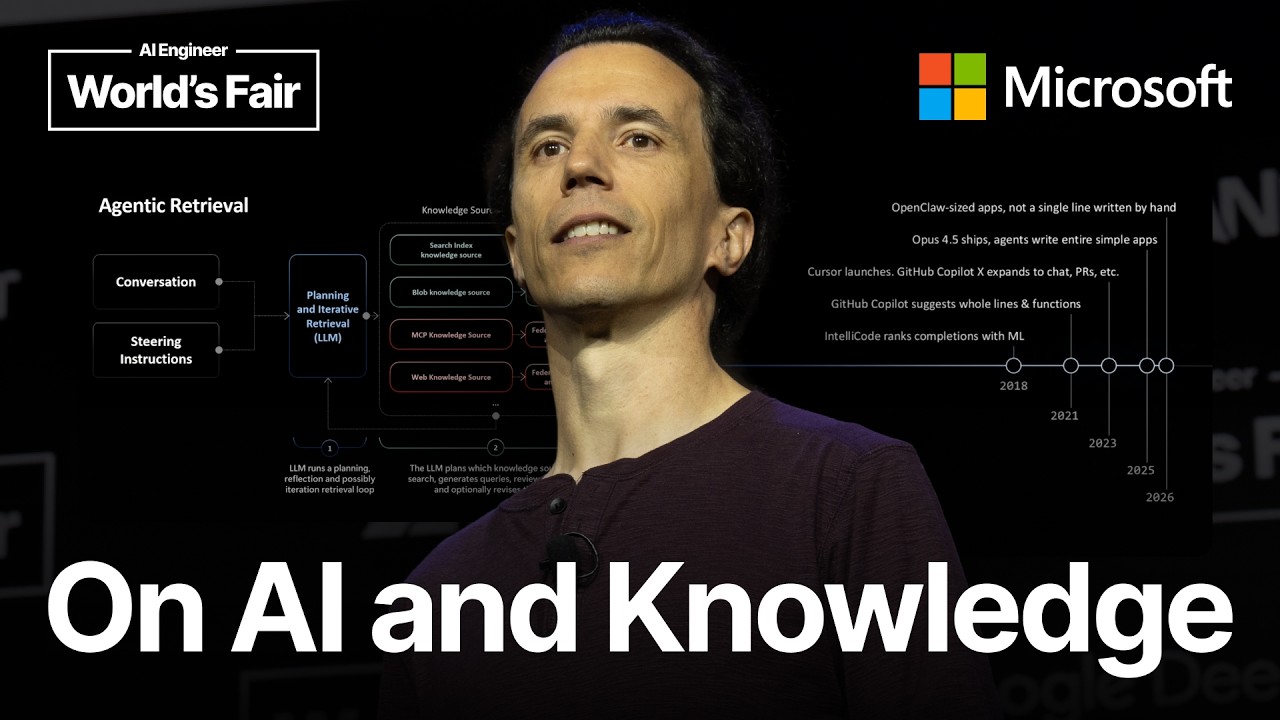
Pablo Castro, CVP and Distinguished Engineer at Microsoft, discusses the intersection of AI and knowledge, emphasizing the importance of understanding different types of knowledge in AI systems. He categorizes knowledge into three types: intrinsic, extrinsic, and learned. Intrinsic knowledge refers to what is embedded within AI models themselves, derived from training data and stored in model parameters. This foundational knowledge has driven exponential advancements in AI, exemplified by tools like IntelliSense, GitHub Copilot, and more recent coding models that have revolutionized software development.
Moving beyond intrinsic knowledge, Castro highlights the significance of extrinsic knowledge, which involves grounding AI agents in the ambient data of organizations. Microsoft addresses this through Microsoft IQ, a platform that integrates various data sources such as documents, emails, analytics, and web data to provide comprehensive context for AI agents. This approach enables agents to operate effectively within the specific environments of companies by accessing relevant, up-to-date information beyond their intrinsic model knowledge.
Castro also delves into the evolution of retrieval systems, noting that while vector search initially seemed sufficient, combining multiple retrieval methods yields better results in real-world applications. Microsoft Foundry IQ exemplifies this layered approach, offering both simplicity for general users and advanced control for experts. Additionally, Foundry incorporates agentic retrieval, where agents iteratively assess and refine their information retrieval to ensure completeness and accuracy, improving performance on complex queries.
The final type of knowledge Castro discusses is learned knowledge, which emerges from continuous reflection and improvement of AI agents based on their interactions and performance. Microsoft’s Foundry platform includes an agent optimizer tool that automates this learning loop by evaluating agent performance, generating improved configurations, and deploying optimized versions. This process allows organizations to capture and enhance their unique operational knowledge, creating differentiated AI capabilities tailored to their specific needs.
In conclusion, Castro presents a comprehensive framework for integrating AI and knowledge, combining intrinsic model capabilities, organizational data grounding, sophisticated retrieval techniques, and continuous learning loops. Microsoft’s platforms like Foundry and Microsoft IQ provide the tools and infrastructure to build, manage, and optimize AI agents effectively. He encourages developers and organizations to explore these technologies via ai.azure.com to harness the full potential of AI-driven knowledge systems.