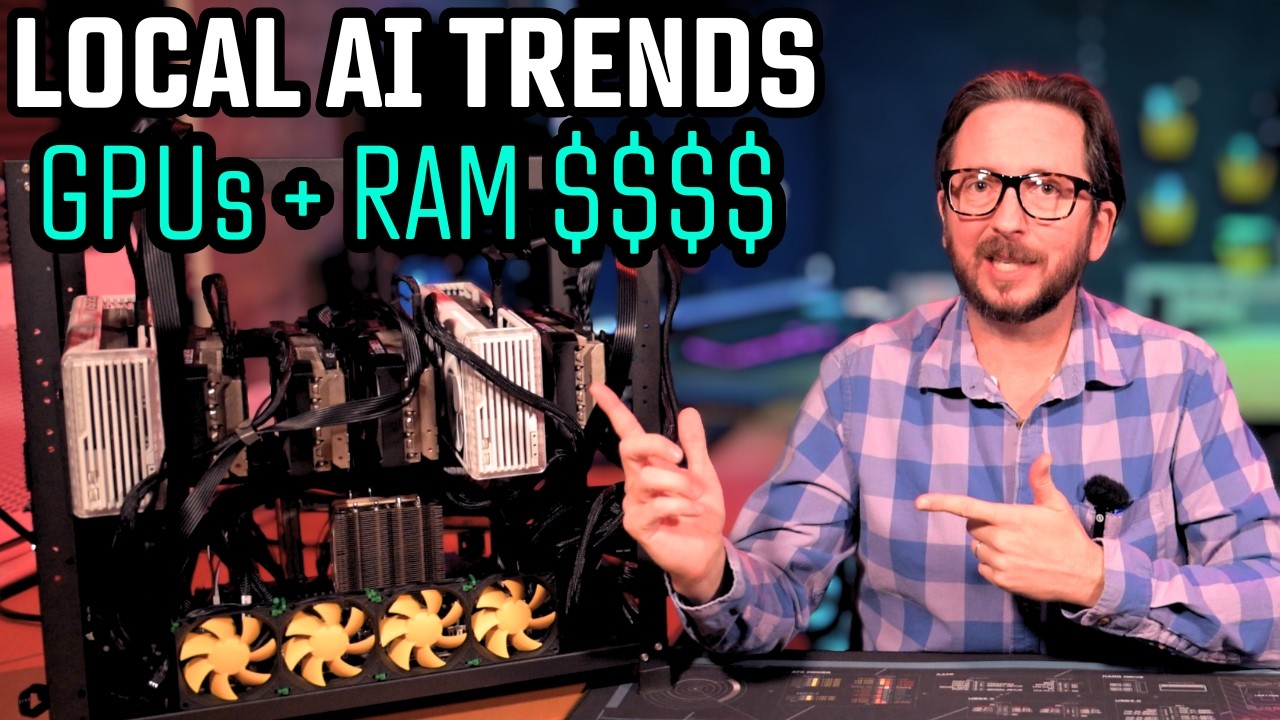
The video discusses the rapid growth and significance of open-weight and open-source AI models, particularly those that can be run locally. The presenter highlights the increasing challenges in hardware requirements, especially system RAM and GPU VRAM, as models grow larger and more complex, approaching frontier-edge capabilities. This trend is expected to continue, with GPUs likely to rise in price due to demand, impacting both new and used markets. The presenter notes that while some GPUs like the Nvidia 3090 remain a good option for local AI work, the overall hardware landscape is becoming more demanding and costly.
One key point is the difficulty in running advanced AI models, especially for video and image generation, on typical consumer hardware. Many state-of-the-art models require extremely high VRAM capacities, such as 80 GB GPUs like the Nvidia H100, which are out of reach for most users. Running everything on a single GPU is ideal to avoid performance bottlenecks caused by PCIe bus communication. The video also touches on the recent release of GPT-OSS by OpenAI, which was influenced by public pressure and marks a shift in the AI landscape, with open-source models gaining more attention alongside closed-source giants like Anthropic and OpenAI.
The presenter expresses skepticism about the near-term arrival of Artificial General Intelligence (AGI), cautioning viewers to be wary of overhyped claims. Instead, the focus should be on the practical benefits of current AI tools, which already offer significant improvements in workflows and productivity. The path to AGI is expected to be long and complex, requiring more than just scaling up data and model size. The geopolitical context, especially competition involving China and Taiwan, also plays a role in shaping AI development and access to technology.
Looking ahead, the video predicts continued growth in large open-source models, with parameter counts reaching into the trillions. However, running these models locally will require advanced techniques like quantization to manage resource demands. The rising costs of system RAM and VRAM are expected to create a “perfect storm” of shortages and price increases over the next several quarters. Despite these challenges, improvements in model sparsity and efficiency may enable lower-power inference, making AI more accessible to a broader audience in the future.
For those interested in getting started with local AI, the presenter advises careful consideration of hardware purchases, emphasizing budget constraints and current market conditions. While Nvidia GPUs generally offer the easiest setup and best performance, AMD and Intel options are also viable with some tinkering. The video recommends experimenting with models like GPT-OSS 20B on CPUs to gauge performance before investing heavily in GPUs. Additionally, building systems with multiple PCIe slots can facilitate scaling for inference tasks. Overall, the video conveys excitement about the rapid progress in AI technology and encourages viewers to stay informed and engaged with the evolving ecosystem.