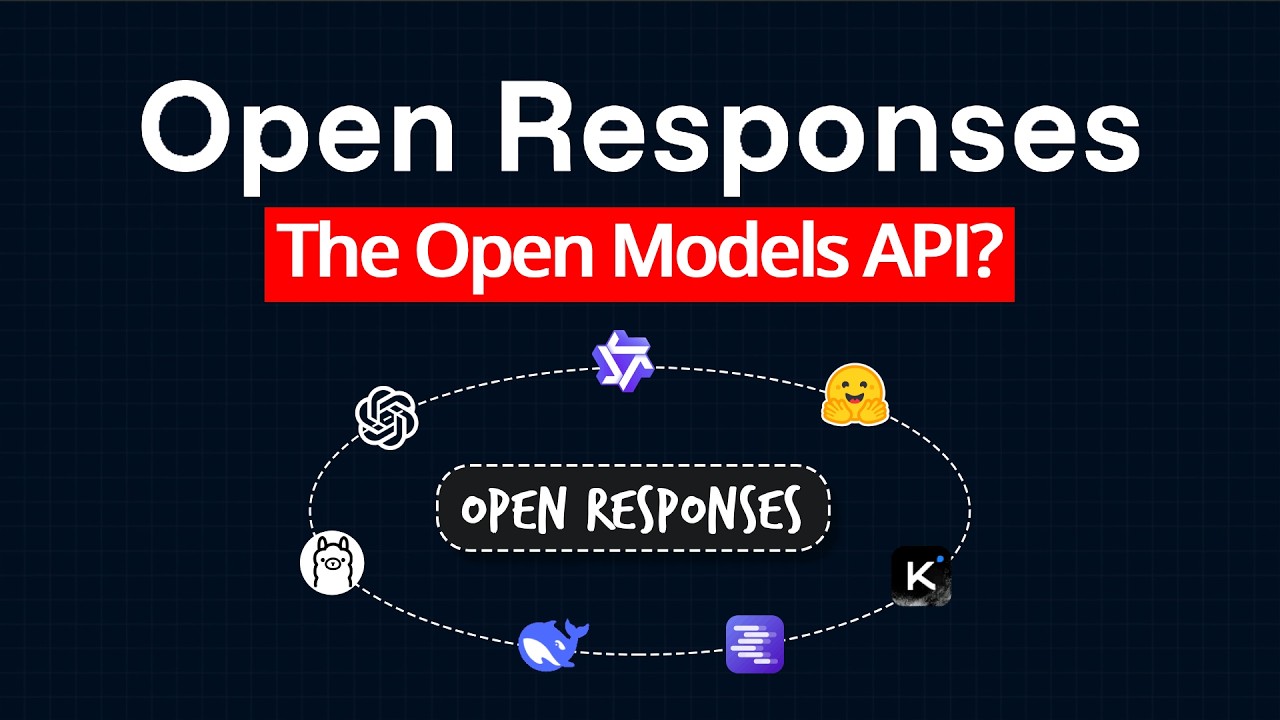
The video discusses OpenAI’s new initiative to support open models through a proposed API standard called “Open Responses.” The creator begins by questioning whether this move genuinely benefits the open-source AI community or is simply an attempt by OpenAI to appear more open. The video also compares OpenAI’s approach to similar efforts by other companies, such as Anthropic, and notes that the landscape has shifted from everyone using OpenAI-compatible APIs to a more fragmented environment where each major lab—like Google (Gemini), Anthropic (Claude), and OpenAI—has its own preferred endpoints and standards.
A key point raised is that, until recently, most open models relied on OpenAI compatibility modes, allowing developers to use the same SDKs and chat completions APIs across different models. However, as the field has evolved, there’s been a push for APIs that better support advanced features like tool calling, agentic workflows, and multimodal inputs. The video highlights that some Chinese model providers, such as Moonshot AI and Zhipu AI, have embraced compatibility with Anthropic’s Claude API, especially for coding tools, rather than OpenAI’s newer responses API.
OpenAI’s “Open Responses” standard aims to address this fragmentation by providing a unified, extensible API for open models. This standard is designed to support advanced features out of the box, such as tool calls, streaming, multimodal inputs, and agentic loops. It also allows model providers to add custom features without breaking compatibility. The initiative has already attracted support from major community players like Hugging Face, Vercel, OpenRouter, LM Studio, Ollama, and vLLM, suggesting strong momentum for broader adoption.
The video delves into the technical details of the Open Responses standard, noting that while much of it maps closely to OpenAI’s existing responses API, it introduces useful abstractions like “items” that can represent messages, tool calls, or reasoning states. The standard also supports streaming, reasoning tokens, and summaries, making it easier for developers to handle complex agentic interactions and introspect model reasoning. The creator demonstrates how to use the API with code examples, showing compatibility with both Hugging Face’s inference endpoints and local deployments via Ollama, and notes that performance and feature support can vary depending on the model and setup.
In conclusion, the creator sees Open Responses as a positive step for the open model ecosystem, making it easier for developers to switch between proprietary and open models and to run advanced workflows locally. However, they also predict that some providers, especially in China, may continue to prioritize compatibility with Anthropic’s API due to its popularity in coding tools. The video ends on an optimistic note, suggesting that as more open models adopt these standards, users will benefit from greater flexibility and capability, especially as local and server-side agentic tools become more prevalent.