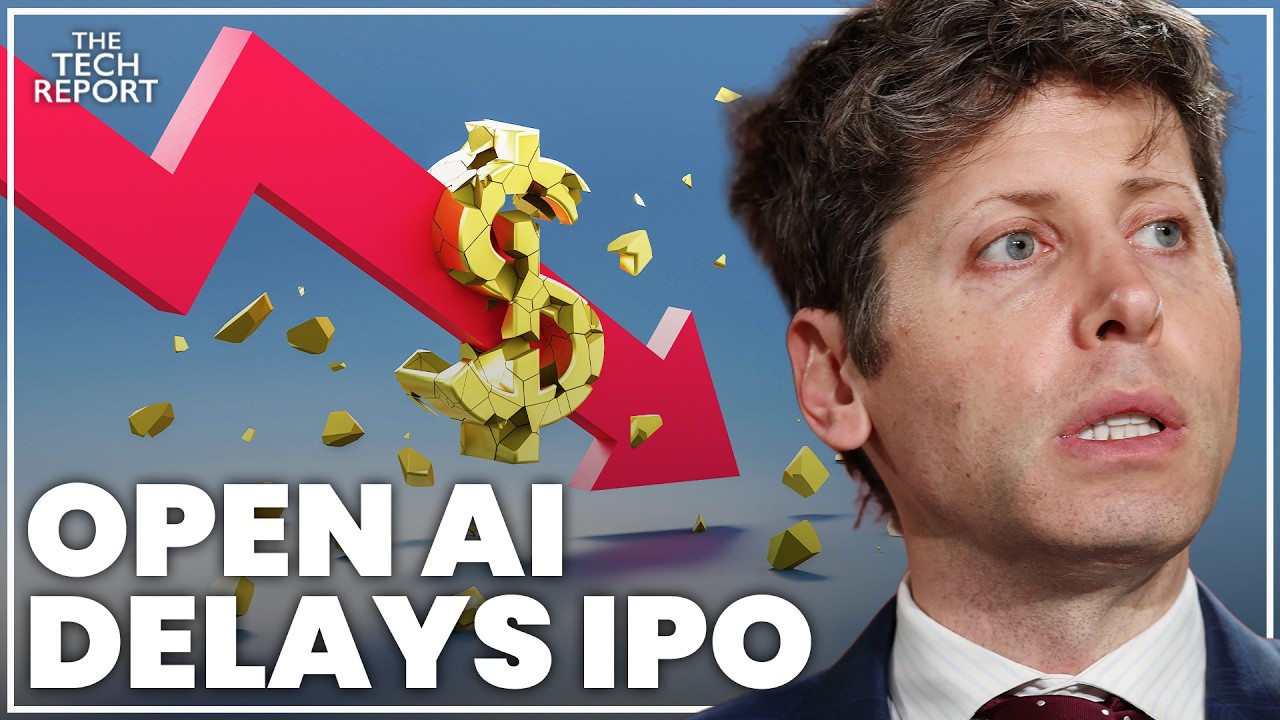
The video discusses OpenAI’s consideration to delay its IPO until 2027 amid a significant downturn in tech stocks, with the company struggling to justify a $1 trillion valuation. Despite earlier enthusiasm and confidential filings suggesting readiness to go public, bankers and investors are skeptical about OpenAI’s financials and growth prospects. The delay signals deeper issues within the AI industry, including rising costs, uncertain profitability, and intense competition from rivals like Anthropic. The increasing expense of AI infrastructure, particularly due to soaring RAM and GPU prices, exacerbates these challenges, making it difficult for companies to sustain their growth or justify their valuations.
A critical concern raised is the lack of clear return on investment (ROI) in AI spending. Many companies are beginning to cap or reduce their AI budgets as doubts grow about the financial benefits of massive capital expenditures on data centers and compute power. The hype around AI is fading as investors and industry insiders question the sustainability of current spending levels, especially given that the cost of hardware and data center operations continues to rise sharply. This skepticism is compounded by the fact that open-source AI models, while cheaper, still rely heavily on the outputs of major players like Anthropic and OpenAI, limiting their potential to disrupt the market or reduce costs significantly.
The conversation also highlights systemic issues within the AI industry, where companies like OpenAI and Anthropic lack innovative ideas beyond scaling large models, which are increasingly expensive and difficult to monetize. These firms resemble large hyperscalers more than nimble startups, often relying on continuous funding rounds without a clear path to profitability. The industry’s focus on building ever-larger models without addressing cost efficiency or viable business models raises concerns about long-term viability. Additionally, geopolitical factors, such as government restrictions on AI model releases, add further uncertainty to the market dynamics.
SoftBank’s role as a major investor in OpenAI is scrutinized, revealing significant financial risks. SoftBank’s inability to secure loans against its OpenAI holdings underscores the difficulty in valuing AI companies amid market volatility. The video points out that SoftBank, despite its past successes, has made several poor investments recently, and its heavy exposure to AI-related ventures could pose systemic risks to the Japanese stock market. The broader implication is that the AI investment bubble, fueled by hype and massive capital inflows, may be on the verge of bursting, with potentially severe consequences for investors and the tech ecosystem.
In conclusion, the video paints a sobering picture of the AI industry’s current state, marked by escalating costs, uncertain returns, and a lack of innovative breakthroughs beyond scaling models. The delay of OpenAI’s IPO symbolizes broader investor skepticism and the challenges facing AI companies in proving their long-term value. With rising hardware costs and tightening capital markets, the industry may face a reckoning soon, forcing companies to rethink their strategies or risk collapse. The discussion underscores the need for more prudent investment, realistic business models, and a clearer understanding of AI’s economic impact as the hype begins to wane.