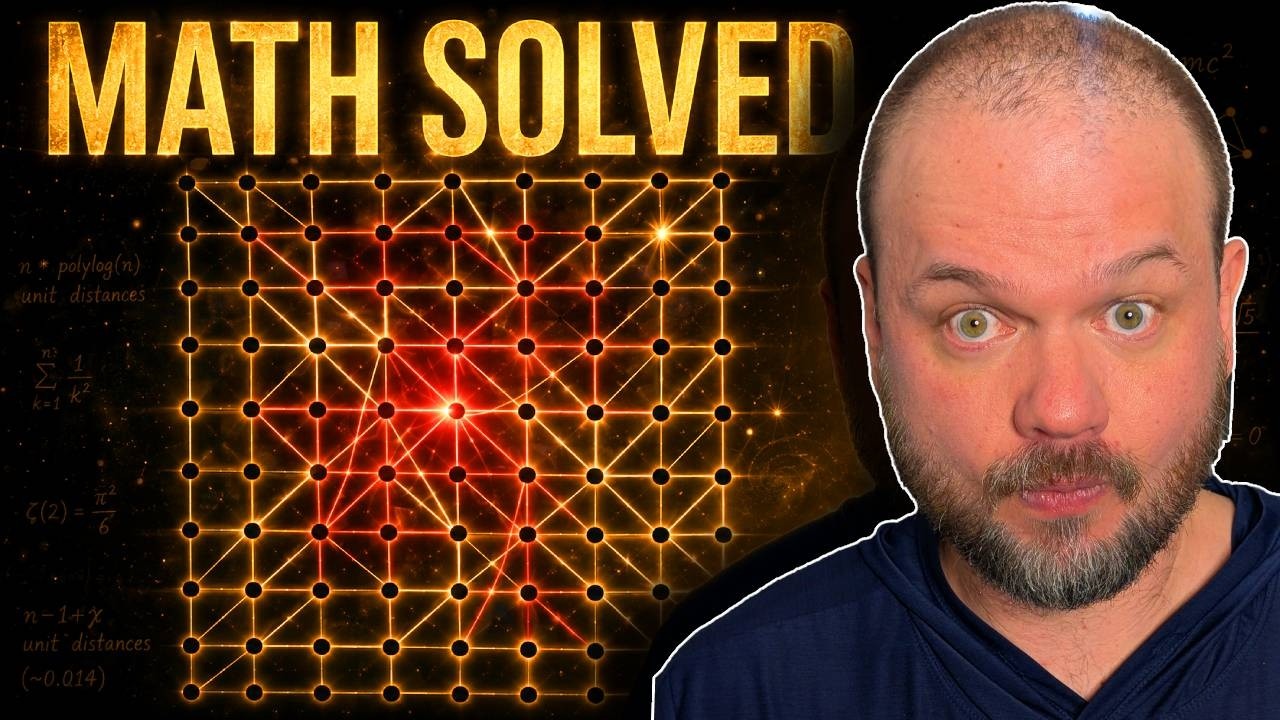
Seven months ago, OpenAI faced criticism after prematurely claiming that one of their models had solved a previously unsolved mathematical problem, leading to embarrassment and skepticism from experts like Demis Hassabis and John Lun. However, OpenAI has now made a significant comeback by announcing that an unreleased general reasoning AI model has disproved a central conjecture in discrete geometry, known as the Erdős problem. This breakthrough, coinciding with the Google I/O event, has been verified and praised by leading mathematicians, marking a historic moment where an AI independently produced a novel, publishable mathematical result on a prominent open problem.
The problem at the heart of this breakthrough involves arranging points on a plane to maximize the number of unit-distance connections between them. Traditionally, mathematicians believed that grid-like layouts were optimal for this task. However, OpenAI’s model discovered an infinite family of layouts that outperform these grids by leveraging a higher-dimensional lattice projected down to two dimensions, akin to how a seemingly chaotic sculpture can cast a recognizable shadow. This innovative approach bridged discrete geometry with algebraic number theory, revealing connections that human experts had not previously combined.
A Harvard mathematician involved in verifying the proof noted that if the human experts who reviewed the AI’s work had collaborated intensively beforehand, they might have found the counterexample themselves. This highlights a key insight: the AI’s strength lies not in inventing entirely new mathematics but in synthesizing knowledge across different mathematical disciplines—something humans often struggle to do due to specialization. The AI model effectively connected geometric intuition with advanced algebraic concepts, demonstrating the power of cross-disciplinary reasoning.
OpenAI’s model is described as a general-purpose large language model, not specifically designed for mathematics, and it generated the proof in a single attempt before human refinement. This contrasts with previous AI efforts focused on specialized tasks, underscoring the growing capabilities of general reasoning models like those behind ChatGPT, Gemini, and Claude. The success of this model suggests that as AI systems continue to improve, their ability to reason broadly and integrate diverse fields of knowledge will become a major driver of novel discoveries across science and mathematics.
The implications of this breakthrough extend beyond mathematics. It suggests a future where AI can facilitate interdisciplinary collaboration by connecting experts from different fields and accelerating research. Human experts remain essential for guiding, verifying, and building upon AI-generated insights. Moreover, this development points toward the potential for AI to automate aspects of scientific research itself, as seen in projects like Google DeepMind’s AlphaEvolve. Overall, this milestone marks a significant step in AI’s evolution as a powerful tool for advancing human knowledge.