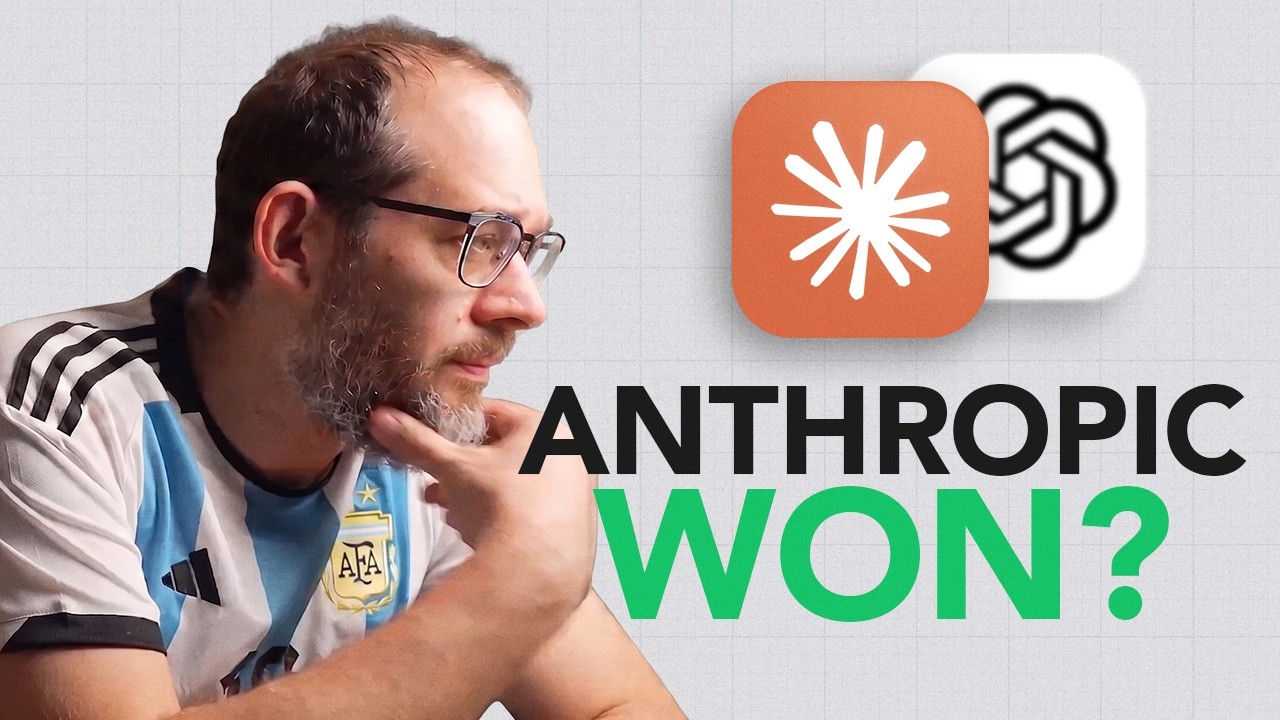
The video argues that despite OpenAI’s perceived dominance, Anthropic may be leading in AI development due to its focus on advanced pre-trained models and key talent acquisitions, while OpenAI faces challenges with its latest model releases. Additionally, it highlights Midjourney’s groundbreaking medical imaging technology as a transformative AI innovation with potentially greater societal impact than the competition between major AI labs.
The video challenges the common perception that OpenAI is currently dominating the AI landscape by suggesting that Anthropic may actually be ahead, despite recent setbacks like the temporary ban of its model, Fable. While OpenAI has had a strong week with rumors of a new model release and a significant hire from Google, the speaker argues that talent acquisition and model development at Anthropic indicate a different story. Notably, Anthropic secured John Jumper, a Nobel Prize winner known for his work on AlphaFold, signaling strong momentum for the company despite negative headlines.
A key point made is that Anthropic has been focusing more on developing large, pre-trained models, whereas OpenAI has invested heavily in improving reasoning and post-training techniques. Anthropic’s recent models, Fable and Methuselah, represent some of the most advanced pre-trained models available, giving them an edge in recursive self-improvement—a process believed to be crucial for future AI advancements. In contrast, OpenAI’s last major pre-trained model, version 4.5, faced issues and was pulled shortly after release, raising questions about their current position in this aspect of AI development.
The speaker emphasizes that the movement of top talent to both OpenAI and Anthropic is a critical factor in the race, suggesting that both companies are heavily invested in pushing the boundaries of AI capabilities. However, the advantage Anthropic holds in pre-trained model scale and freshness could be significant in the near term. This nuanced view encourages looking beyond headline news and considering the deeper technical and strategic developments that shape the AI landscape.
Beyond the competition between OpenAI and Anthropic, the video highlights a major breakthrough from Midjourney, a company better known for its AI art generation. Midjourney has developed a revolutionary medical imaging device that uses a new type of ultrasound to scan the entire body quickly, affordably, and non-invasively. This technology could enable preventative medical care on a massive scale, potentially transforming how diseases like cancer and heart disease are detected and monitored. The innovation represents a shift in AI energy and impact beyond just language models and benchmarks.
The video concludes by inviting viewers to reconsider where the most meaningful AI progress is happening, suggesting that breakthroughs like Midjourney’s medical imaging may have a far greater societal impact than the ongoing model race between OpenAI and Anthropic. The speaker encourages discussion about other exciting developments outside the major AI labs and stresses the importance of broadening the conversation about AI’s role and potential in the world. This perspective urges a more holistic view of AI innovation, beyond just who is leading in model performance.