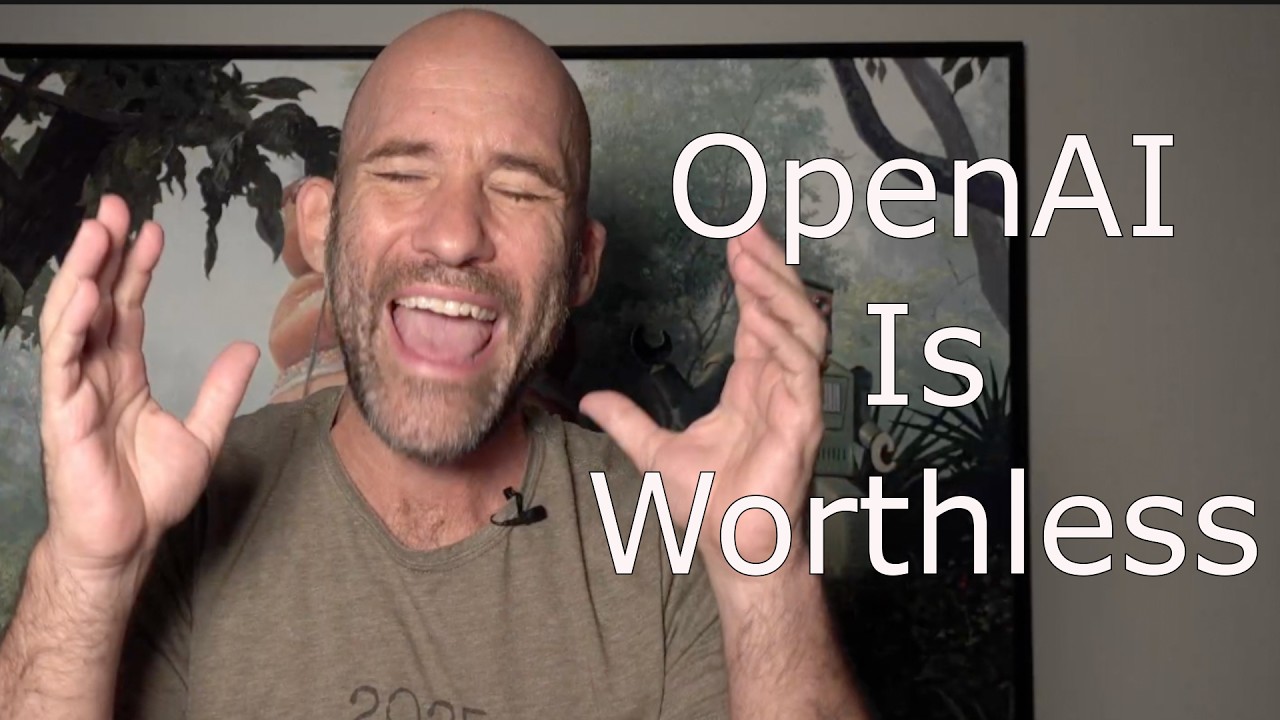
The video discusses OpenAI’s recent decision to significantly cut prices for two of its GPT 5.6 AI models, Terra and Luna, amid growing cost sensitivity among enterprise customers. Despite the hype around artificial intelligence, many companies are struggling to see a clear return on investment, leading to reluctance in deploying expensive AI solutions. This shift signals a move beyond the initial excitement phase of AI, where businesses now demand tangible value before committing substantial funds. OpenAI’s price reductions—20% for Terra and 80% for Luna—reflect the pressure to remain competitive against rivals like Google and Microsoft, who offer more cost-effective models.
The speaker highlights the broader challenge facing AI companies: the technology’s perceived value does not yet justify the high costs, making it difficult to achieve the massive revenues once anticipated. OpenAI, in particular, faces the daunting task of reaching a trillion-dollar valuation to justify its business model and future IPO ambitions. However, with prices dropping to as low as 20 cents per million input tokens, the path to such lofty financial goals appears increasingly uncertain. The complexity and token consumption of newer reasoning and agentic AI models further exacerbate cost concerns, raising questions about the sustainability of current pricing strategies.
Drawing a parallel to the robotics industry of the 1980s and 1990s, the video explains how technological progress can stall due to external economic factors. Back then, robots initially advanced rapidly but plateaued when cheap human labor, especially in China, became a more cost-effective alternative. This historical context is used to illustrate how macroeconomic conditions, such as labor costs and demographics, heavily influence the adoption and development of technology. Currently, China’s aging population is driving renewed investment in robotics, showing how external pressures can reignite technological innovation.
The discussion then shifts to the practical value of AI compared to human labor and simpler automation tools. The speaker argues that while AI, particularly large language models (LLMs), will play a role in the upcoming automation revolution, they will likely be just one small part of a broader, more efficient automation ecosystem. In many cases, traditional relational databases and rule-based systems may offer more cost-effective solutions than running every process through resource-intensive LLMs. This perspective challenges the prevailing narrative that AI alone will revolutionize automation, suggesting a more nuanced and economically driven approach.
In conclusion, the video questions the long-term viability and valuation of AI companies like OpenAI, given the current pricing pressures and unclear ROI for customers. It invites viewers to consider whether OpenAI can survive and thrive through 2028 amid these challenges. The speaker encourages reflection on the true worth of AI technologies and their place within the larger technological and economic landscape, emphasizing the need for realistic expectations about AI’s role and value in business.