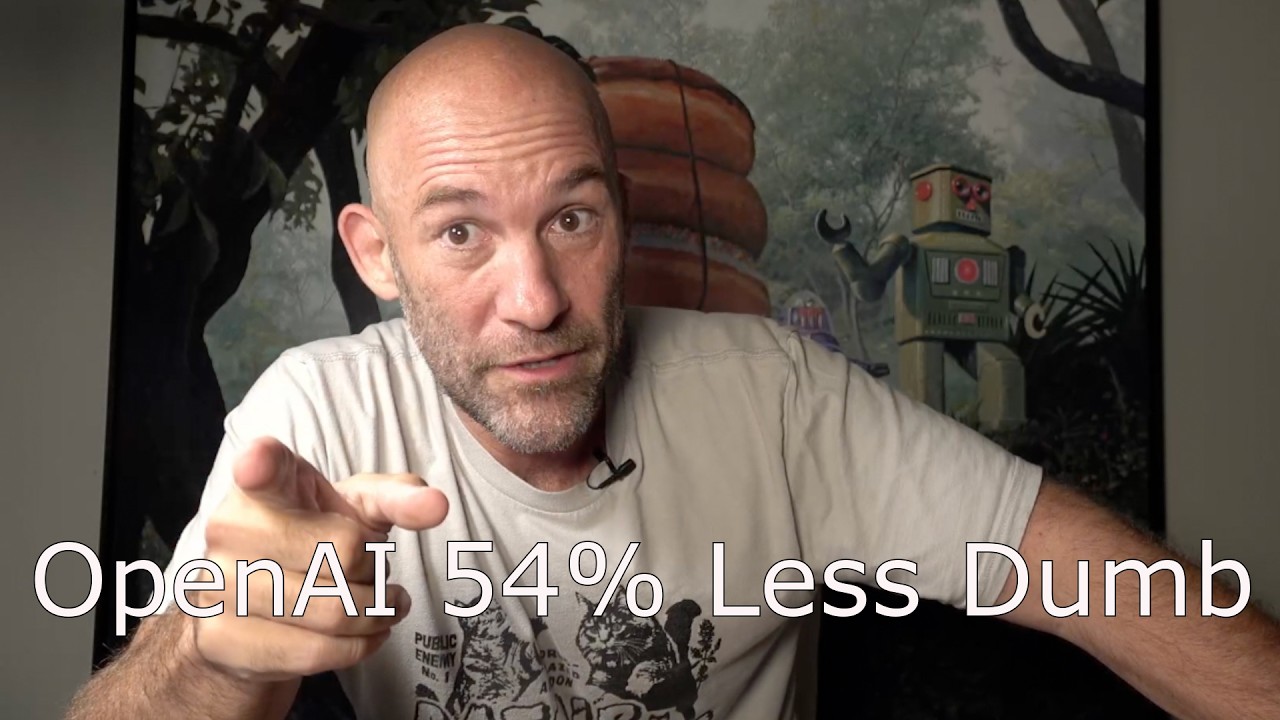
The video critiques OpenAI’s claim that its GPT-5.6 model is 54% more efficient for coding agents, arguing that despite this improvement, AI costs remain prohibitively high due to token-intensive usage patterns, limiting practical benefits for businesses. It also highlights widespread public misunderstanding of AI, industry-wide cost challenges, and urges skepticism toward such announcements, emphasizing the need for significant cost reductions to make AI adoption sustainable.
The video discusses OpenAI’s announcement that its latest AI model, GPT-5.6, is 54% more token efficient for agentic coding tasks, as stated by CEO Sam Altman during an interview with CNBC. While this sounds impressive on the surface, the speaker expresses skepticism about the real-world value of this improvement. They explain that AI costs have risen significantly due to the way models are used, especially with reasoning models that consume many tokens by iteratively asking and answering questions to improve responses. Agentic models, which operate continuously to gather and process data, can burn through tokens rapidly, leading to high expenses for companies.
The speaker highlights that although a 54% efficiency gain might reduce costs from extremely high to somewhat less extreme, the overall expense remains substantial. This raises questions about the return on investment for businesses using these AI tools. The announcement is seen as a targeted improvement for a specific subset of tasks—agentic coding—leaving open the question of efficiency gains in other areas. The rollout of GPT-5.6 and related models is initially limited to trusted partners, following a collaborative approval process with U.S. government officials to ensure safety and address concerns.
A major concern raised is the misunderstanding and hype around AI among the general public, or “normies,” who often lack technical knowledge but confidently discuss AI as if they understand it. This widespread confusion contributes to unrealistic expectations and misinterpretations of announcements like OpenAI’s efficiency claims. The speaker suggests that OpenAI’s statement may serve more as PR aimed at less informed audiences rather than a clear, meaningful advancement for all users.
The video also touches on broader industry trends, noting that many companies like Uber, Tesla, Meta, and Microsoft are scaling back their AI initiatives due to cost concerns. The speaker references comments from other industry leaders who argue that AI costs need to drop dramatically—by as much as 90%—to be sustainable. Against this backdrop, OpenAI’s claim of 54% efficiency improvement is viewed with caution, as it may not be sufficient to address the fundamental economic challenges facing AI adoption.
Finally, the speaker expresses personal skepticism about OpenAI and Sam Altman, referencing controversies and lawsuits involving Altman’s family to underscore a general distrust. They encourage viewers to critically evaluate such announcements rather than accepting them at face value. The video closes by inviting audience engagement and promoting the speaker’s other content on various platforms. Overall, the message is one of cautious optimism mixed with critical scrutiny regarding AI efficiency claims and the broader AI industry’s trajectory.