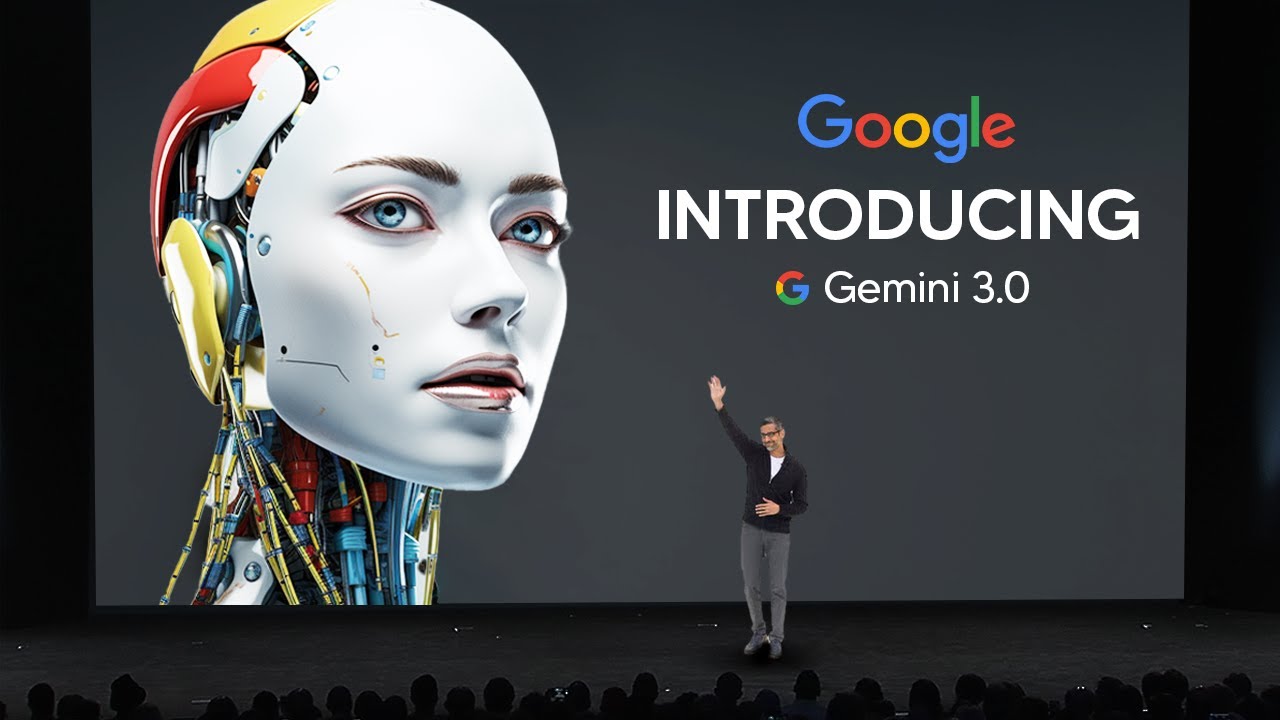
The video discusses the upcoming release of Google’s Gemini 3.0, following the current Gemini 2.5 model, highlighting the extraordinary progress Google has made in AI development. Sundar Pichai, Google’s CEO, expressed excitement about Gemini 3.0 and its anticipated advancements in 2026. Gemini 2.5 is already state-of-the-art and widely used, but Gemini 3.0 is expected to bring significant improvements, especially in reasoning and multimodal capabilities, potentially reshaping the AI landscape.
One of the key points covered is the benchmarking of Gemini 3.0, particularly through unofficial platforms like LM Arena and new evaluation frameworks such as the Hieroglyph benchmark. This benchmark measures lateral reasoning—the ability to make creative connections between seemingly unrelated ideas—where Gemini 3.0 Pro, also referred to as “Lithium Flow,” shows a remarkable leap over Gemini 2.5 and performs just below GPT-5i. This indicates a substantial improvement in abstract and intuitive reasoning, setting Gemini 3.0 apart from many existing models.
The video also highlights Gemini 3.0’s dominance in the Kingbench AI benchmark, which tests real-world reasoning, coding, and adaptability. Gemini 3.0 Pro tops this leaderboard, outperforming models like Sonet 4.5, which is known as a leading coding AI. This suggests that Gemini 3.0 could become the best coding model available, posing a serious challenge to competitors like Anthropic. The model’s coding prowess was demonstrated through its ability to generate complex code for a game similar to Geometry Dash in one shot, showcasing its practical and advanced programming skills.
Another fascinating aspect discussed is Gemini 3.0’s enhanced visual reasoning capabilities. Previous vision-language models struggled with tasks that require intuitive visual understanding, such as reading clocks or recognizing line intersections. Gemini 3.0, however, shows significant improvements in these areas, correctly interpreting images that other models misread. This advancement in vision models is crucial because even small improvements in accuracy can unlock millions of new use cases and innovative applications, making Gemini 3.0 a powerful multimodal AI.
Finally, the video touches on the expected release timeline and Google’s strategic positioning. While some predictions suggest a release by the end of October 2025, the more likely scenario is a launch toward the end of the year, consistent with Google’s historical patterns. Industry insiders and analysts emphasize Gemini 3.0’s potential to excel in coding and multimodal tasks, reinforcing Google’s competitive edge. Sundar Pichai envisions these models evolving into highly intelligent agents, marking a significant step forward in AI capabilities for 2026 and beyond.