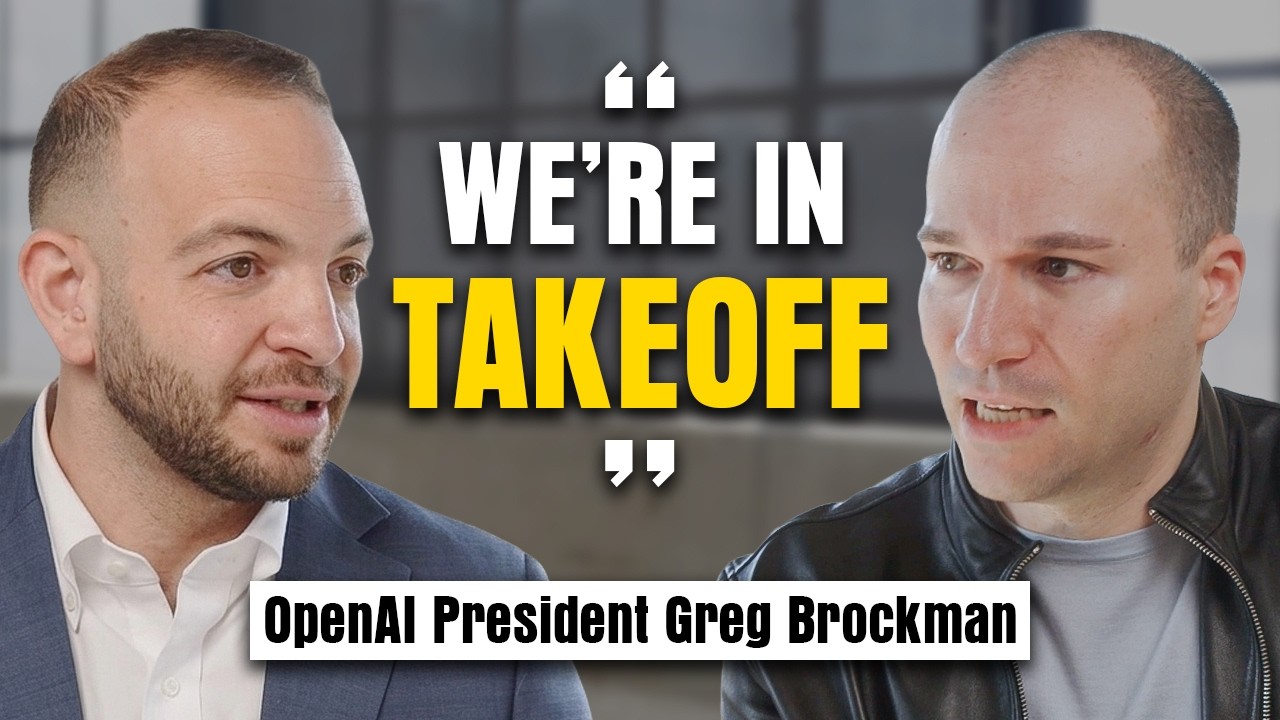
OpenAI President Greg Brockman discusses the near-future arrival of Artificial General Intelligence (AGI), emphasizing that while the technology will be jagged initially, it will soon be capable of handling almost any intellectual task on a computer. He reflects on the moment after launching ChatGPT when the team felt like winners but he personally felt they were still underdogs due to intense competition and high demand for compute resources. OpenAI is strategically shifting focus from broad consumer applications to prioritizing key synergistic applications, particularly personal assistants and AI that can solve complex business problems, acknowledging that compute limitations necessitate careful selection of development areas.
Brockman explains OpenAI’s technological direction, highlighting a focus on the GPT series of models over alternative approaches like world models used in robotics and video generation. While acknowledging the promise of these other branches, he stresses that pursuing multiple complex model architectures simultaneously is unsustainable given current compute constraints. He also clarifies that image generation remains a priority but is integrated within the GPT architecture, allowing for technological unification. This unified approach underpins OpenAI’s vision of a “super app” that combines coding, browsing, and chat functionalities into a single, versatile personal and business assistant, capable of managing diverse tasks with memory and contextual awareness.
The super app aims to transform how users interact with computers by enabling natural language commands to perform a wide range of activities, from coding and knowledge work to personal organization. Brockman describes incremental rollout plans starting with enhancements to the Codex app, which, although initially designed for software engineers, is evolving to serve broader knowledge work needs. He acknowledges competition from other AI companies like Anthropic but expresses confidence in OpenAI’s roadmap, emphasizing ongoing improvements in model capabilities and usability. The company is integrating research and deployment more closely to accelerate progress and maintain leadership in the rapidly evolving AI landscape.
Brockman also addresses the challenges and risks associated with rapid AI development, emphasizing OpenAI’s commitment to safety, alignment, and responsible deployment. He discusses the concept of AI “takeoff,” where AI systems increasingly improve themselves and accelerate technological progress, and reveals plans for an autonomous AI researcher to assist in speeding up model development. Despite the race-like environment with many players, he advocates for a resilient ecosystem involving multiple stakeholders and societal infrastructure to ensure safe and beneficial AI adoption. He acknowledges public concerns about AI’s impact on jobs, environment, and society, urging people to try AI tools firsthand to appreciate their potential benefits.
Finally, Brockman reflects on the broader societal implications of AI, including its potential to democratize entrepreneurship, enhance creativity, and solve complex scientific problems. He stresses the importance of human agency and accountability in working with AI agents and encourages individuals to develop skills in managing and directing AI tools effectively. On the business side, he explains the massive investments in compute infrastructure as necessary to meet soaring demand and fuel economic growth powered by AI. He concludes with a hopeful message about AI’s capacity to improve human connection and quality of life, urging people to embrace the technology with curiosity and a proactive mindset to prepare for the transformative future ahead.