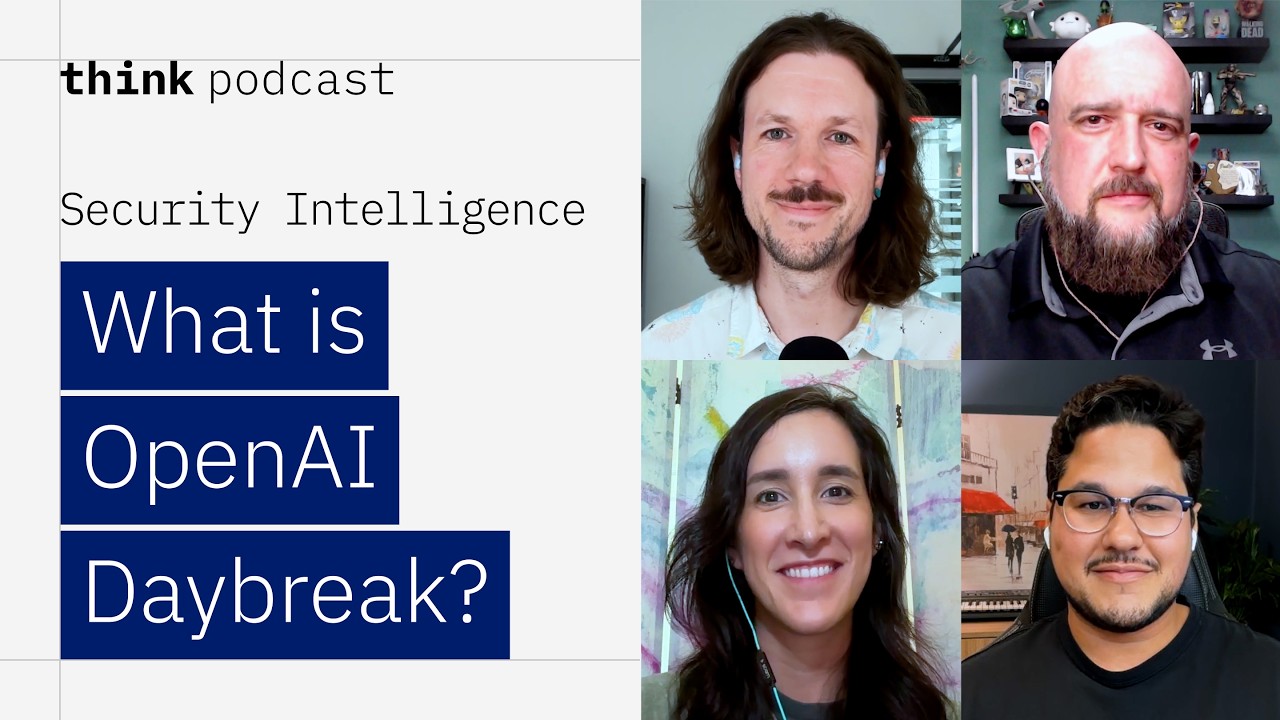
The discussion highlights the emergence of specialized AI cybersecurity tools like OpenAI’s Daybreak, Mistl’s Mythos competitor, and Microsoft’s Mdash, emphasizing their roles in enhancing vulnerability detection while underscoring the necessity of human oversight to manage false positives and validate findings. Additionally, concerns are raised about evolving threats such as the open-sourced Shy Hallude worm, reinforcing the need for layered security strategies that combine AI capabilities with expert intervention to effectively address complex cyber risks.
The discussion opens with an overview of the latest AI-powered cybersecurity tools, focusing on OpenAI’s newly announced Daybreak, French startup Mistl’s Mythos competitor, and Microsoft’s Mdash. Daybreak offers three specialized GPT-5.5 models tailored for general use, trusted cyber defense, and offensive security research. Mdash employs a multi-agent system to orchestrate vulnerability hunting on Windows systems, while Mistl aims to fill a gap for European institutions unable to access Mythos. Panelists highlight the trend toward specialization in AI models and agents, emphasizing that different tools serve distinct purposes within the cybersecurity landscape.
The conversation then shifts to the challenges and opportunities presented by AI in vulnerability detection. While AI accelerates the identification of known vulnerabilities, experts caution that it largely finds existing types of issues rather than novel ones. However, AI’s ability to rapidly analyze and chain together multiple vulnerabilities presents new risks and advantages. The panel agrees on the importance of maintaining a human-in-the-loop approach to validate AI findings, balancing automation with expert oversight to manage the influx of AI-generated vulnerability reports effectively.
A significant portion of the discussion centers on the practical experiences with AI tools, exemplified by curl developer Daniel Stenberg’s testing of Mythos. Despite initial hype, Mythos identified mostly low-severity or previously known vulnerabilities, leading Stenberg to view much of the excitement as marketing-driven. Nonetheless, he remains supportive of AI’s role as a force multiplier in security scanning. The panel underscores that AI tools enhance efficiency but also create challenges, such as overwhelming bug bounty programs with false positives, necessitating robust human review processes.
The latter part of the episode addresses the open-sourcing of the Shy Hallude worm by the hacker group Team PCP. This move is seen as a “chaos bomb,” potentially enabling widespread misuse and rapid evolution of the malware through community-driven modifications. The worm’s latest iteration, Mini Shy Hallude, includes dangerous features like a dead man’s switch that can wipe infected systems if stolen credentials are revoked. Panelists express concern over the ongoing evolution and proliferation of such threats, emphasizing the need for comprehensive security controls and defense-in-depth strategies to mitigate risks.
In conclusion, the panel stresses that while AI tools are transforming vulnerability hunting and cybersecurity defenses, they do not fundamentally solve the underlying challenges organizations face in managing complex attack paths. The future lies in combining specialized AI capabilities with human expertise and layered security measures. The episode closes with a call for vigilance, strategic deployment of AI, and robust security architectures to stay ahead of evolving threats like Shy Hallude and to effectively harness AI’s potential in cybersecurity.