The video critiques OpenAI’s claim that GPT-5.2 made a new discovery in theoretical physics, clarifying that the AI simply automated the process of generalizing existing results rather than independently generating novel scientific knowledge. It emphasizes that while AI is a powerful tool for accelerating research, true breakthroughs still rely on human expertise and creativity.
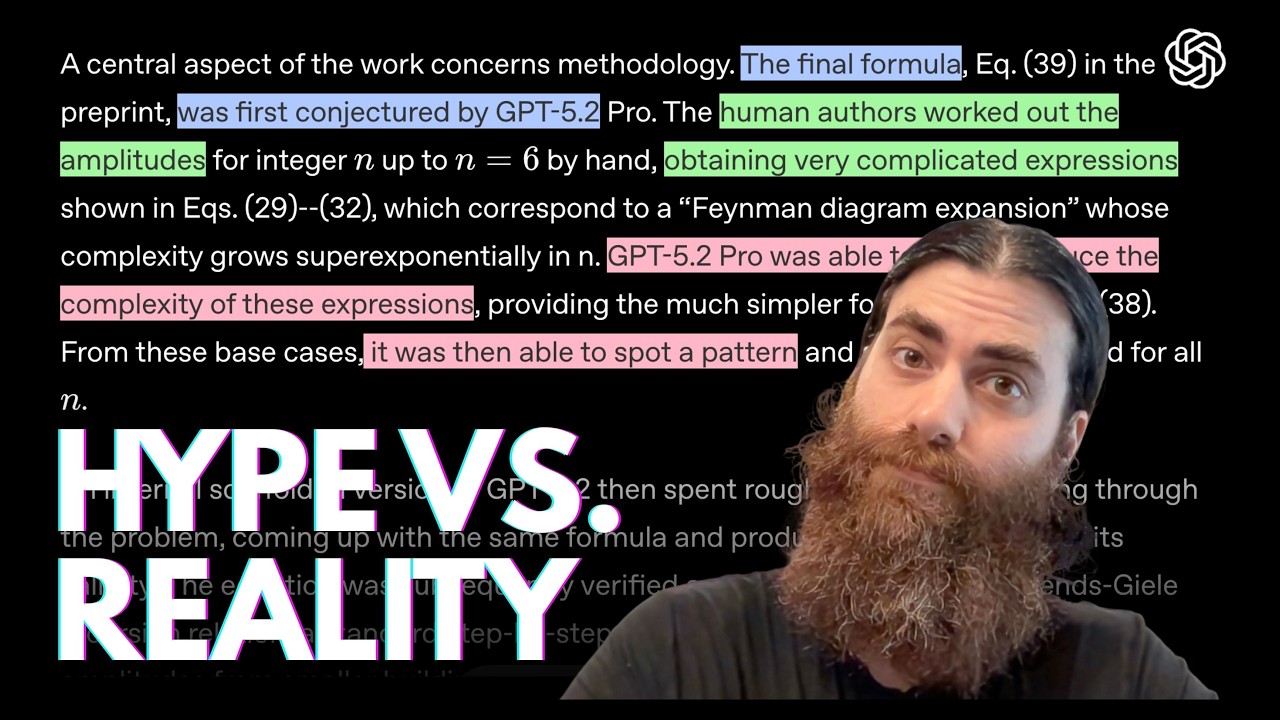
The video critiques OpenAI’s recent announcement and social media promotion claiming that GPT-5.2 “derived a new result in theoretical physics.” The creator points out that many people, especially on X (formerly Twitter), reacted to the headline without reading the article, leading to widespread hype and misconceptions that AI is now making groundbreaking scientific discoveries independently. The video aims to clarify what actually happened, separating the sensationalized narrative from the reality of the achievement.
Upon examining the details, the creator explains that the actual accomplishment involved GPT-5.2 Pro simplifying complex mathematical expressions that human physicists had already derived for specific cases (up to n=6). Using these simplified expressions, GPT-5.2 was able to spot a pattern and propose a generalized formula valid for all n. While this is impressive and useful, the creator emphasizes that it is more akin to having an advanced, semi-autonomous calculator than an AI making novel discoveries on its own.
The video draws an analogy to software engineering, noting that large language models (LLMs) excel at problems where there is a clear validation criterion—similar to how code can be tested with unit tests. If the acceptance criteria for a problem can be codified, LLMs can search for solutions efficiently. In this case, the physicists provided the criteria, and GPT-5.2 searched the constrained possibility space to find a formula that fit, automating a laborious process that would have taken humans much longer.
The creator also discusses the technical aspects of the model used, suggesting that OpenAI likely employed an “internal scaffolded version” of GPT-5.2, possibly with test-time adaptation—where the model can update its weights while working through a problem. This is different from the base models available to the public, which cannot learn or adapt in real time. While this technology is powerful, it is not the same as autonomous scientific reasoning or discovery.
In conclusion, the video urges viewers to resist the hype and recognize that AI is not independently generating new scientific knowledge. Instead, it is a powerful tool that, when used in collaboration with human experts, can accelerate research and automate tedious tasks. The creator likens this to athletes using advanced shoes: the tool is important, but it is the human skill and creativity that drive real progress. Rather than fearing AI, scientists and researchers should see it as an opportunity for a new era of productivity and discovery.