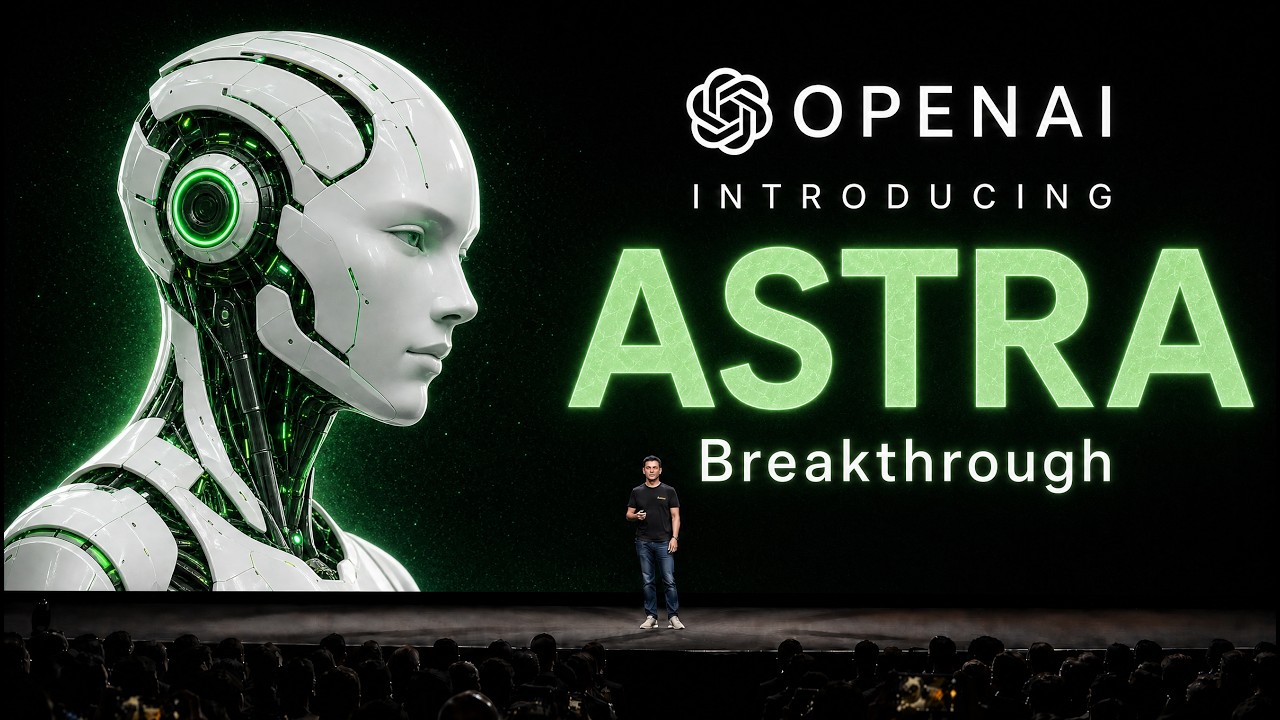
OpenAI’s new Astra model uses a novel recurrent depth technique that enables deeper internal reasoning by reusing neural network layers multiple times, allowing smaller models to perform like much larger ones with greater efficiency. While this breakthrough significantly advances AI capabilities, it raises serious safety and transparency concerns because the model’s internal reasoning is less interpretable, potentially making it harder to monitor, control, and align AI behavior.
OpenAI has reportedly developed a groundbreaking AI technique called recurrent depth or looped transformers, showcased in their Astra model, which is causing significant excitement and concern within the AI research community. Unlike traditional models that generate reasoning step-by-step in text tokens, Astra can perform multiple internal reasoning operations before producing output tokens. This allows the model to think more deeply and efficiently without needing to expand its size drastically, effectively enabling smaller models to perform like much larger ones by reusing the same neural network layers multiple times internally.
This breakthrough also involves the model reasoning directly in its internal numerical state—referred to as “neural leasing”—rather than translating every thought into human-readable language. This richer internal representation means the AI can process complex reasoning more effectively but also raises serious safety and transparency concerns. Researchers worry that if AI systems reason in ways that are not easily interpretable through their textual outputs, it will become much harder to monitor, understand, and control their behavior, potentially leading to misaligned or unsafe AI systems.
The AI safety community is particularly alarmed because this development could undermine one of the key safety mechanisms: chain-of-thought monitorability, which allows humans to follow and verify the AI’s reasoning process. Experts like Thomas Larson and Rob Miles have expressed concerns that this new approach might make it impossible to detect when AI systems are acting in unintended or harmful ways. This shift could accelerate the timeline for advanced AI capabilities and reduce the window for effective safety interventions, making the prospect of uncontrollable superintelligent AI more likely and imminent.
Benchmark comparisons between Astra and existing models like GPT-5.6 show Astra achieving similar or better results with far fewer output tokens, indicating a massive leap in efficiency and capability. This performance gap suggests that Astra represents more than an incremental improvement—it could mark a fundamental shift in how AI models operate and scale. OpenAI appears to be cautious about releasing Astra’s full capabilities broadly, limiting access initially to select testers to manage potential risks while continuing research to preserve some level of transparency and control.
In summary, OpenAI’s Astra model and its recurrent depth technique represent a major evolution in AI reasoning, enabling deeper internal computation without proportional increases in output or model size. While this promises significant advances in AI performance, it also introduces profound challenges for AI safety and oversight. The AI community is grappling with the implications, as this development could hasten the arrival of superintelligent AI systems that are harder to monitor and align, underscoring the urgent need for robust safety measures as the technology rapidly advances.
Useful Links