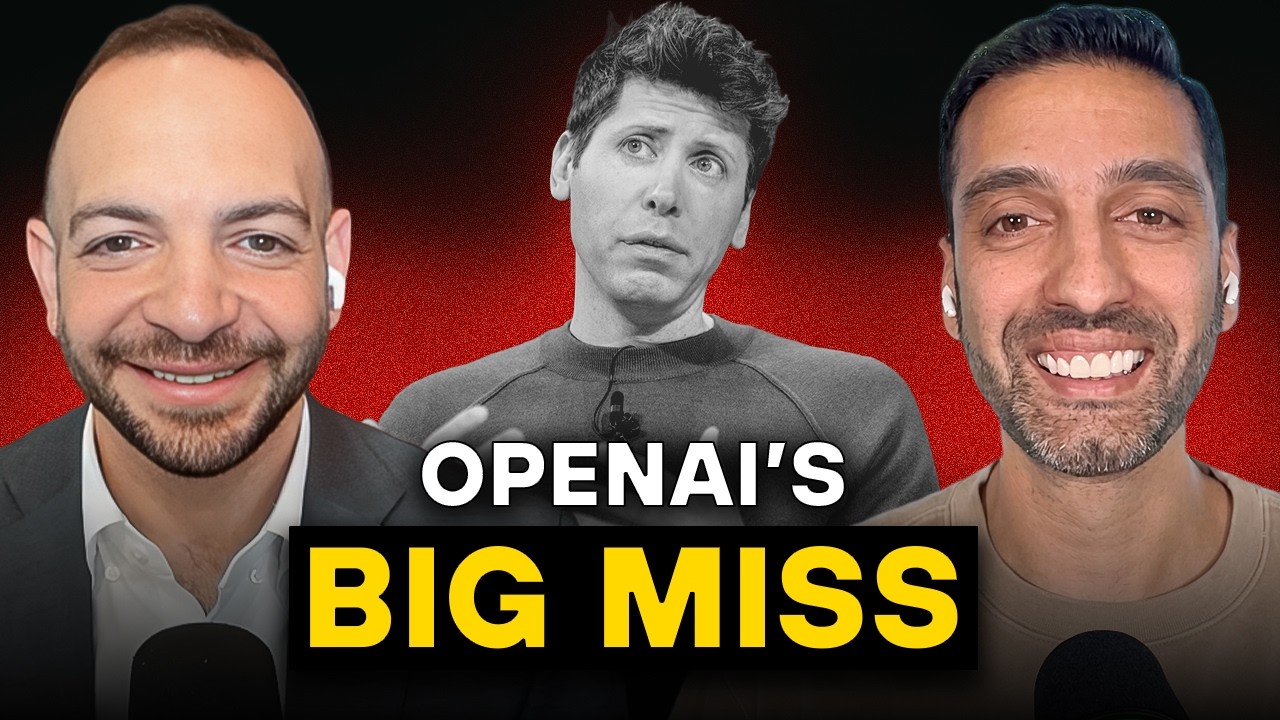
The Big Technology Podcast Friday edition opens with a discussion on OpenAI’s recent slowdown in user growth and revenue, highlighting that the company missed its ambitious target of reaching one billion ChatGPT users by the end of 2025, currently standing at around 900 million. This shortfall has raised internal concerns about sustaining massive spending on data centers. The hosts debate whether OpenAI should focus on consumer products or pivot more aggressively toward enterprise and developer-focused solutions like Codex. While consumer engagement with generative AI chatbots appears to be plateauing or declining, AI integration in everyday consumer experiences—such as recommendation engines and virtual try-ons—is growing, suggesting a more embedded rather than standalone consumer AI adoption.
The conversation then shifts to the ongoing legal battle between Elon Musk and OpenAI, where Musk alleges that OpenAI betrayed its original nonprofit mission by converting to a for-profit entity, unjustly enriching its leadership. The trial reveals complex issues around the organization’s structure and Musk’s claims for compensation or leadership changes. Despite the drama and Musk’s strong arguments, the hosts express skepticism about any significant consequences arising from the trial, though they acknowledge potential financial penalties. The trial also touches on technical aspects like AI model distillation, with Musk admitting that companies commonly use other AI models to train their own, raising questions about the future economics and competitiveness of AI development.
Next, the podcast covers the escalating tensions around the use of Chinese AI models by U.S. companies, with Republican House committees probing firms like Airbnb for employing Chinese technology. This reflects the broader U.S.-China tech cold war, where concerns about national security and technological sovereignty are intensifying. The hosts discuss the complexities of banning Chinese AI models, noting that many are open source and widely used, and debate whether such restrictions would be practical or beneficial. They also highlight Nvidia CEO Jensen Huang’s warning that restricting technology exports to China could backfire by pushing China to develop independent AI hardware and software ecosystems, potentially limiting U.S. access to cutting-edge AI.
The podcast then reviews recent big tech earnings, noting that cloud providers like Google Cloud, AWS, and Microsoft Azure are experiencing significant growth fueled by enterprise AI demand, contrasting with the more mixed or disappointing results from consumer-focused AI applications. The hosts discuss concerns about the massive capital expenditures by these companies, likening it to a “greatest capital misallocation” with uncertain profitability and the risk of a price war as AI models become commoditized. Apple is highlighted as an outlier, having grown iPhone sales significantly without heavy investment in AI infrastructure, though it plans to enhance Siri and AI capabilities in the future.
Finally, the episode concludes with a discussion on prediction markets and recent bipartisan U.S. Senate legislation banning senators from trading on such platforms to prevent insider trading and ethical issues. The hosts share concerns about the societal impact of prediction markets, especially when insider information is used to influence outcomes, citing a recent case involving a college football player entering a gambling addiction program. They criticize media outlets for promoting betting odds in sensitive contexts, arguing that this normalization of gambling can have harmful consequences. The podcast ends on a cautionary note about the complex interplay between technology, regulation, and societal impacts in the evolving AI and digital landscape.