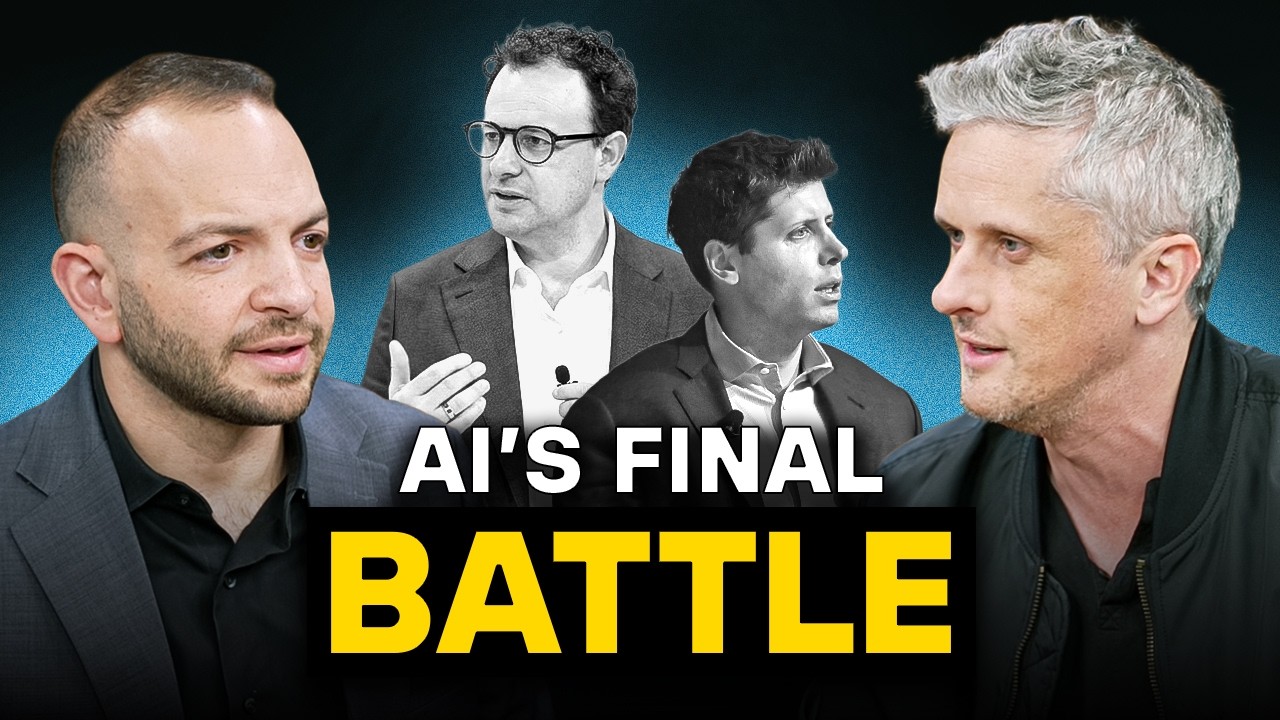
In this insightful discussion on the Big Technology Podcast, Box CEO Aaron Levie explores the evolving competition between OpenAI and Anthropic, two leading AI labs now converging on similar product roadmaps centered around AI agents. Levie explains that while OpenAI initially dominated consumer-facing chatbots and Anthropic made significant strides in enterprise and coding applications, both companies are now competing head-to-head to build versatile AI assistants capable of handling a broad range of knowledge work tasks. These AI agents are envisioned as powerful tools that can access multiple systems, write code on the fly, and automate complex workflows, potentially transforming how knowledge workers operate across industries.
Levie emphasizes that the future of AI agents lies in their ability to act as expert collaborators who can autonomously perform tasks over extended periods, accessing diverse data sources and software tools. This shift moves beyond simple chatbots to agents that can deeply integrate with enterprise environments, dramatically expanding the total addressable market from just engineers to all knowledge workers. However, he notes that adoption will be primarily business-driven due to the higher return on investment in enterprise settings, where automating complex workflows can significantly impact productivity and economic output.
Despite the promise, Levie highlights several challenges that will slow widespread adoption. Unlike coding, where outputs are verifiable and users are highly technical, many knowledge work domains involve subjective tasks, fragmented data across numerous legacy systems, and less technical users who must learn to trust and effectively interact with AI agents. Additionally, enterprises face significant hurdles in organizing and providing accurate, authoritative data for agents to access, making AI deployment as much a data infrastructure problem as an AI problem. Security, compliance, and liability issues further complicate the landscape, especially in regulated industries like healthcare and finance.
Regarding the competition between OpenAI and Anthropic, Levie refrains from declaring a clear winner, instead drawing parallels to the early cloud wars where multiple players eventually thrived in a rapidly expanding market. He suggests that both horizontal, general-purpose AI platforms and vertical, domain-specific solutions will coexist, each serving different customer needs. The labs will remain the foundational intelligence providers, while startups and enterprises build specialized applications on top. He also anticipates significant improvements in upcoming AI models, which will unlock even more advanced agent capabilities across various knowledge work domains.
Finally, Levie discusses the evolving nature of AI agents, from fast but sometimes inaccurate chatbots to slower, more thorough agents capable of completing complex tasks asynchronously. He underscores the importance of balancing speed, accuracy, and user trust, noting that enterprises will need to carefully manage how much autonomy they grant AI agents. Overall, the conversation paints a nuanced picture of a transformative but complex AI future, where agents become indispensable collaborators in knowledge work, enabled by ongoing advances in AI technology and enterprise data infrastructure.