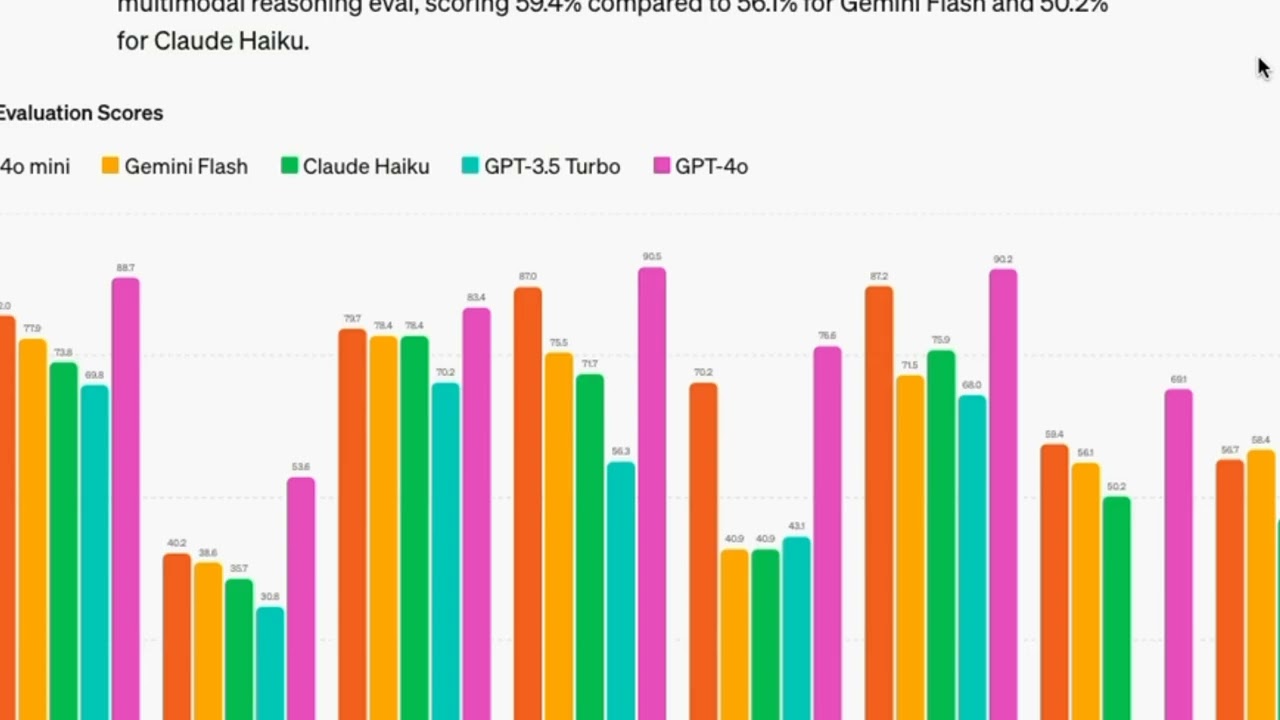
OpenAI has recently launched GPT-4o Mini, a smaller variant of their GPT-4 model, aimed at regaining market share from competitors like Claude 3.0 Haiku and Gemini 1.5 Flash. These competitors have gained traction due to their efficiency and lower costs, prompting OpenAI to introduce a more affordable option. GPT-4o Mini is designed to be cost-effective, priced at 15 cents per million input tokens and 60 cents per million output tokens, making it significantly cheaper than its rivals, particularly Haiku, which costs 25 cents for input and $1.25 for output.
The model is also reported to have lower latency and better performance benchmarks compared to others in the market. According to OpenAI, GPT-4o Mini consistently outperforms Gemini Flash and Haiku in various benchmarks, although some comparisons were omitted, raising questions about the model’s training data. It is noted that GPT-4o Mini features a substantial output token capacity of 16,000 tokens, allowing for more extensive text generation without truncation, which is beneficial for tasks requiring detailed edits or rewrites.
In terms of functionality, GPT-4o Mini supports multimodal capabilities, handling text and images and promising future support for video and audio inputs. Its knowledge base is current only up to October 2023, meaning users will need to provide updated context manually for tasks requiring recent information. The model also employs an improved tokenizer that enhances its multilingual capabilities, addressing limitations seen in previous versions.
Safety measures have been emphasized in the training of GPT-4o Mini, with OpenAI implementing stricter pre-training filtering processes aimed at preventing the model from generating harmful content. However, some early testers have reportedly managed to circumvent these safety features, raising concerns about the model’s robustness against prompt injections and jailbreak attempts. OpenAI has introduced new instruction hierarchy methods intended to improve stability and reduce vulnerabilities.
Overall, GPT-4o Mini positions itself as a strong contender in the cost-effective AI model landscape, challenging competitors by offering lower prices and enhanced features. As AI development continues to evolve, this model could shift the focus of companies towards creating more affordable solutions rather than merely larger, more complex models. The competition is expected to intensify as other companies, like Anthropic, prepare to release their own updated models, potentially reshaping the marketplace further.