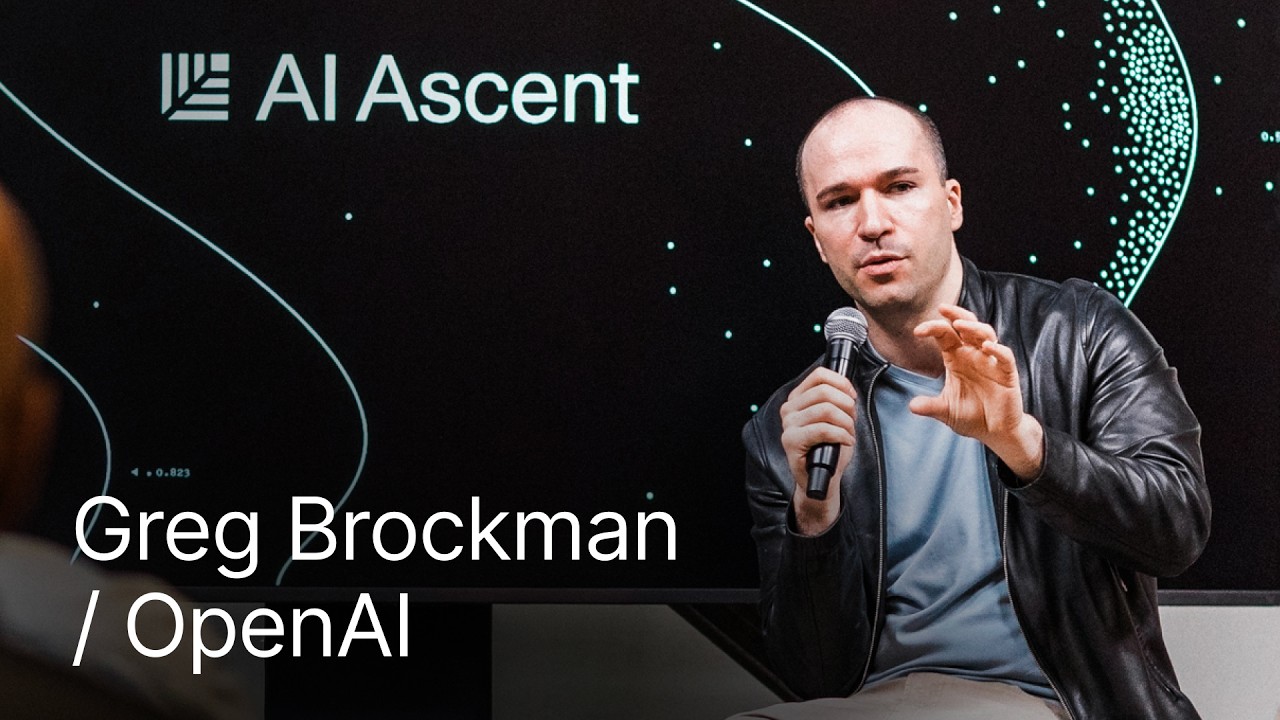
In this insightful discussion, Greg Brockman, co-founder and president of OpenAI, shares his perspectives on the rapid advancements in AI technology and its implications. He emphasizes the relentless demand for compute power, noting that despite OpenAI’s aggressive efforts to secure resources, the need far outpaces supply. Brockman highlights the fundamental nature of scaling laws in neural networks, describing them as a profound scientific mystery that continues to drive AI capabilities without hitting a ceiling. He also underscores the continuous innovation in AI architectures, moving beyond traditional models like transformers to develop more advanced and efficient algorithms.
Brockman discusses OpenAI’s approach to building and deploying AI models, including their formal yet flexible definition of Artificial General Intelligence (AGI). He believes we are approximately 80% of the way to AGI, with models already surpassing human capabilities in specific tasks like software development. He shares examples of AI systems autonomously optimizing complex code, illustrating the transformative potential of these technologies. For startups and developers, Brockman advises embracing AI tools now, integrating them deeply into workflows to leverage their growing capabilities, while also investing in context and information sharing to maximize effectiveness.
The conversation also delves into organizational and security challenges posed by AI adoption. Brockman notes that AI is reshaping team structures and workflows, making prototyping cheaper and shifting bottlenecks toward governance, data provenance, and human oversight. He stresses the importance of human attention as the new scarce resource, particularly in validating AI outputs and ensuring alignment with human values. On security, he advocates for leveraging AI in vulnerability detection and red teaming, while emphasizing the need for community collaboration and responsible deployment to mitigate risks.
Addressing the pace of technological change, Brockman encourages individuals and companies to stay engaged by actively experimenting with AI technologies to understand their capabilities and limitations. He acknowledges the tension between rapid innovation and responsible deployment, highlighting OpenAI’s commitment to balancing speed with safety through trusted access programs and careful mitigation strategies. This approach reflects a broader mission to empower people with AI tools while thoughtfully managing potential risks.
Finally, Brockman looks ahead to AI’s role in advancing scientific frontiers, particularly in physics and biology. He shares exciting developments where AI has contributed to solving complex physics problems previously deemed intractable, signaling a forthcoming renaissance in scientific discovery driven by AI. Despite challenges in applying AI to messy real-world domains like biology, he remains optimistic about the transformative impact AI will have in the near future. Concluding on a personal note, Brockman mentions enjoying simple pleasures like movies and hiking, reflecting a balance between the intense pace of AI development and everyday life.