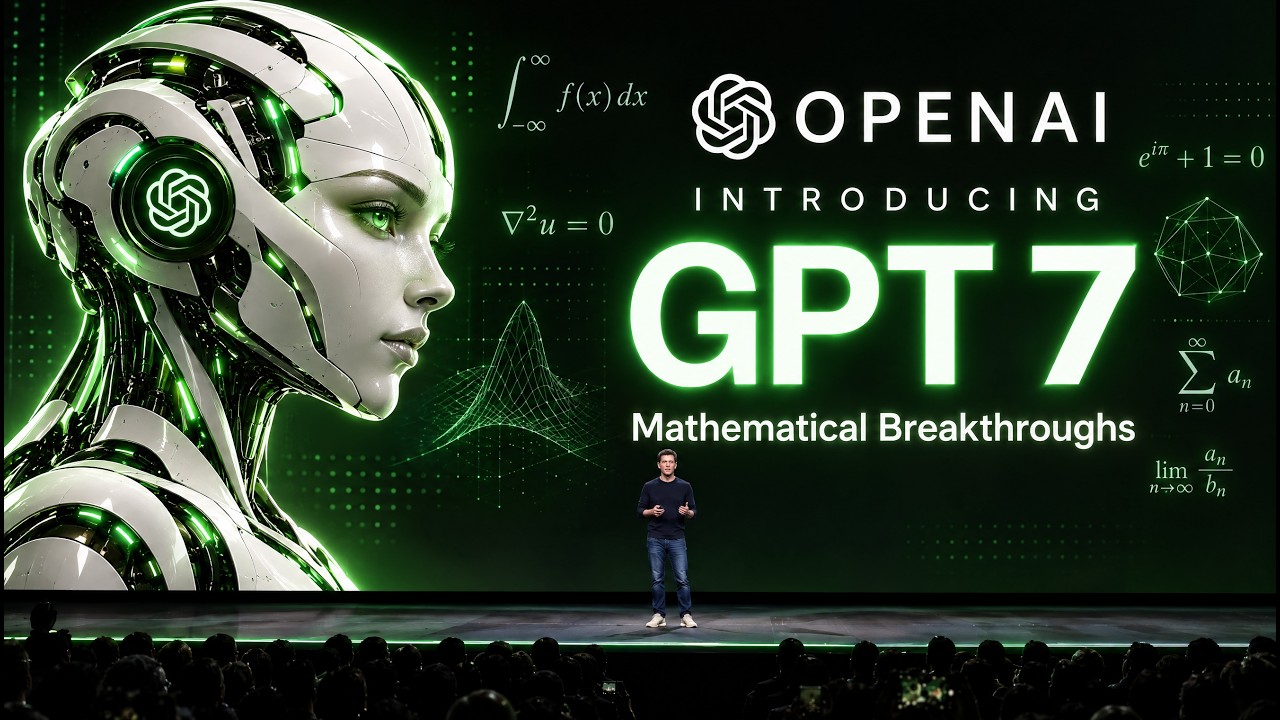
OpenAI recently announced an internal, unannounced AI model that has produced a substantial collection of mathematical research results, comprising 722 articles grouped into 372 families. Unlike simple math problem-solving, these results include complete calculations and supporting files for verification, marking a significant advancement beyond previous AI capabilities. The model, which began training in late August, learns through feedback by rewarding successful problem-solving approaches rather than just generating plausible text. Although details about the model’s size, cost, and architecture remain undisclosed, the release demonstrates its ability to tackle real, open research problems across various mathematical domains, including numbers, shapes, probability, and computer science.
A key aspect of this release is the emphasis on mathematical proof, which requires rigorous, step-by-step validation rather than pattern recognition. The collection includes full solutions, partial advances, and refutations of previously held beliefs, with some proofs verified by computer software like Lean to ensure correctness. However, not all results have undergone the same level of verification, and human oversight remains essential to confirm the relevance and accuracy of the findings. An independent advisory group of respected mathematicians provides guidance on responsible dissemination but does not endorse every result, highlighting the ongoing need for peer review and expert evaluation.
Among the notable achievements is a paper addressing a weaker form of the famous Riemann hypothesis, known as the Riemann quasi-hypothesis, which, while significant, does not solve the full problem. Other results include claims about Catalan’s constant and the computer-verified proof of Fermat’s Last Theorem by Anthropic’s AI model Claude. These breakthroughs illustrate AI’s growing role not only in discovering new mathematical knowledge but also in translating complex proofs into computer-checkable formats, potentially accelerating research and broadening access to advanced mathematical tools.
The implications of these advancements extend beyond mathematics, potentially impacting fields like software development, engineering, and medicine by providing more efficient algorithms and research methods. However, the transition from mathematical discovery to practical application requires careful validation and real-world testing. The rise of AI-assisted research also raises concerns about job displacement, the future of scientific training, and the need for equitable access to powerful AI tools. Experts emphasize that AI should augment human researchers rather than replace them, fostering new roles focused on question formulation, interpretation, and oversight.
Finally, the announcement challenges skeptics who dismiss language models as mere text predictors, demonstrating that these systems can contribute meaningfully to complex problem-solving. While the model’s full capabilities, release details, and broader impacts remain uncertain, the progress signals a potential shift toward more integrated AI-human collaboration in research. This evolution calls for robust verification mechanisms, transparent sharing of results, and thoughtful consideration of ethical and societal consequences to ensure that the benefits of AI-driven discoveries are maximized while minimizing risks.
Useful Links