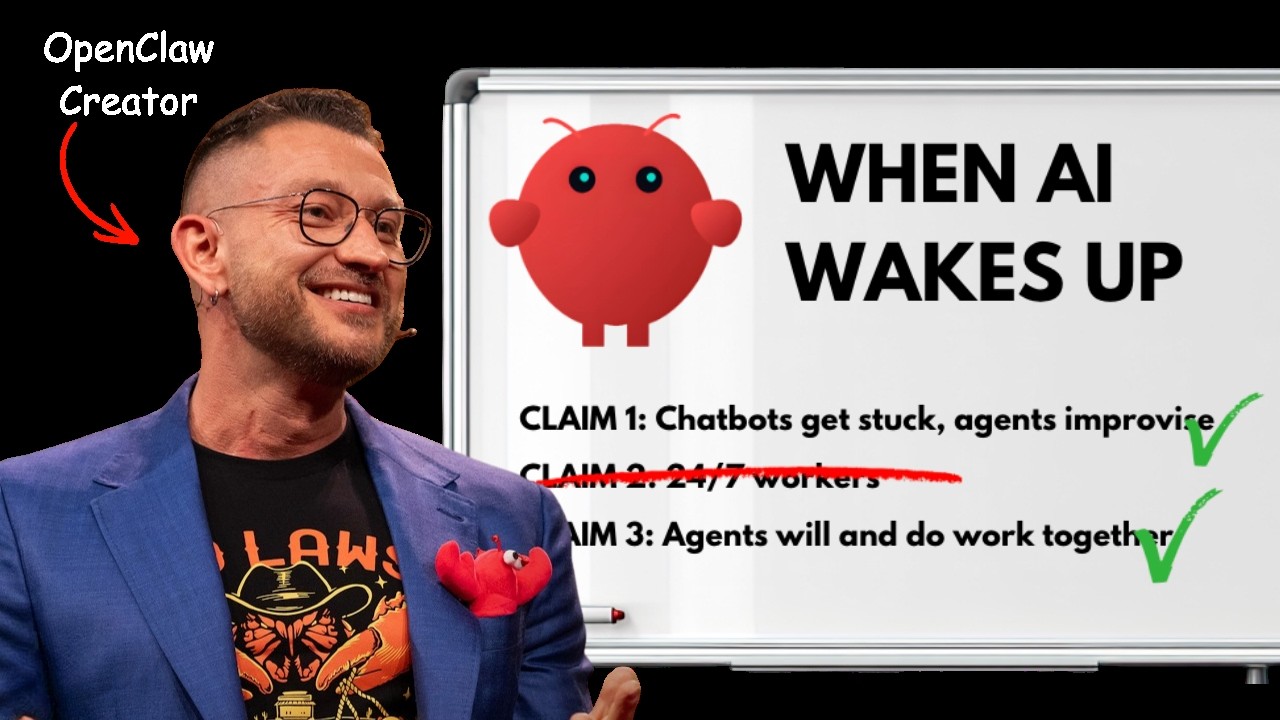
The video explores OpenClaw, touted as the fastest growing software of its kind, created by Peter Steinberger, who recently gave a TED Talk outlining three major claims about AI agents like OpenClaw. The presenter demonstrates how to get started with OpenClaw using Claw Bro, a platform that simplifies setup and offers discounted API access. After setting up an OpenClaw instance, the video dives into testing the three claims made by Steinberger, showcasing the software’s capabilities in real-time.
The first claim is that OpenClaw agents can improvise where traditional chatbots fail. To test this, the presenter asks the agent to perform tasks it doesn’t have explicit skills for, such as checking news about OpenClaw without a dedicated skill and interpreting files with misleading extensions. Impressively, the agent uses available tools to search the web and correctly identifies an audio file disguised as a PNG image, transcribing its contents. This demonstrates OpenClaw’s ability to adapt and use multiple resources to fulfill user requests, surpassing earlier AI limitations.
The second claim involves OpenClaw’s “heartbeat” feature, which allows the agent to wake up periodically and perform tasks autonomously, such as checking emails, calendars, or news, without user prompts. The video shows this feature in action via Telegram, where the agent sends updates and performs configured tasks continuously, effectively acting as a 24/7 assistant. The presenter highlights the ease of integrating OpenClaw with various chat platforms, enabling users to interact with their agents from anywhere, reinforcing the claim that OpenClaw can operate independently and proactively.
The third claim focuses on collaboration between multiple specialized agents working securely together. The presenter tests this by having OpenClaw spawn multiple agents to create a social media campaign from a large transcript. The agents operate in parallel, generating quotes and tweets efficiently. While the current version doesn’t show agents communicating directly with each other, the system allows users to interact with the results seamlessly through chat apps like Telegram. This illustrates OpenClaw’s potential for managing complex, multi-agent workflows behind the scenes.
In conclusion, the video affirms all three claims made by Peter Steinberger about OpenClaw: its improvisational intelligence, autonomous heartbeat functionality, and multi-agent collaboration capabilities. The presenter praises OpenClaw as a significant advancement in AI agent technology and recommends Claw Bro as the easiest way to start using it, offering viewers a discount link. The video ends by emphasizing that the future of AI agents lies not just in technology but in making these powerful tools accessible to everyone.