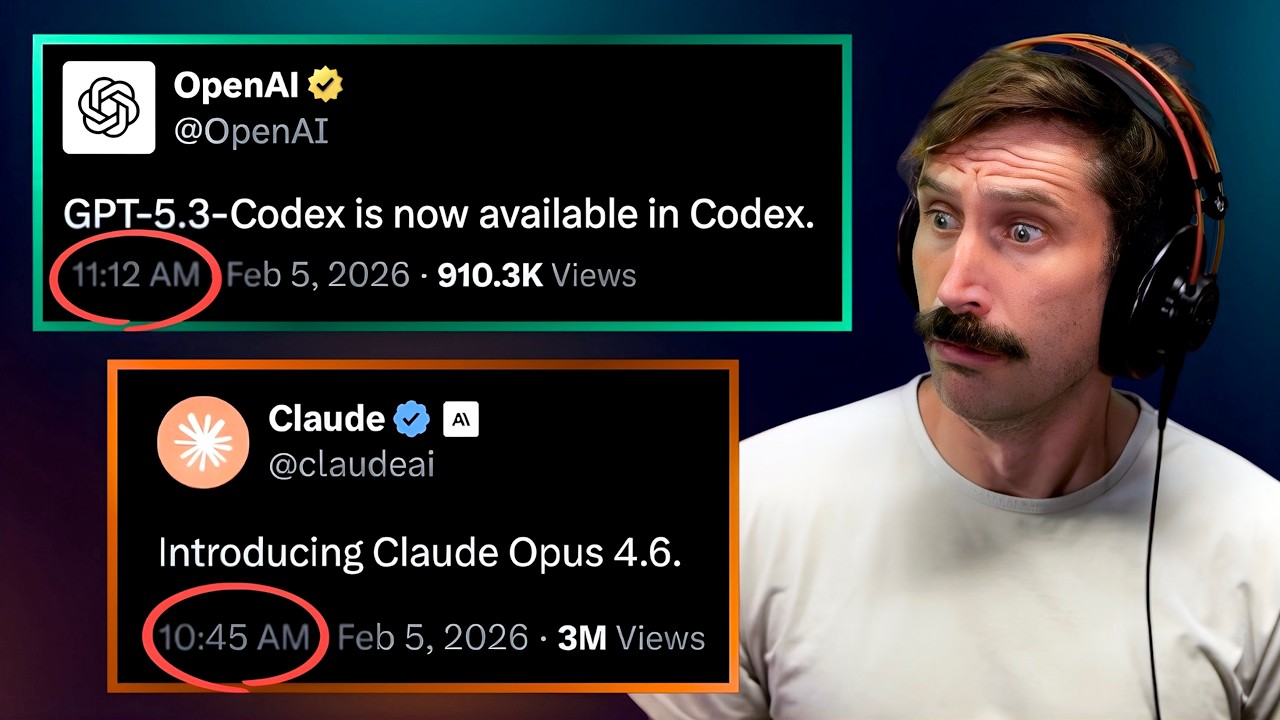
The video compares the newly released Opus 4.6 and ChatGPT 5.3 AI models by having both generate code for the same JSX-to-terminal application, finding that while both are highly capable, ChatGPT 5.3 produced more organized and concise code. Ultimately, the creator concludes that AI models are tools that amplify a developer’s existing skills, and the choice between them matters less than the user’s own expertise.
The video discusses the simultaneous release of two advanced AI models: Opus 4.6 and ChatGPT 5.3 (referred to humorously as “Chad Chippity” and “Jippidity”). The creator notes the close timing of their launches and speculates about competition and rivalry between the companies behind them. To compare the models, the creator built the same application using both, aiming for a fair and controlled test by using identical prompts and workflows.
The application in question was a JSX transformer that takes JSX input and produces a 60 frames-per-second terminal application rendered with Bun, with the transformer itself written in Rust. Both models were tasked with generating the necessary code, including features like hot module reloading. The creator observed that ChatGPT 5.3 asked a few more clarifying questions, while Opus 4.6 was more direct, but both followed the same general process.
In terms of results, ChatGPT 5.3 successfully generated JSX code and an on-the-fly compiling system, though it struggled to implement hot module reloading. Its output was concise, with about 1,000 lines of JavaScript and a working JSX parser in just 520 lines of Rust. Opus 4.6, on the other hand, produced a larger codebase (about 2,000 lines of JavaScript and 1,300 lines of Rust for the compiler), and while it did achieve hot module reloading, it sidestepped true JSX compilation by using functions instead. The creator found this approach less satisfactory and noted that Opus’s code organization felt less elegant.
The creator expresses a preference for ChatGPT 5.3’s code output, citing better organization and style, though acknowledging that both models are highly capable. Ultimately, the video argues that the differences between state-of-the-art models are becoming less significant for most users. The real determinant of code quality remains the skill and experience of the developer using the tools, rather than the specific AI model chosen.
Finally, the creator shares a broader theory: AI acts as a multiplier of a developer’s existing abilities, rather than a magic solution that turns poor programmers into great ones. The impact of AI depends on the user’s baseline skill, and while AI can greatly speed up certain tasks (like debugging or running integration tests), it cannot replace the need for good engineering practices. The video ends with a lighthearted coffee ad and a reminder that personal preference and experience often drive model loyalty more than objective benchmarks.