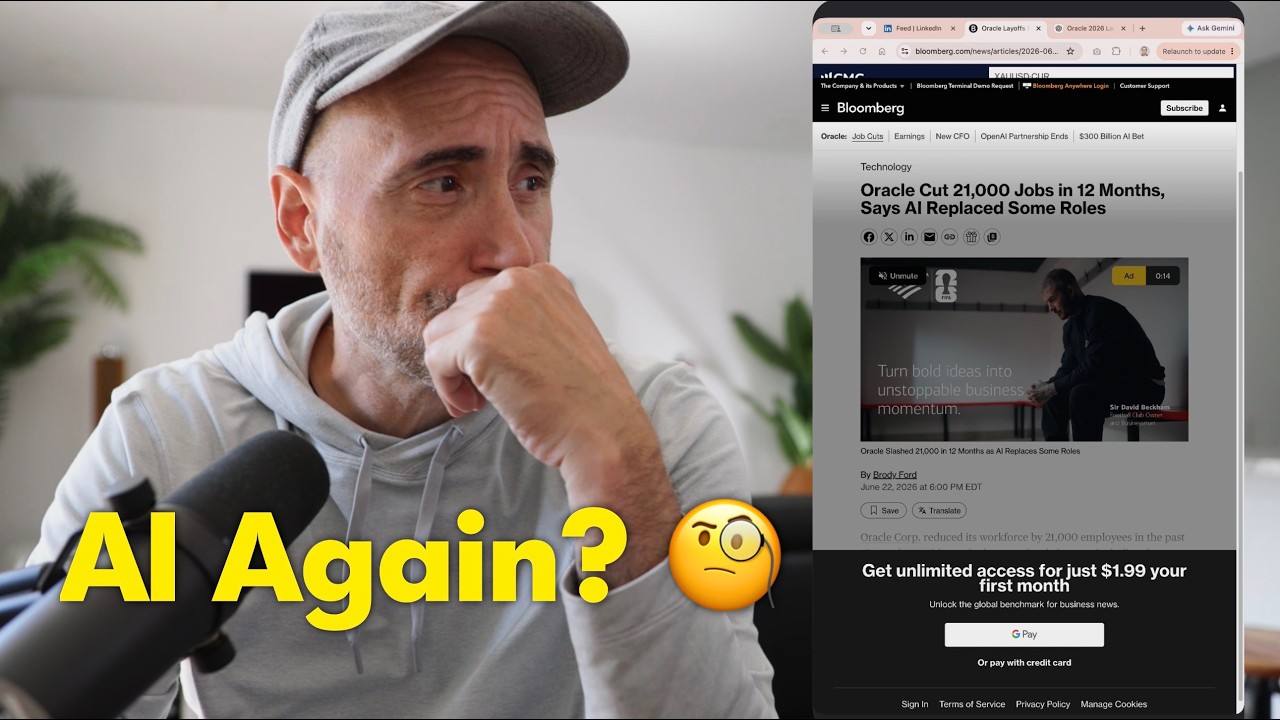
Oracle’s decision to cut 21,000 jobs is part of a broader restructuring and cost-cutting strategy rather than solely driven by AI adoption, as the company continues to invest heavily in AI infrastructure. The video emphasizes that AI currently serves more as a tool to enhance human productivity than replace workers, urging developers to embrace AI to augment their skills amid ongoing technological shifts.
The video discusses Oracle’s recent decision to cut 21,000 jobs over a 12-month period, which amounts to about 13% of its workforce as reported in their fiscal year ending May 31, 2026. While some speculate that AI is the primary cause of these layoffs, the speaker emphasizes that only a portion of the job cuts are linked to AI adoption. Oracle is simultaneously investing heavily in AI infrastructure and data centers, spending $5.6 billion despite a negative cash flow of $2.4 billion, indicating that the layoffs are part of a broader restructuring and cost-cutting strategy rather than solely due to AI replacing jobs.
The speaker reviews public reactions, including a LinkedIn discussion where opinions vary. Some commenters criticize Oracle’s management for not valuing employees, while others argue that AI is being used as a scapegoat for cost-cutting measures. The consensus is that AI is still in its infancy and it is premature to attribute massive layoffs directly to AI. The speaker agrees that layoffs are management decisions influenced by multiple factors, including the challenge of integrating new technologies and the cultural resistance among employees to adapt to these changes.
A key point made is that AI is currently more of an operational model reset than a pure growth engine. The layoffs at Oracle likely reflect a combination of traditional cost-cutting, AI-driven productivity improvements, and capital redeployment into AI infrastructure. However, the speaker notes that AI’s impact on productivity is uneven and still chaotic, with some areas seeing significant gains and others lagging behind. This mirrors past technological disruptions, such as the early days of the web, where skepticism and uneven adoption were common.
The video also highlights expert opinions and research showing that AI is more effective as an amplifier of human work rather than a replacement. For example, MIT found that most companies have not yet seen measurable returns on their AI investments, and cases like Klarna demonstrate the risks of over-reliance on AI leading to quality issues and rehiring. The speaker stresses that successful companies use AI to enhance employee productivity rather than replace workers, and warns against reckless replacement strategies that can backfire.
In conclusion, the speaker advises software developers to embrace AI as a tool to augment their skills rather than fear it as a job threat. They recommend mastering fundamental software development concepts and learning how to integrate AI to improve efficiency. Despite the current market turbulence and inevitable failures among AI startups, the speaker views this period as a significant opportunity for developers, comparable to the early dot-com era. The message is clear: adapt, learn, and leverage AI to thrive in the evolving tech landscape.