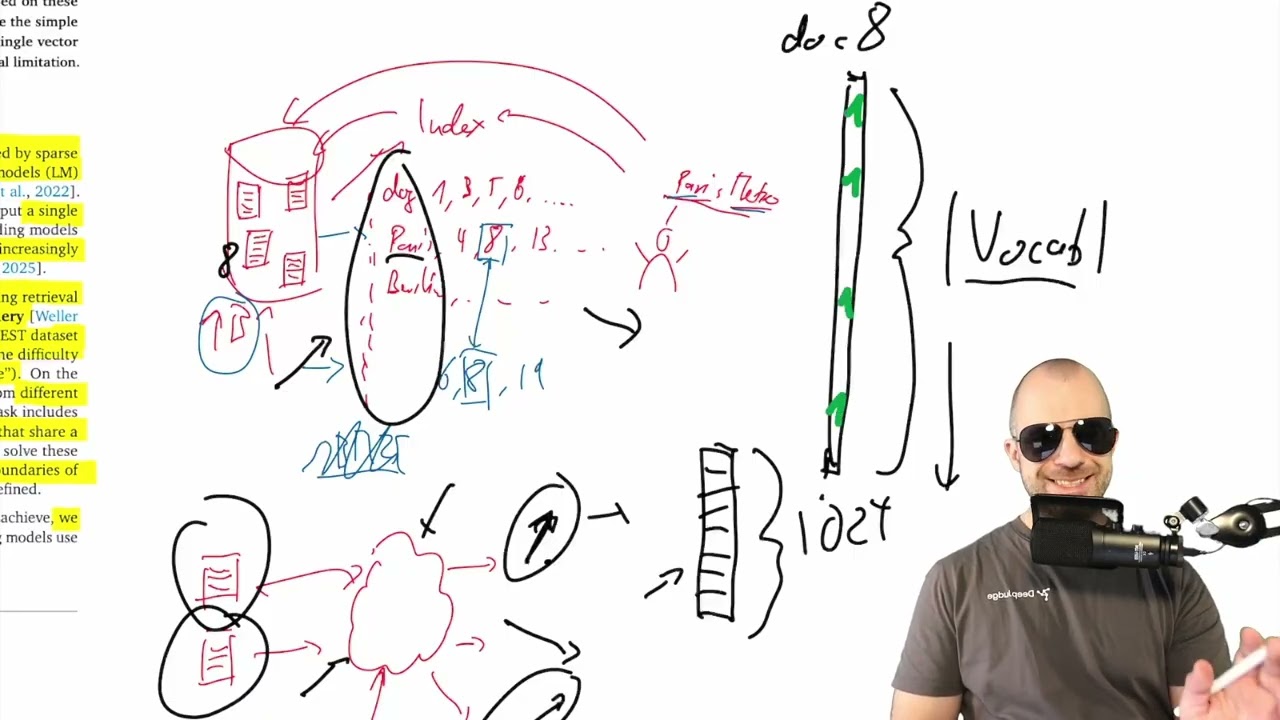
The video provides an in-depth analysis of a paper discussing the theoretical limitations of embedding-based retrieval, particularly in the context of vector databases and retrieval-augmented generation (RAG). The paper proves that embedding-based retrieval methods have inherent limitations when it comes to representing and retrieving arbitrary combinations of data, especially random data. The key takeaway is that if the data consists of random combinations, a certain embedding dimension is insufficient to represent all possible combinations, which restricts retrieval capabilities. However, the video emphasizes that this limitation is mostly theoretical and does not significantly impact practical applications, where data and queries have inherent structure.
The video explains the difference between classical information retrieval methods, such as inverted indexes and BM25, and modern embedding-based retrieval. Classical methods rely on sparse representations where documents are indexed by the words they contain, allowing exact matching and intersection of query terms. In contrast, embedding-based retrieval converts documents and queries into dense vectors using neural networks, and similarity is measured by inner products or cosine similarity. The video also clarifies that sparse embeddings, where vectors have mostly zeros except for positions corresponding to words in the document, are a form of vector-based retrieval as well, but dense embeddings are more compact and generalizable.
The core argument of the paper is that embedding models cannot perfectly represent arbitrary combinations of relevant documents for any given query due to dimensionality constraints. The video illustrates this with simple examples, showing that while single elements can be retrieved easily, retrieving arbitrary pairs or combinations of elements becomes impossible in low-dimensional spaces. This is because embedding vectors have limited capacity to represent all possible combinations, especially when the embedding dimension is small. The paper uses mathematical tools like sign rank and matrix factorization to establish lower bounds on the embedding dimension required to capture certain retrieval tasks, and experimentally verifies these bounds by optimizing embeddings directly.
Despite the theoretical rigor and interesting mathematical results, the video criticizes the paper’s practical relevance. It argues that real-world data and queries are not random but structured, and embedding-based retrieval leverages this structure to compress and generalize information effectively. The paper’s adversarial examples and random data sets do not reflect typical use cases, where users search for meaningful combinations of concepts. Moreover, the video points out that current retrieval benchmarks and datasets are limited and do not test arbitrary combinations extensively, which aligns with practical user behavior. Thus, the paper’s conclusions about embedding limitations do not translate into significant practical drawbacks.
Finally, the video acknowledges the quality and correctness of the paper’s theoretical contributions and experimental validation but expresses skepticism about the way the paper connects its findings to real-world implications. It suggests that the academic environment encourages researchers to frame their work with broad practical impact, sometimes overstating relevance. The video also notes that future work might explore multi-vector embeddings or relaxed retrieval criteria allowing some errors, which could mitigate some limitations. Overall, the video appreciates the paper’s insights but cautions viewers not to overinterpret its practical significance in the current landscape of embedding-based retrieval.