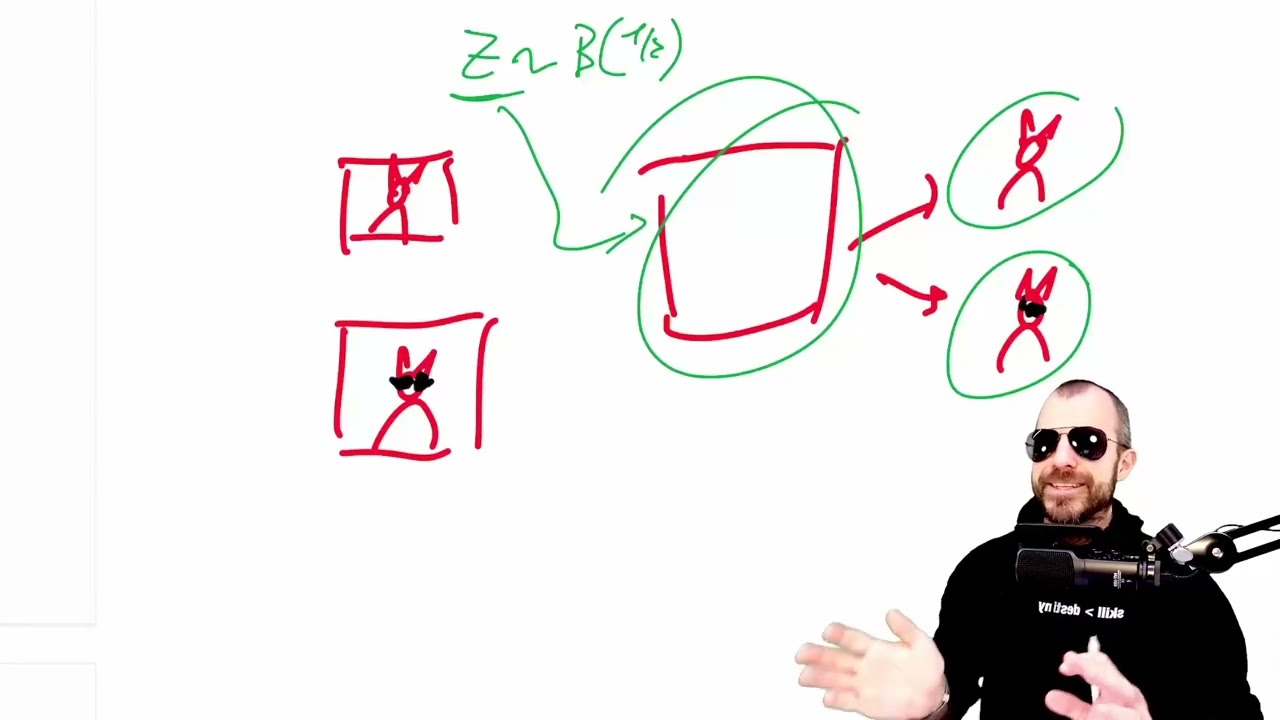
The video discusses the Free Transformer, a novel extension of the classic decoder-based transformer model, introduced by France Fur at Farret Meta. This model incorporates latent variables to make underlying decisions about the sequence being generated, which helps in capturing complex, multimodal distributions in data. For example, when generating movie reviews based on a movie description, the model can internally decide whether to produce a positive or negative review, reflecting the natural bimodal distribution of opinions. Unlike traditional transformers, where randomness only occurs at the token sampling step, the Free Transformer introduces latent variables early in the generation process to guide the overall output more coherently.
The speaker explains how traditional transformers generate sequences token by token, sampling from a probability distribution over the vocabulary at each step. This process ensures self-consistency in the generated text but relies heavily on randomness at the token level, which can make it difficult to maintain global coherence in outputs that have distinct modes, such as good versus bad reviews. The Free Transformer addresses this by introducing a latent variable that is sampled once at the beginning, conditioning the entire sequence generation on this choice. This approach simplifies the model’s task by explicitly modeling the latent structure underlying the data, rather than relying solely on incremental token-level randomness.
To implement this, the Free Transformer borrows concepts from variational autoencoders (VAEs). During training, an encoder “cheats” by looking at the entire sequence to produce the latent variable, which is then used by the decoder to reconstruct the sequence. This encourages the decoder to pay attention to the latent variable and learn to generate sequences consistent with it. The model also limits the amount of information the encoder can transmit through the latent variable and regularizes the latent distribution to match a predefined prior. This ensures that during inference, when the latent variable is sampled from the prior distribution, the decoder can still generate meaningful and coherent sequences.
The video also covers experiments on synthetic data that demonstrate the importance of balancing the information flow through the latent variable. If too little information passes through, the latent variable becomes useless; if too much passes through, the decoder relies entirely on the encoder and fails to learn meaningful generation. The Free Transformer finds a middle ground where the latent variable captures meaningful global structure, such as the position of a recurring block in a sequence, showing that the model can learn to associate latent variables with important features in the data without explicit supervision.
In conclusion, while the Free Transformer presents an interesting approach to incorporating latent variables into transformers and shows promise in tasks with clear latent structure, the speaker remains cautious about its broad applicability. The model introduces complexity and requires careful tuning of hyperparameters to balance information flow and regularization. It excels in some domains like coding and math but not as much in question answering or knowledge tasks. Overall, the Free Transformer is a valuable research direction but may not become a universal solution for all large language model challenges. The speaker invites viewers to join discussions on this and other papers in a community setting.