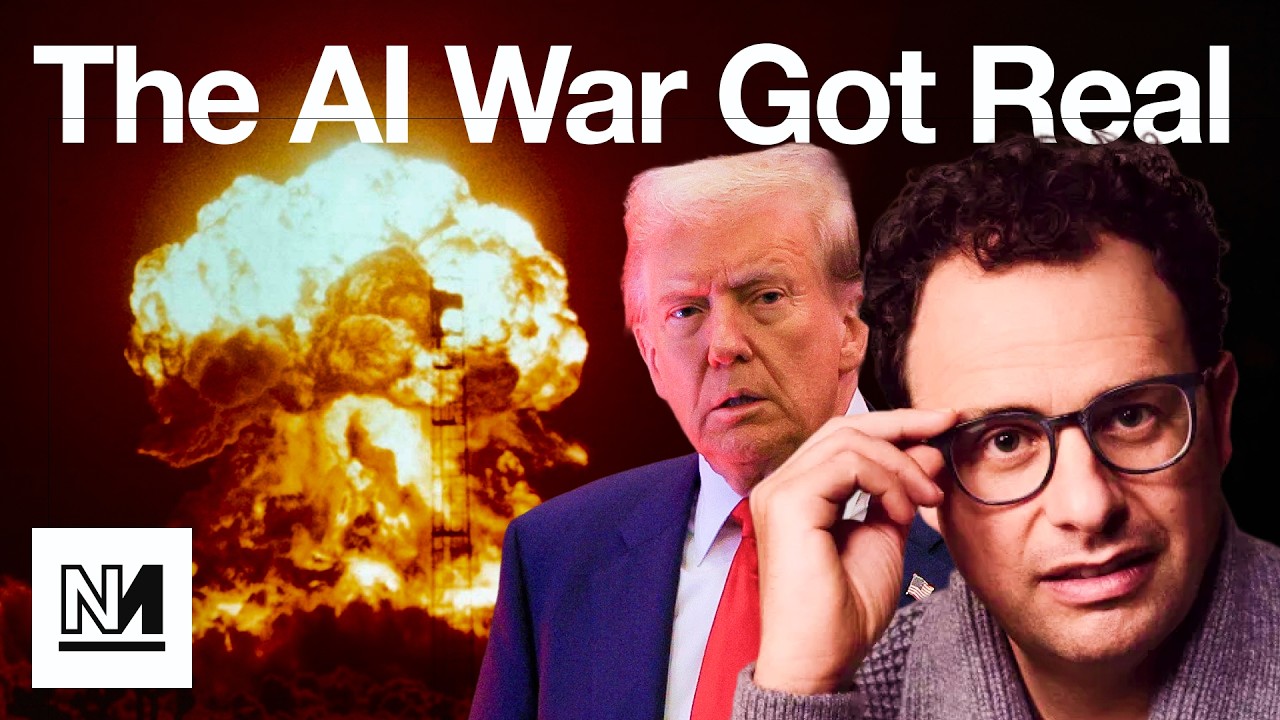
The video discusses the escalating conflict between the AI company Anthropic and the US government, specifically the Pentagon, over the use of Anthropic’s AI model, Claude. The Pentagon wanted unrestricted access to Claude for various purposes, including potentially for fully autonomous weaponry and surveillance. Anthropic, led by CEO Dario Amodei, refused to allow their AI to be used for autonomous weapons or for spying on American citizens, drawing a firm ethical line. As a result, the Pentagon not only severed ties with Anthropic but also officially blacklisted the company as a supply chain risk, meaning any Pentagon contractor must prove they are not using Anthropic’s technology.
In the wake of Anthropic’s blacklisting, OpenAI and its CEO Sam Altman quickly moved to fill the gap, offering the Pentagon unrestricted use of their own AI models, such as ChatGPT. This opportunistic move was criticized as lacking integrity, especially in contrast to Anthropic’s principled stance. An internal memo from Dario Amodei, later leaked, expressed his frustration with both the US government and OpenAI, accusing them of political favoritism, lack of genuine commitment to AI safety, and prioritizing profit over principle. Amodei later apologized for the tone of the memo but maintained his intention to pursue legal action against the Pentagon for breach of contract.
The video presents two perspectives on Amodei’s actions. Historian Rutger Bregman and many on social media praise Amodei for his moral leadership and willingness to put principles before profit, which is seen as rare among tech CEOs. Bregman lauds Amodei for standing up to political and corporate pressure, suggesting that his actions represent a much-needed example of ethical leadership in the tech industry. This view holds that Amodei’s refusal to compromise on AI safety and civil liberties deserves recognition and support.
However, not everyone is convinced by Amodei’s stance. AI safety expert Nate Soares, co-author of a book warning about the existential risks of superintelligent AI, offers a more skeptical view. While he acknowledges that Amodei’s principled stand is commendable, he points out that Anthropic has recently backed away from some of its own responsible scaling commitments, admitting it is difficult to determine when their models might become dangerously unsafe. Soares argues that the debate over Pentagon access is ultimately less important than the broader issue of whether advanced AI can be controlled at all, suggesting that the real danger lies in the potential for AI to escape human oversight entirely.
The discussion concludes with a reflection on the responsibilities of AI company leaders. Soares suggests that if Amodei truly believes in the catastrophic risks posed by advanced AI, he has the power—and perhaps the duty—to take even more drastic action, such as shutting down his company to alert the world to the dangers. However, Soares notes that even the most principled leaders are not taking such extreme steps, which casts doubt on the depth of their convictions. Ultimately, the video frames the Anthropic-Pentagon dispute as a microcosm of the larger ethical and existential dilemmas facing the AI industry, highlighting the tension between profit, principle, and the unprecedented power wielded by those developing advanced AI systems.