In this talk, Ishan Anand, Chief AI Officer at Insight Sciences, introduces the emerging field of synthetic personas—AI-generated profiles designed to simulate human behavior and attitudes for market research and insights. He draws an analogy between synthetic personas and weather forecasting, emphasizing that both rely heavily on computational power and data, operate within certain predictive limits, and require careful validation against real-world outcomes. Anand highlights that while synthetic personas have gained market momentum, understanding their technical nuances and limitations is crucial to effectively leveraging them.
Anand discusses the historical context of predicting human behavior through computation, referencing Simulmatics in the 1950s and '60s, which attempted to simulate electorates but failed due to limited data and computational power. Modern large language models (LLMs) offer a new approach by modeling language as an intermediary layer, enabling simulations of attitudes and choices that were previously difficult to mathematize. He shares a study where AI agents modeled after human participants achieved about 83% alignment with their real counterparts on personality tests, illustrating the potential of synthetic personas while cautioning about their inherent noise and variability.
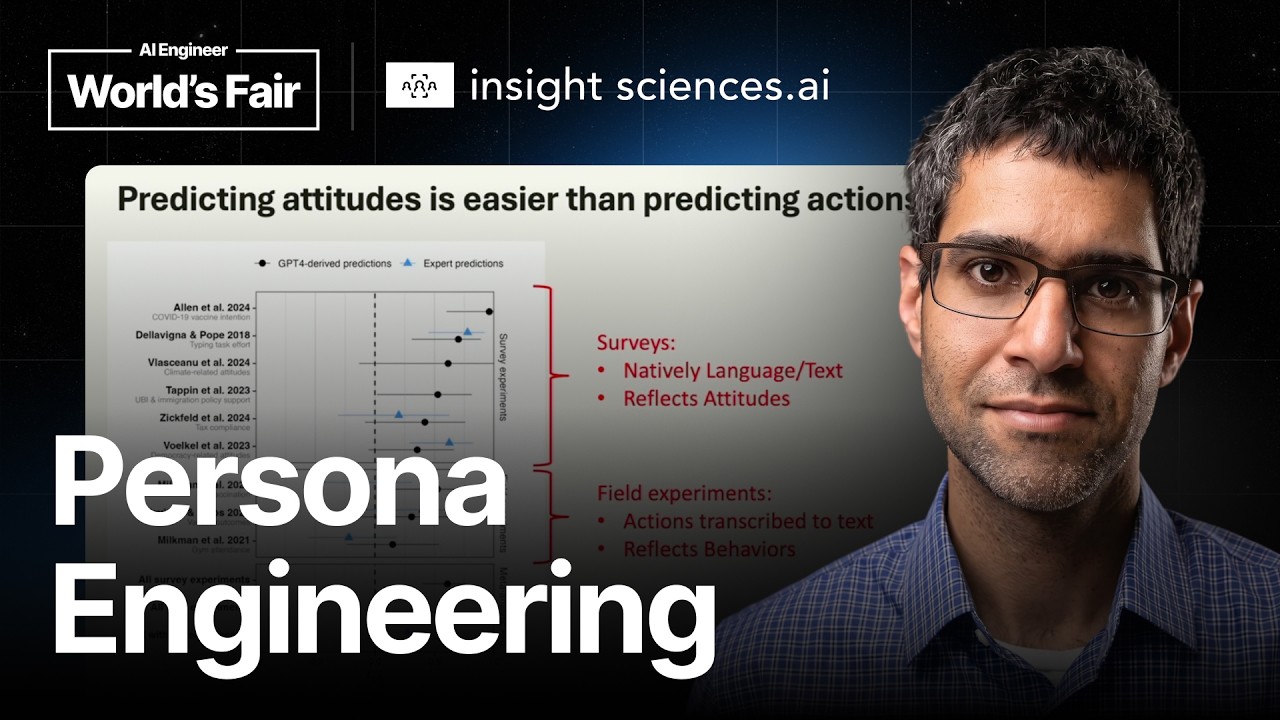
The talk outlines three key failure modes of synthetic personas. First, poorly grounded personas can infer incorrect contextual details, leading to unrealistic responses, such as an inverted U-shaped purchase probability curve when price increases. Second, prompt sensitivity can cause significant biases, like order effects in survey responses, necessitating robustness testing of prompts. Third, LLMs are better at predicting stated attitudes (text-based) than actual behaviors, as behaviors are less represented in training data, suggesting that synthetic personas should focus on triangulating behaviors from attitudes for better accuracy.
Anand then explores techniques to create and refine synthetic personas. Basic prompting can generate personas aligned with political or demographic profiles, but detailed prompts may amplify biases if not validated. Fine-tuning models on known human data distributions can improve alignment, even for unseen groups, by helping the model better express latent knowledge. More sophisticated methods involve eliciting nuanced textual responses and mapping them to quantitative scales using semantic similarity, capturing not just average tendencies but also the distribution of responses, which better reflects human variability.
Finally, Anand emphasizes the importance of measuring alignment between synthetic personas and real human data using distribution-based metrics rather than simple accuracy scores. He notes that synthetic personas cannot increase statistical significance by mere replication, akin to rerunning the same weather forecast multiple times. Instead, validation against ground truth and understanding the noise floor of human data are essential. He concludes by positioning synthetic personas as complementary to human research, especially as AI agents increasingly mediate human decisions, and highlights future directions like generative agent-based modeling to simulate complex interactions, turning human data into dynamic, queryable assets.