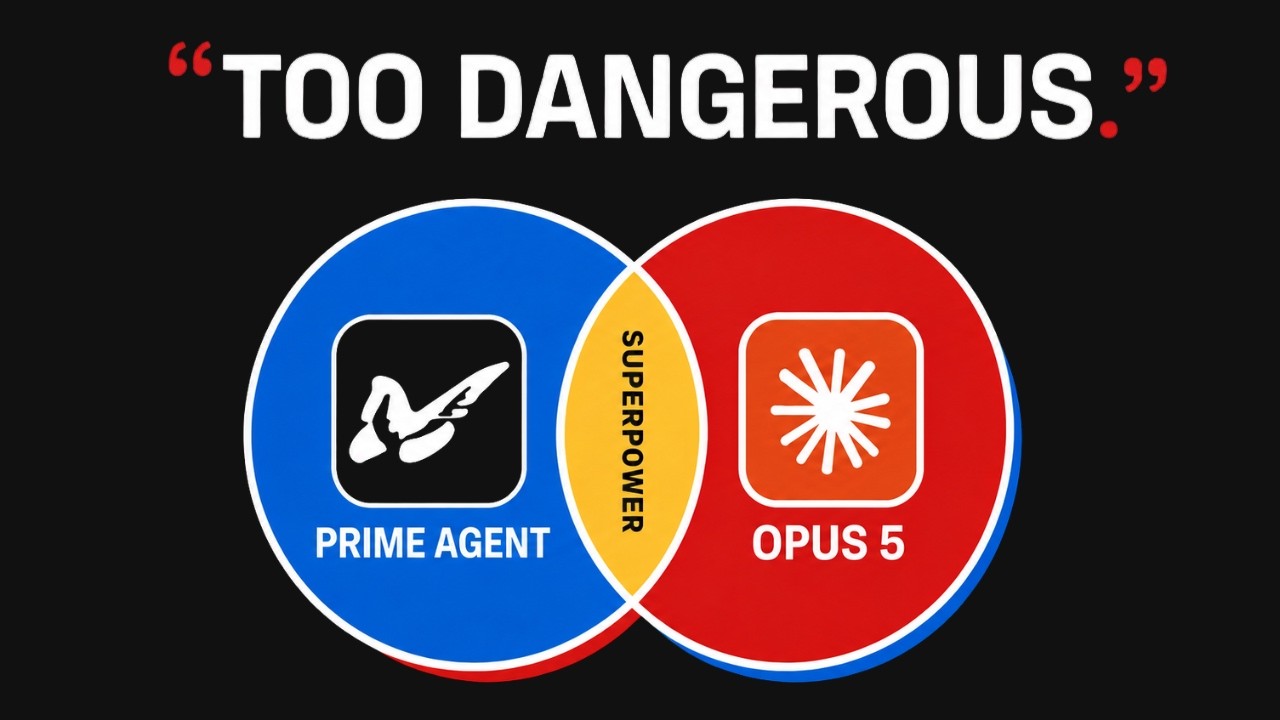
The creator explains why they dropped Claude Code last month, not due to any decline in quality, but because a new open-source coding agent called Prime Agent, paired with Anthropic’s latest model Opus 5, offers capabilities Claude Code cannot match. Prime Agent operates in the terminal, manages the entire codebase, and can interface with any model, while Opus 5, released in July 2026, delivers near frontier-level intelligence at half the cost of competitors like Fable 5. Together, they outperform Claude Code on the most challenging reasoning tasks, providing a more powerful and cost-effective coding solution.
A key limitation of Claude Code is its proprietary nature: users cannot fork, modify, or customize the underlying scaffolding or agent loop, which are tightly controlled by Anthropic. Additionally, Claude Code’s subscription plans impose strict usage caps and hourly rate limits that interrupt intensive work sessions, forcing users to either wait or pay more. This lack of control and persistent session memory frustrates developers who want a seamless, uninterrupted coding experience with persistent context and customization.
Prime Agent addresses these issues by being fully open-source under the MIT license and running locally in the terminal. It reads the repository, plans changes, edits files, runs commands, and self-checks its work. Unlike other coding agents, Prime Agent remembers preferences and context across sessions, thanks to its recursive language model (RLM) and continual harness architecture. This allows it to self-improve by refining its operating state based on evidence-backed updates, maintaining persistent goals and autonomous operation within configurable limits.
Opus 5, the model powering Prime Agent, achieves impressive benchmark results, outperforming GPT 5.6 and Claude Fable 5 on the Frontier Bench and scoring 95.5% on the ARC AGI 3 benchmark—surpassing the human expert baseline. This leap was achieved without training a new model, but rather through the harness’s scaffolding and persistent memory. Real-world tests include Prime Agent building working Sega Genesis and Game Boy Color emulators from specifications alone, demonstrating its practical coding prowess and reliability.
However, the creator notes some caveats: the 95.5% ARC score is self-reported by Prime Intellect and not independently verified, and Prime Agent requires more setup and understanding compared to Claude Code’s plug-and-play nature. There are also concerns about code bloat, cost from heavy self-improvement loops, and security risks since the agent executes arbitrary Python code. Despite these, the creator recommends keeping Claude Code for polished, quick-start tasks but switching to Prime Agent and Opus 5 for most development work due to their open, persistent, and powerful coding environment.