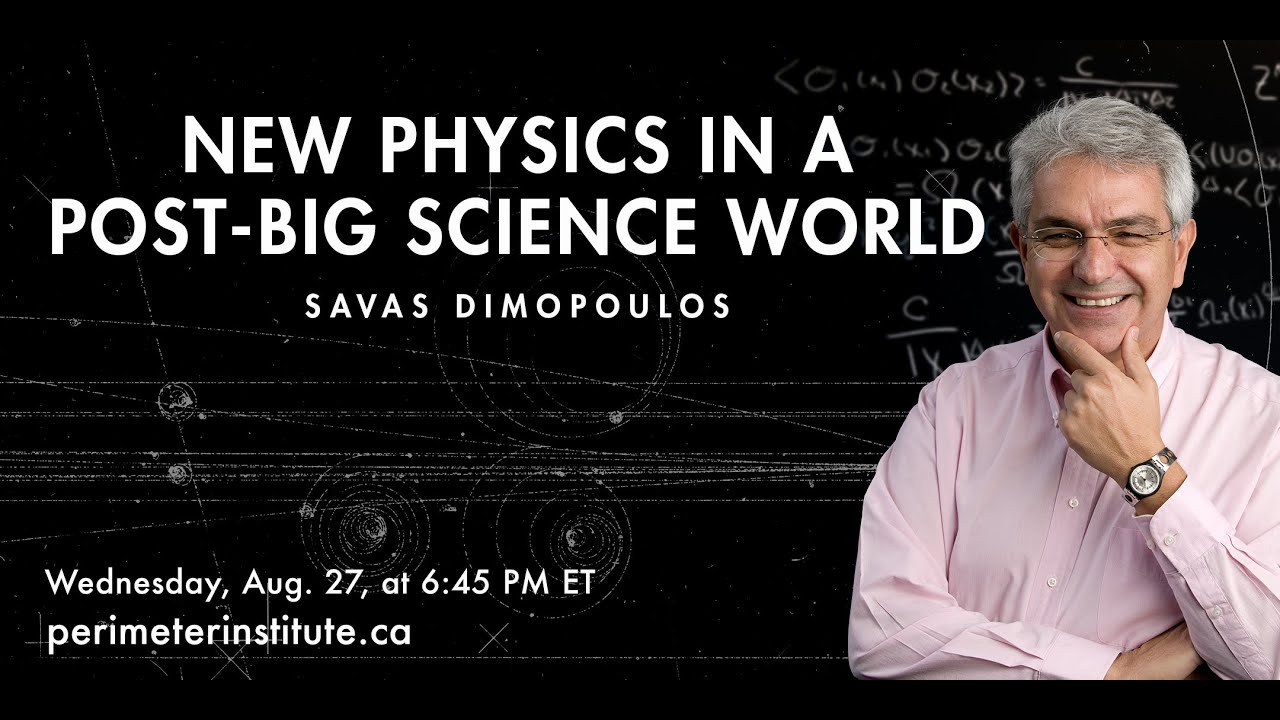
The lecture, delivered by Professor Savas Dimopoulos at Perimeter Institute, explores the evolution and future directions of physics, particularly focusing on new physics beyond the Standard Model. He begins by emphasizing the dual pillars of physics: mathematics and experiment. Mathematics serves as a powerful language and tool to express physical laws, while experiments validate these theories by observing nature. The interplay between these two has driven scientific progress from ancient times, illustrated by historical figures like Archimedes and Newton, who combined theoretical insight with experimental ingenuity.
Dimopoulos then discusses the rise of “big science,” characterized by large-scale experiments such as particle accelerators, culminating in the Standard Model of particle physics. This model, with about 20 particles and parameters, successfully explains a vast range of phenomena with extraordinary precision, such as the electron’s magnetic moment. Despite its success, the Standard Model is incomplete, notably failing to account for dark matter and dark energy, and leaving unresolved fundamental problems like the cosmological constant problem and the hierarchy problem, which question why gravity is so weak compared to other forces.
To address these challenges, the lecture highlights the principle of minimalism and unification in physics, tracing historical successes like Newton’s unification of celestial and terrestrial mechanics and Maxwell’s unification of electricity, magnetism, and light. The current frontier aims to unify all fundamental forces, including gravity, but this is complicated by the vast difference in strength between gravity and electromagnetism. One promising approach is the theory of large extra dimensions, where gravity spreads into additional spatial dimensions beyond the familiar three, diluting its apparent strength. This idea also naturally leads to the concept of a multiverse, with multiple parallel universes potentially having different physical laws.
Dimopoulos explains how the existence of extra dimensions and a multiverse could solve the cosmological constant problem through environmental selection, where only universes with suitable parameters can support life. He also discusses experimental efforts to detect signatures of extra dimensions and related particles, such as axions and moduli, through precision small-scale experiments rather than large colliders. These particles might manifest as dark matter or produce observable effects like gravitational waves from black holes or subtle changes in atomic properties, opening new avenues for discovery in the coming decades.
In conclusion, the lecture reflects on the transition from the era of large-scale high-energy experiments to a new era dominated by precision measurements and smaller-scale experiments. While the Standard Model remains a monumental achievement, the future of physics lies in exploring subtle phenomena that could reveal new physics, including evidence for extra dimensions and the multiverse. Dimopoulos encourages embracing this shift, highlighting the exciting potential for breakthroughs that deepen our understanding of the universe and our place within it.