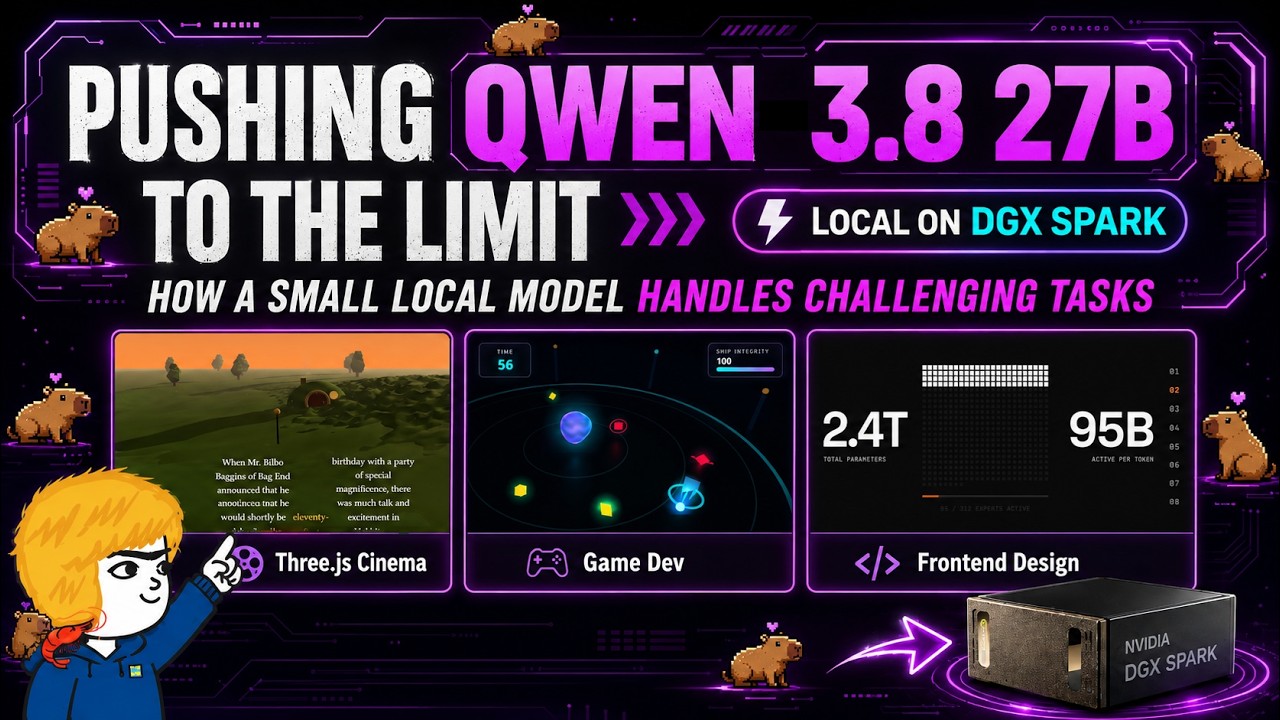
The video explores the capabilities of the Qwen 3.8 27B, a smaller local large language model (LLM) running on a DGX Spark, by putting it through a series of challenging tasks. Initially, the creator demonstrates a browser mini-game where players control a ship to collect energy fragments and avoid enemies. Despite some gameplay limitations, the game features impressive visual effects and shadows, showcasing the model’s ability to generate engaging interactive content entirely locally. This sets the stage for more complex tests comparing the local 27B model to the much larger Qwen 3.8 Max (2.4 trillion parameters) running on the cloud.
The first major test involves creating a production-quality launch website using advanced web technologies like Next.js, React, TypeScript, and GSAP for smooth scrolling and dynamic effects. The local 27B model completes the task in about 6.7 hours, producing a smooth, visually appealing site with solid transitions and effective use of color and typography. Meanwhile, the cloud-based Max version, although more advanced and visually richer, takes longer and costs around $40, highlighting the trade-offs between local and cloud-based models in terms of cost and performance.
Next, the model is tasked with building a 3D cinematic world in 3.js based on the first paragraph of “The Lord of the Rings.” The local Qwen 3.8 27B completes this in just over two hours, delivering a visually impressive scene with glowing effects, detailed hobbit holes, and effective camera work. This output surpasses previous attempts by other models like Deep Seek, demonstrating the strong multimodal and vision capabilities of Qwen 3.8 despite its smaller size compared to cloud models.
The final and most challenging task is to develop a polished browser-based car racing game inspired by classic arcade visuals. This task proves difficult, with the initial attempts resulting in broken visuals and rendering bugs. After about 12 hours and some debugging aided by a more powerful GPT-5.6 model acting as an orchestrator, the local model produces a playable but graphically poor game. This highlights the current limitations of the model in complex game development tasks and the potential need for hybrid workflows combining vision-capable models with stronger coding assistants.
Overall, the video showcases the impressive capabilities of the Qwen 3.8 27B local model, especially in vision-related tasks and creative coding, while also acknowledging its limitations in speed, complexity, and cost-efficiency compared to larger cloud models. The creator emphasizes the importance of choosing tasks suited to the model’s strengths and suggests future experiments to optimize performance and output quality. The video concludes with an invitation for viewers to share their experiences with local AI models and hints at more content exploring local AI tinkering and optimization.