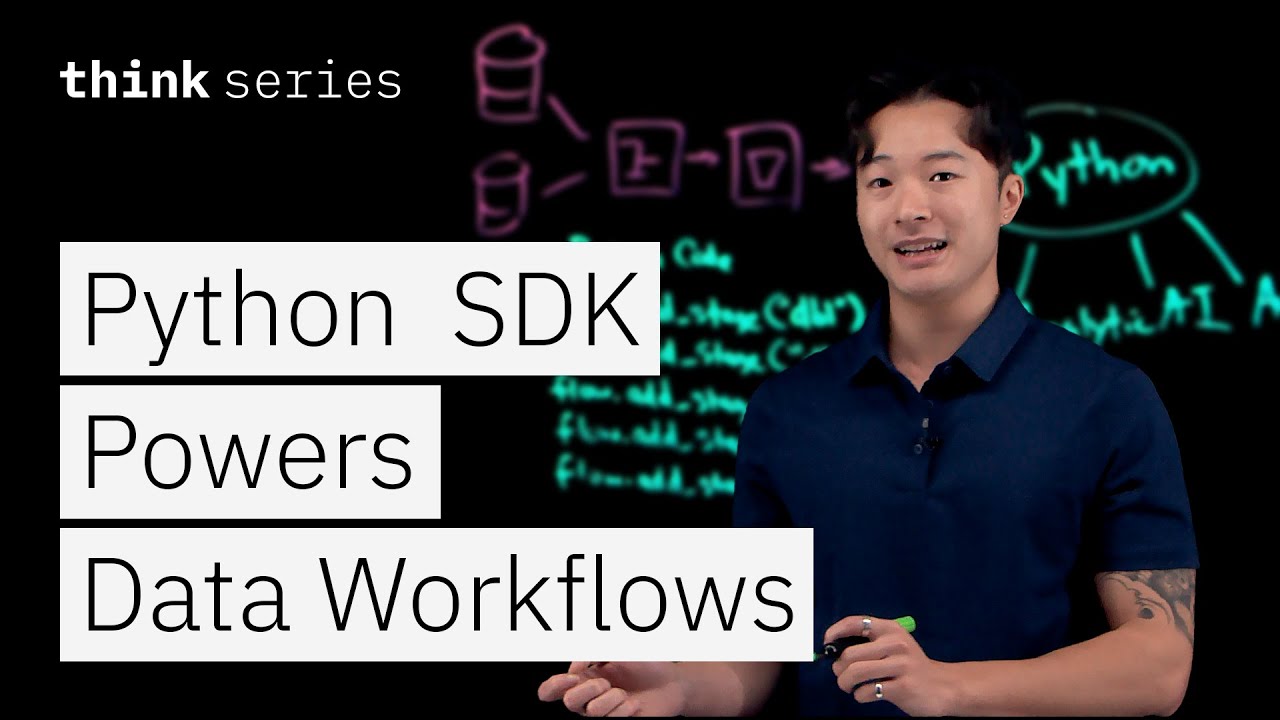
The video discusses the pervasive role of Python in data-related fields such as data engineering, analytics, AI, and automation, highlighting a common reliance on visual canvas tools for data integration. While these visual tools are intuitive, collaborative, and useful for mapping workflows and spotting dependencies, they struggle to scale when managing hundreds or thousands of pipelines. The video proposes using a Python SDK (Software Developer Kit) as a solution, enabling teams to build and modify data pipelines entirely in Python code. This approach bridges the gap between code-first and visual-first workflows, allowing both developers and non-developers to collaborate effectively within the same ecosystem.
A Python SDK simplifies the creation and management of data workflows by providing an intuitive interface to define data sources, transformations, and targets with just a few lines of code. It leverages Python’s full programming capabilities, such as loops, conditionals, parameters, and reusable templates, making pipeline development flexible and scalable. This code-first approach allows for programmatic updates across multiple pipelines, dynamic workflow generation, and easy deployment of templates across teams, transforming pipeline development into a fast, maintainable, and scalable process.
The video illustrates a typical ETL (Extract, Transform, Load) workflow example where two data sources, such as a user database and a transaction database, are joined, filtered, and loaded into a target database. Traditionally managed through GUI tools, this workflow can be expressed as a simple Python script using the SDK, which can be versioned, tested, and deployed like any other code. This method drastically reduces the time needed for bulk updates, such as changing connection strings across many pipelines, and enables templating and dynamic pipeline creation based on metadata or event triggers—capabilities that visual tools alone cannot efficiently handle.
Beyond human developers, the video emphasizes the integration of AI systems and autonomous agents into data integration workflows through the Python SDK. Large language models (LLMs) can act as intelligent teammates by generating Python code to modify pipelines, adding new steps, scheduling jobs, diagnosing failures, and coaching new users with explanations. This transforms LLMs from passive Q&A tools into active pipeline engineers, enhancing productivity and knowledge sharing within teams.
Finally, the video explores the role of autonomous agents that operate programmatically via the SDK rather than through GUIs, which are less effective for machines. These agents can autonomously create, execute, monitor, and recover pipelines without human intervention. They can dynamically assign permissions to new team members, retry failed jobs, scale resources, and integrate with external systems like Slack for notifications. This vision positions the Python SDK as a central interface where humans, LLMs, and autonomous agents collaborate seamlessly, representing the future of scalable, efficient, and intelligent data integration.