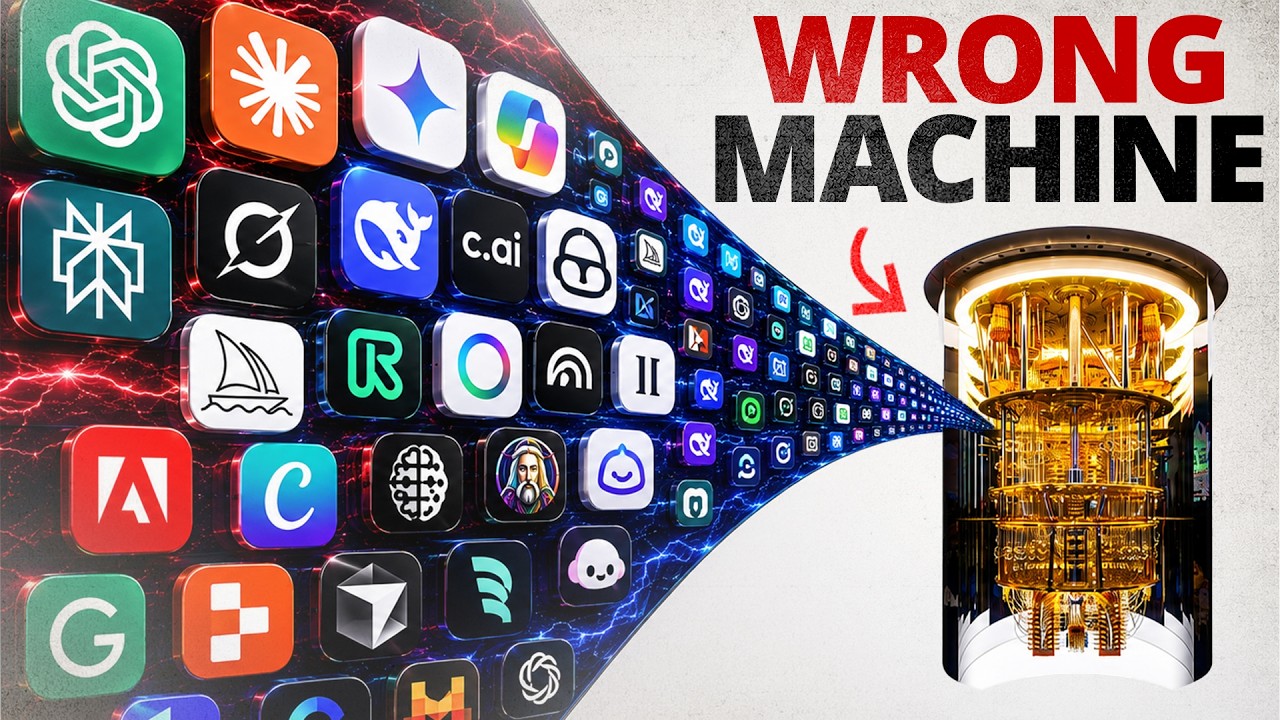
The video debunks the common claim that quantum computing will revolutionize AI by explaining that quantum advantages are limited to specific problems with deep quantum structures, whereas AI training relies on classical data and linear algebra unsuited for quantum speedups. It emphasizes that current quantum technology faces significant physical and practical challenges, making it unlikely to replace classical computing in AI tasks anytime soon, and urges skepticism toward exaggerated hype linking quantum computing directly to AI breakthroughs.
The video critically examines the popular narrative that quantum computing will revolutionize artificial intelligence (AI) and potentially replace classical computing in AI tasks. It begins by highlighting Google’s quantum chip, Willow, which reportedly solves specific problems exponentially faster than classical supercomputers. However, the presenter emphasizes that this impressive benchmark is narrowly focused on quantum chemistry problems and does not translate to the broad, complex computations required for AI training. The hype around quantum computing’s impact on AI is largely driven by corporate claims and media headlines, but these claims often misunderstand or oversimplify the fundamental physics and mathematics involved.
Quantum computers operate using qubits, which can exist in superpositions of states, allowing them to represent exponentially large spaces of possibilities. However, this does not mean they perform all computations exponentially faster. The key strength of quantum computing lies in its ability to exploit interference patterns to solve problems with deep underlying structures, such as factoring large numbers or simulating quantum systems like molecules. AI training, by contrast, involves massive amounts of linear algebra on classical data without such hidden patterns, making it unsuitable for quantum speedups. The presenter explains that quantum computers collapse their rich quantum states into classical bits upon measurement, limiting their direct applicability to AI tasks.
The video also addresses the repeated failure of quantum machine learning algorithms to deliver promised exponential speedups. Many early claims were debunked through “dequantization,” where classical algorithms were found to match or nearly match the performance of quantum ones once data access assumptions were properly accounted for. Furthermore, the practical challenges of loading classical data into quantum states and extracting results impose significant overheads that negate theoretical advantages. Quantum computing struggles with the “memory wall” problem that AI faces, as moving large classical datasets in and out of quantum systems is inherently inefficient.
Another fundamental obstacle is the “barren plateau” problem in training quantum neural networks, where the optimization landscape becomes exponentially flat as the number of qubits increases, making training infeasible. Current quantum hardware is far from capable of overcoming these challenges, with error rates and qubit counts orders of magnitude away from what would be needed for useful AI applications. Industry experts and roadmaps generally agree that quantum computing’s near-term utility lies in specialized tasks like quantum chemistry simulations rather than general AI acceleration or replacement of GPUs.
In conclusion, the video argues that while quantum computing is a real and promising technology, its strengths lie in simulating quantum systems and materials science, not in accelerating or transforming AI training. The hype linking quantum computing directly to AI breakthroughs is misleading and overlooks fundamental physical and mathematical limitations. Quantum computing may indirectly benefit AI in the long term through advances in materials and hardware, but it will not replace classical computing for AI tasks anytime soon. The presenter encourages viewers to appreciate quantum computing for its true potential and to be skeptical of exaggerated claims about its immediate impact on AI.