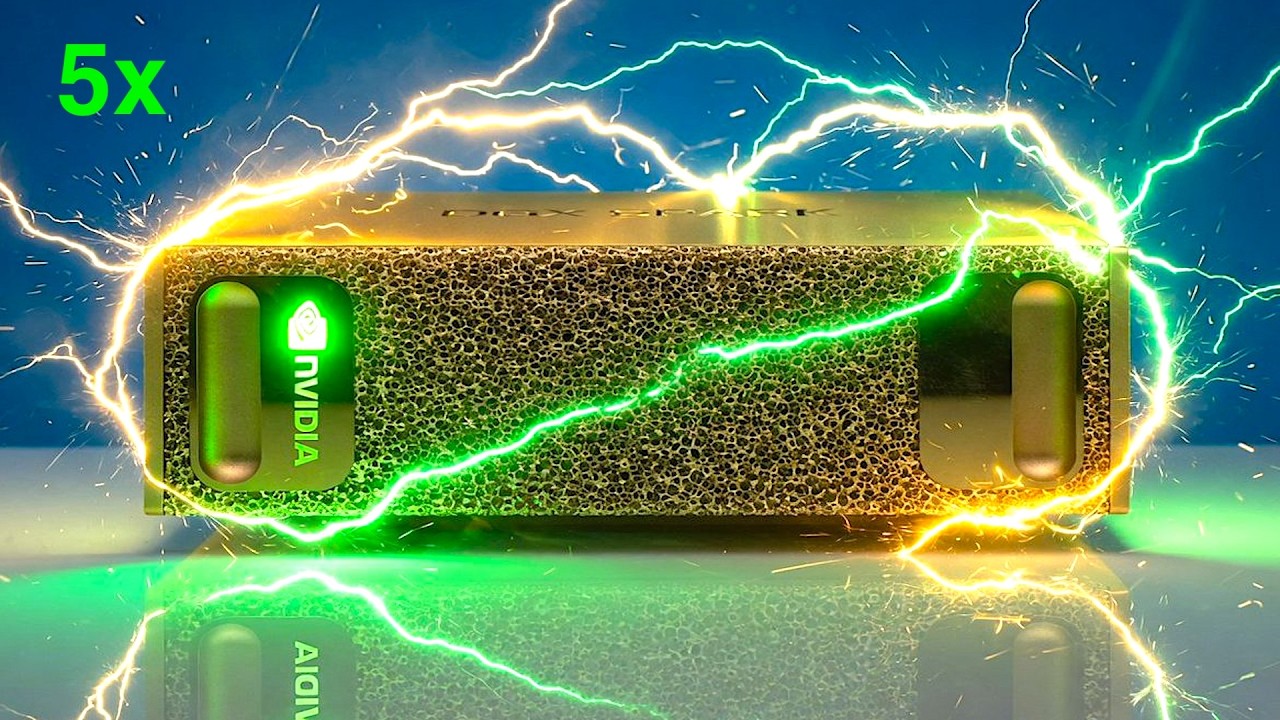
In this video, the creator, named Zero, explores a hypothetical scenario from October 25th, 2025, where they had to choose between purchasing an ounce of gold or pre-ordering an Nvidia DGX Spark, a cutting-edge local AI hardware system. They reflect on which choice would have been better for running the Qwen 3.6 27B AI model today. The video delves into the evolution and performance of local AI hardware, comparing traditional GPU setups like multiple Nvidia 3090s to the unified memory architecture of the DGX Spark, highlighting the differences in how these systems handle AI inference workloads.
The Nvidia DGX Spark initially faced challenges due to its unique architecture, which combines CPU and GPU with shared high-bandwidth memory (HBM). This unified memory model offers theoretical speed advantages by eliminating data transfer bottlenecks between CPU and GPU, but it also requires different optimization strategies compared to conventional multi-GPU rigs. The video emphasizes that the DGX Spark is fundamentally different from Apple Silicon systems, despite some superficial similarities in memory sharing, and that local AI enthusiasts initially struggled to leverage its full potential.
Recent advancements, particularly the deployment of Dlash quantization techniques on Qwen 3.6 27B, have significantly boosted performance on the DGX Spark, achieving 3 to 5 times speed improvements that are difficult or impossible to replicate on 3090 GPUs. These improvements utilize FP8 precision rather than Nvidia’s proprietary NVFP4 format, offering better model capabilities without relying solely on specialized hardware features. The video also notes that some of the fastest AI model runs on leaderboards are now hosted on DGX Spark systems, underscoring its growing relevance in local AI.
From a cost perspective, the video compares the price of an ounce of gold at around $4,000 to the cost of purchasing a DGX Spark or a set of four 3090 GPUs, which offer similar VRAM capacity but different performance characteristics. Interestingly, used DGX Sparks are becoming more affordable, especially in Europe and Japan, with some listings as low as $1,200 to $4,000, making them a potentially attractive option for AI practitioners looking for powerful local inference hardware without the high power consumption and complexity of multi-GPU setups.
In conclusion, while the creator personally prefers a traditional GPU setup for its versatility in other machine learning tasks, the DGX Spark’s unified memory architecture and recent software optimizations make it a compelling choice for running large AI models like Qwen 3.6 27B efficiently. The video encourages viewers to consider their own hardware preferences and invites discussion on whether local AI users favor GPUs, Apple Silicon, or unified memory systems like the DGX Spark, highlighting the dynamic and evolving landscape of local AI hardware.