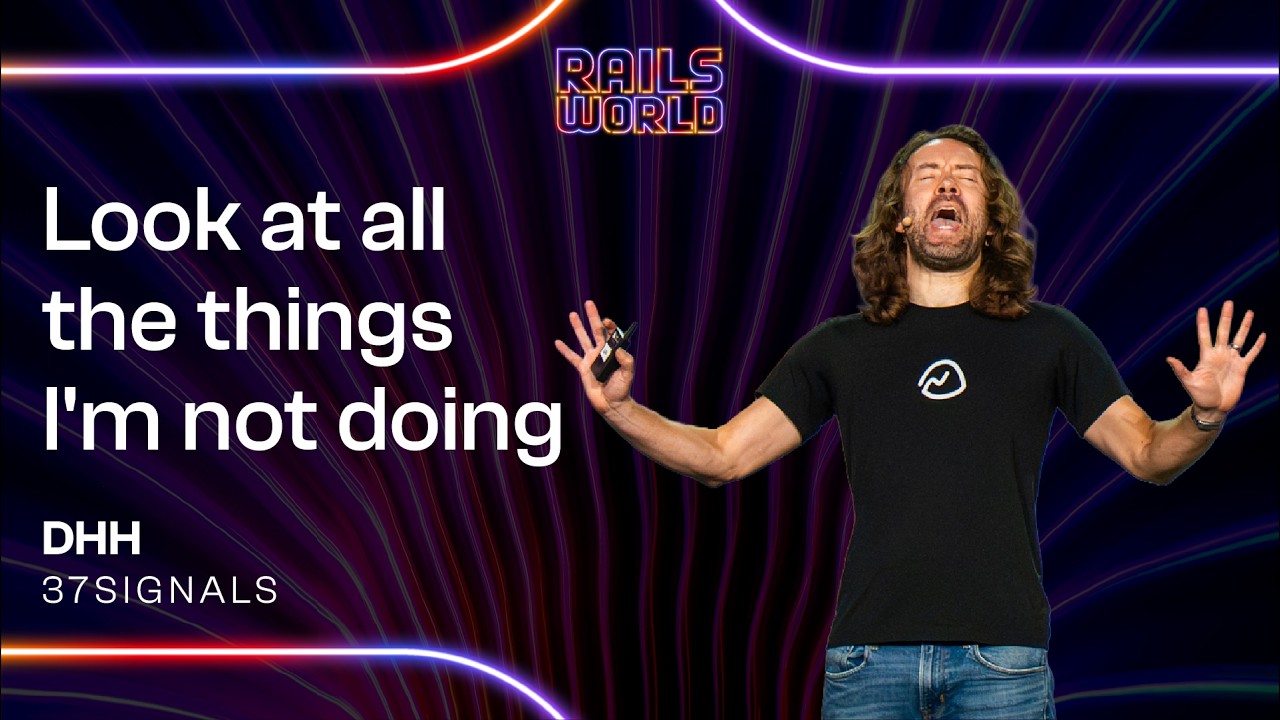
In his keynote at Rails World 2026, DHH reflects on the transformative impact of AI and agent technologies on software development, drawing parallels with historical technological shifts such as the democratization of photography. He highlights how just as photography revolutionized portraiture and artistic expression, AI—marked by milestones like the release of Opus 4.5—has ushered in a new era where programming is no longer about writing code by hand but about collaborating with intelligent agents. This shift has dramatically accelerated productivity, with DHH noting that in recent months he has written far less code manually yet achieved more, signaling a fundamental change in how software is created.
DHH discusses the evolving nature of software development, emphasizing that the traditional craft of coding is becoming obsolete for most programmers and companies. At his company, 37signals, they have effectively stopped writing code by hand, relying instead on AI agents to generate and maintain software. This new paradigm enables the rapid creation of high-fidelity native applications across multiple platforms without the massive teams previously required. He illustrates this with their work on Hey Next, a native app suite developed almost entirely through AI-generated code, showcasing the dramatic reduction in development time and effort.
The keynote also addresses the backend evolution, where languages like Rust, despite being complex and less human-friendly, are embraced because AI agents can handle the intricacies of writing and maintaining such code. This division of labor allows developers to focus on higher-level design and outcomes while agents manage verbose, low-level implementation details. DHH envisions asynchronous collaboration with agents as the future workflow, where tasks are delegated and reviewed rather than manually coded in real-time, marking a significant shift in software architecture and methodology.
Looking ahead, DHH sees Ruby on Rails and web applications continuing to play a vital role, especially for ephemeral or convenience-driven use cases, but acknowledges that many applications will transition to native platforms due to the drastically lowered cost of development. He stresses the need to rethink software architecture, moving away from traditional abstractions that no longer fit well in an environment where AI can handle repetition and synchronization effortlessly. This moment is likened to the early days of object-oriented programming, with the industry collectively exploring new paradigms and best practices.
Finally, DHH urges optimism amid uncertainty, drawing lessons from history where technological disruptions initially sparked fear but ultimately led to new opportunities and growth. He encourages embracing AI-driven development as a chance to redefine the profession, focusing on outcomes rather than manual coding. Despite concerns about security and societal impact, he believes the potential for abundance and creativity far outweighs the risks. His message is clear: the future belongs to those who lean into this revolution with enthusiasm and an open mind, as the age of AI-powered software development is just beginning.
Useful Links