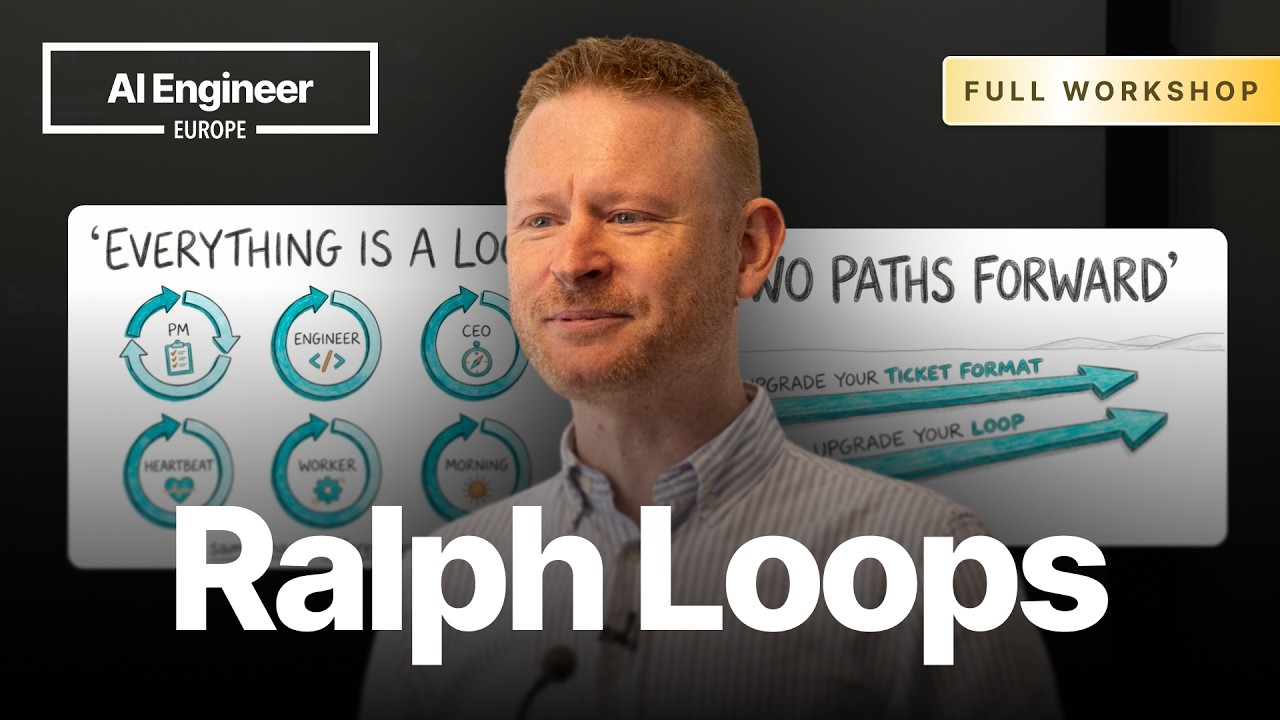
The workshop, led by Chris Parsons, focuses on “Ralph loops,” a practical approach to building AI-driven automation loops that continuously improve and ship code or other outputs. Chris introduces the concept by contrasting traditional complex AI orchestration workflows, such as those built with NA10, with simpler, iterative loops powered by tools like Claude Code. He demonstrates this with a live coding example of a Pomodoro timer project, showing how Ralph loops repeatedly process tickets to incrementally build and improve the software. The key insight is that these loops allow AI to revisit tasks, identify missed elements, and refine outputs until completion, leveraging the latest AI models for better reliability.
Chris emphasizes that Ralph loops are fundamentally about running a loop where the AI reads a task, executes it, reviews the outcome, and then decides on the next step, repeating this process until the work is done. This iterative approach contrasts with earlier, brittle workflows and enables more coherent and maintainable automation. He also discusses the importance of feedback mechanisms within these loops, such as tests and status updates, to ensure quality and progress. The workshop encourages participants to experiment with running these loops on their own laptops, using simple ticket systems to guide the AI’s work.
A significant part of the discussion revolves around scaling Ralph loops beyond single tasks to managing entire projects or startups. Chris shares his experiences with attempts to orchestrate multiple parallel agents and complex dependency graphs, which initially failed due to coordination challenges. He advocates for simpler, sequential loops where the AI picks the next most important ticket dynamically, rather than trying to manage all dependencies upfront. This approach aligns with agile principles and avoids recreating rigid waterfall processes. He also highlights the potential for AI to handle various roles and workflows, from coding to project management, by continuously running loops tailored to specific contexts.
The workshop also addresses practical concerns such as sandboxing, security, and version control of AI skills (the modular prompts and scripts that guide AI behavior). Chris explains strategies for safely running AI agents, including using VPS environments, Docker sandboxes, and fine-grained permission controls. He acknowledges current challenges in sharing and versioning skills across teams and is working on tools to improve this. Additionally, he discusses how to handle context management in loops, whether to maintain session state or start fresh each iteration, and the importance of designing clear stopping criteria and feedback loops to know when tasks are truly complete.
Finally, Chris reflects on the evolving role of humans in AI-driven workflows. While Ralph loops can automate many tasks, human oversight remains crucial, especially for reviewing code changes, defining tickets, and making strategic decisions. He shares his personal approach of delegating routine work to AI while focusing on higher-level thinking and strategy. The workshop concludes with a Q&A exploring topics like multi-agent coordination, continuous integration, knowledge management, and the ethical implications of AI automation. Chris encourages experimentation, iterative improvement, and embracing the transformative potential of Ralph loops in software development and beyond.