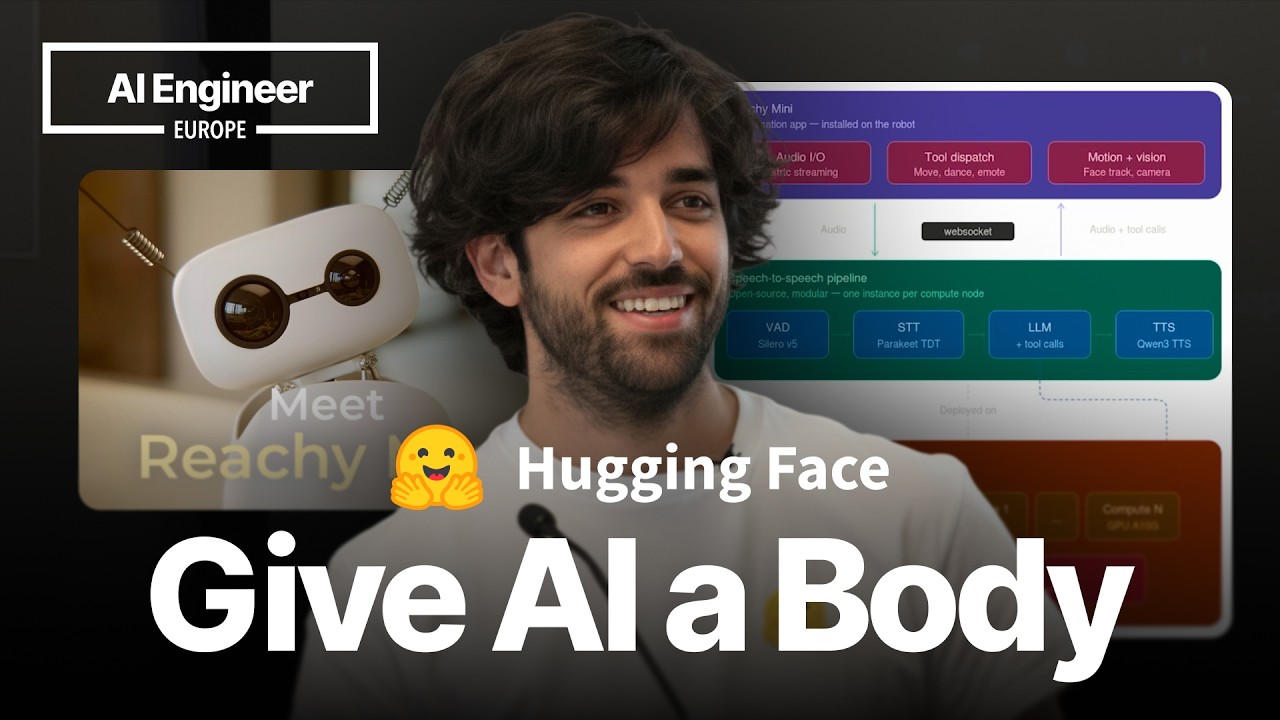
Andres Marafioti from Hugging Face presents the Reachy Mini, an affordable, open-source robot designed to democratize robotics and voice interaction. He begins by discussing the current state of robotics, noting significant advancements in humanoid robots and autonomous vehicles but highlighting their high costs and limited accessibility. These expensive robots, often priced in the mid five-figure range, are primarily targeted at companies and are not easily adaptable or friendly for everyday users, especially students or hobbyists. Marafioti emphasizes that current robots tend to imitate human forms, which restricts creativity and innovation in robot design and interaction.
Marafioti contrasts the maturity of voice AI technology with the limited integration of voice interaction in robotics. He points out that while voice AI has advanced significantly, with many commercial and open-source models available, there is a gap in how these technologies are applied to robots. The Reachy Mini aims to fill this gap by providing a robot that is expressive, hackable, and designed for voice interaction, but without mimicking human appearance. This approach encourages users to explore new forms of interaction and creativity, making robotics more accessible to hackers, researchers, students, and dreamers.
The Reachy Mini is sold in two versions, priced at $300 and $450, with the more expensive model including a Raspberry Pi and battery. The robot ships unassembled, promoting hands-on learning and easy repairability. Users have already begun customizing the robot by 3D printing parts and adding features like lights and interactive behaviors, demonstrating its hackability and versatility. Marafioti showcases a demo where the robot engages in a natural voice conversation, highlighting the integration of advanced speech-to-speech pipelines and large language models (LLMs) to enable fluid and responsive interactions.
Technically, the system operates on three levels: the speech-to-speech pipeline, the conversation app running on the robot, and cloud-based inference endpoints that manage LLM processing. Marafioti details efforts to optimize text-to-speech (TTS) performance using Coqui 3 TTS, overcoming challenges like latency and streaming to achieve real-time voice synthesis. These improvements enable more natural and immediate robot responses, enhancing user experience. The entire software stack is open source, allowing users to build and customize their own voice agents and interactions with the robot.
In conclusion, Marafioti envisions Reachy Mini as a platform to foster communal development of robot interaction, breaking down barriers posed by expensive, proprietary systems. He encourages users to experiment, hack, and create new applications, emphasizing that no advanced coding skills are necessary to get started. The project supports extensibility through hardware add-ons and software plugins, aiming to cultivate a vibrant ecosystem around accessible robotics and voice AI. Marafioti invites further discussion and collaboration, underscoring the robot’s role as a conversation starter and a tool for innovation.