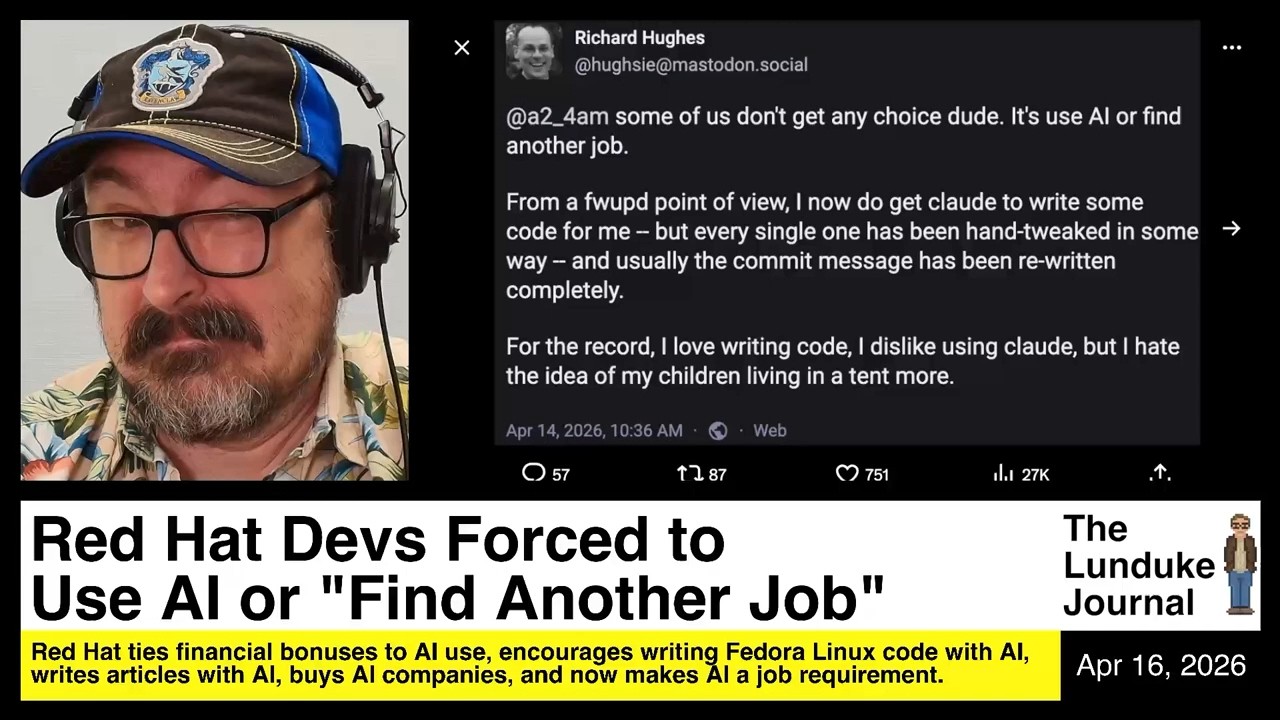
The video highlights Red Hat’s aggressive push for AI integration, including tying employee bonuses to AI usage and mandating AI adoption under threat of job loss, while also noting similar risky AI implementations at SUSE. In contrast, Canonical is portrayed as taking a more cautious and balanced approach to AI, with the speaker expressing concern over the rapid, forceful AI adoption and its potential dangers in enterprise Linux environments.
The video discusses Red Hat’s strong push towards integrating artificial intelligence (AI) into its work culture and development processes. Red Hat has been tying employee bonuses to AI usage, encouraging developers to incorporate AI into projects like Fedora Linux, and even publishing AI-generated articles. A longtime Red Hat engineer revealed that employees are essentially forced to use AI or face the prospect of losing their jobs, highlighting the company’s aggressive stance on AI adoption. This engineer expressed personal dislike for relying on AI but felt compelled due to financial and job security concerns.
Red Hat’s AI emphasis extends beyond internal coding practices to project management and content creation. Fedora Linux, a distribution fully owned and managed by Red Hat, has introduced an AI-assisted contribution policy, explicitly allowing AI tools in development. The company’s CEO has publicly stated that AI “needs to be everywhere,” reinforcing the strategic priority placed on AI integration. Red Hat has also acquired multiple AI companies, such as Chatterbox Labs, to bolster its AI capabilities, further embedding AI into its ecosystem.
The video also touches on similar trends at other enterprise Linux companies like SUSE. SUSE has introduced agentic AI features in its Linux Enterprise servers, allowing AI to autonomously manage system administration tasks with root access. This move raises concerns about the risks of giving AI such control over critical infrastructure. The speaker sarcastically warns about potential problems with AI bots managing servers, likening it to a “Skynet” scenario, emphasizing the perceived recklessness of these developments.
In contrast, Canonical, the company behind Ubuntu, is portrayed as more cautious regarding AI integration. While Canonical supports AI workloads on Ubuntu, it has not adopted extreme measures like granting AI root access or mandating AI use for job retention. The speaker suggests that Canonical remains one of the few enterprise Linux companies maintaining a more balanced and sane approach to AI adoption compared to Red Hat and SUSE.
Overall, the video expresses concern and skepticism about the rapid and forceful push for AI in enterprise Linux environments. It highlights the pressure on developers to use AI or risk unemployment, the questionable quality of AI-generated content, and the potential dangers of autonomous AI system management. The speaker encourages viewers to stay informed through independent coverage, emphasizing the importance of unbiased reporting free from corporate influence.