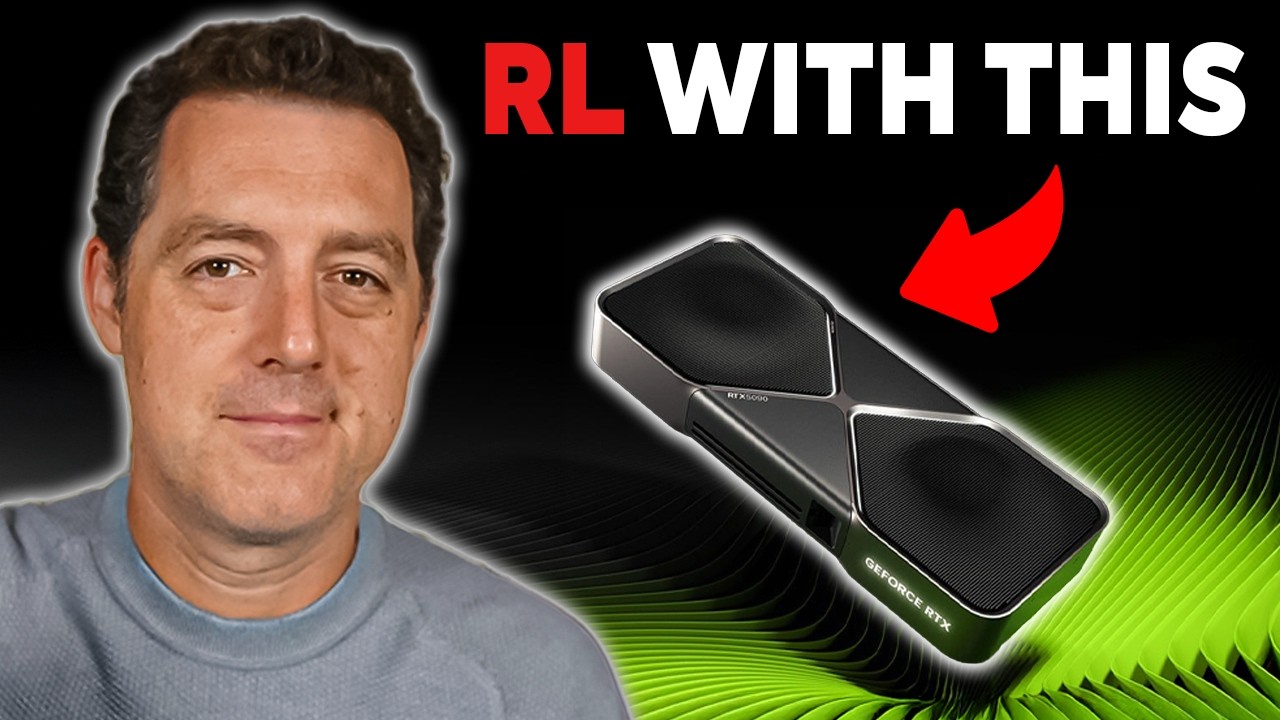
This video tutorial, created in partnership with NVIDIA and Unsloth, demonstrates how to set up and run reinforcement learning with verifiable rewards (RLVR) locally on a home computer using an NVIDIA RTX GPU. Reinforcement learning is the technology behind AI systems that have surpassed humans in games like chess, Go, and League of Legends, as well as in autonomous driving. Previously, running such AI models required massive, expensive machines, but now, thanks to advancements in GPU technology like the RTX series, it is possible to perform reinforcement learning on a regular gaming PC.
The tutorial focuses on teaching an AI model to master the game 2048, a simple number puzzle where players slide tiles to combine numbers and reach the tile 2048 without filling up the board. The AI starts with no knowledge of the game and learns through reinforcement learning by receiving automated feedback on its actions without human intervention. The model used is GPTOSS, an open-source model from OpenAI, and the environment is set up using Windows Subsystem for Linux (WSL) with Ubuntu, which was found to be the most straightforward method after testing multiple options.
The setup process involves updating NVIDIA drivers, installing CUDA, setting up WSL and Ubuntu, and configuring a Python environment with necessary packages like PyTorch, Unsloth, and Jupyter Notebook. The tutorial walks through downloading and running a Jupyter Notebook that contains the entire reinforcement learning pipeline. This includes loading the model, running the 2048 game environment (which was actually created by GPT-5), and defining reward functions that guide the AI’s learning by scoring its performance and preventing cheating.
The reinforcement learning process involves the AI generating strategies for playing 2048, testing them, and receiving feedback through reward functions. Over multiple iterations, the AI refines its strategies, learning from failures and improving until it can consistently solve the game. The video shows the model’s progress, from initial failures to eventually achieving the 2048 tile, demonstrating the power of RLVR. The entire training process took about six hours, including setup and compute time, which is quite accessible for home users with an RTX GPU.
Finally, the video emphasizes the broader significance of running reinforcement learning locally. As AI models become smaller and more efficient, running and fine-tuning them on edge devices like personal computers will become increasingly common, offering greater control, customization, and privacy. The presenter encourages viewers to explore RLVR for various applications beyond games, such as financial analysis or autonomous control, and invites feedback for future tutorials. The collaboration with NVIDIA and Unsloth highlights the growing ecosystem supporting accessible AI development on consumer hardware.