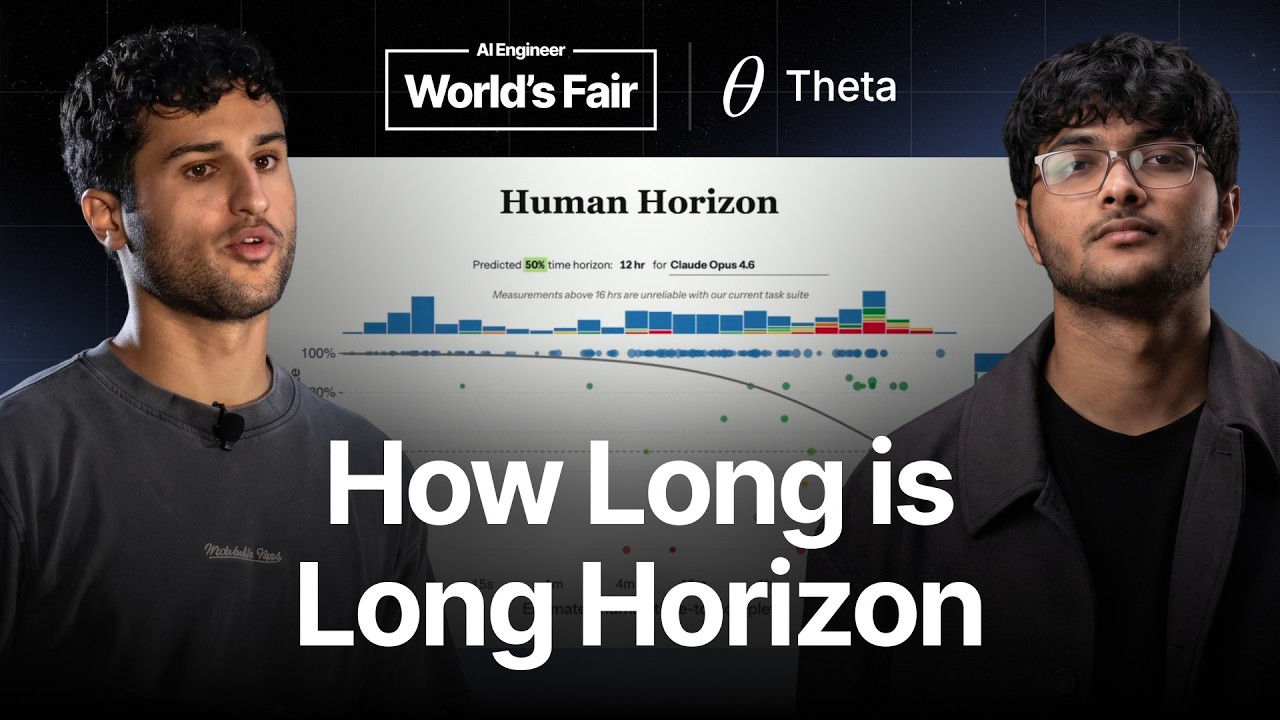
In this presentation, Rayan Garg and Ryan from Theta Software discuss the concept of long-horizon tasks in AI environments, emphasizing the evolving nature of what constitutes “long horizon.” They highlight that the definition is scalar and relative, changing over time as AI capabilities improve. Two main approaches to defining long horizon are considered: human benchmarks, where tasks are measured by the time humans take to complete them, and model-based metrics, such as token consumption and steps taken by AI agents. Both approaches have limitations; human time may not reflect AI difficulty accurately, and model metrics can be noisy due to variability in models and task setups. The presenters argue for a combined perspective to better understand AI capabilities in long-horizon work.
The discussion then shifts to measuring model capabilities beyond just task duration, focusing on environment complexity, particularly tool coordination and state changes. Early AI tasks often involved simple environments with limited tools, but modern long-horizon tasks require agents to coordinate multiple tools and manage complex state changes over time. The distinction between parallelizable tasks, which can be broken into independent subtasks, and sequential tasks, where earlier decisions impact later outcomes, is crucial. Additionally, ambiguity in task instructions and artifacts is highlighted as a key factor, reflecting real-world scenarios where agents must explore and adapt to incomplete information, making evaluation more challenging.
A significant portion of the talk addresses the challenge of verifying AI agent performance in complex environments. Traditional deterministic verification methods are often insufficient for open-ended, economically valuable tasks, especially in software domains. To address this, the presenters advocate for the use of judge or critic models that assess both the final state of the environment and the trajectory of the agent’s actions. These judges help detect issues like reward hacking and ensure that the agent’s solutions are valid and robust. Designing effective judges involves balancing strictness to avoid collapsing the solution space and flexibility to accommodate multiple correct approaches, which is essential for evaluating ambiguous tasks.
The presenters also outline best practices for building judges, emphasizing that judges themselves are agents requiring clear observability and access to the environment without causing unintended changes. They discuss the need for sophisticated processing of long and complex agent trajectories, including making trajectories queryable and enriching them with metadata to identify critical steps. Learnability is another focus, with the importance of reward signal density and task distribution to ensure models can effectively learn from the environment. They note emerging patterns in rubric design, such as combining deterministic checks with judge evaluations and using dynamic rubrics that assign partial credit based on assumptions about earlier steps.
In closing, the team critiques existing benchmarks in finance-related AI tasks, pointing out that many do not meet the criteria for long-horizon tasks as defined by human time metrics and are already saturated, limiting their usefulness for advancing model capabilities. They highlight the narrow scope of these benchmarks and the lack of granular reward signals necessary for effective training. Presenting their own finance data, they show that tasks average around 15 human hours and remain challenging for current models, underscoring the need for more comprehensive, nuanced benchmarks and evaluation methods to push the frontier of long-horizon AI work.