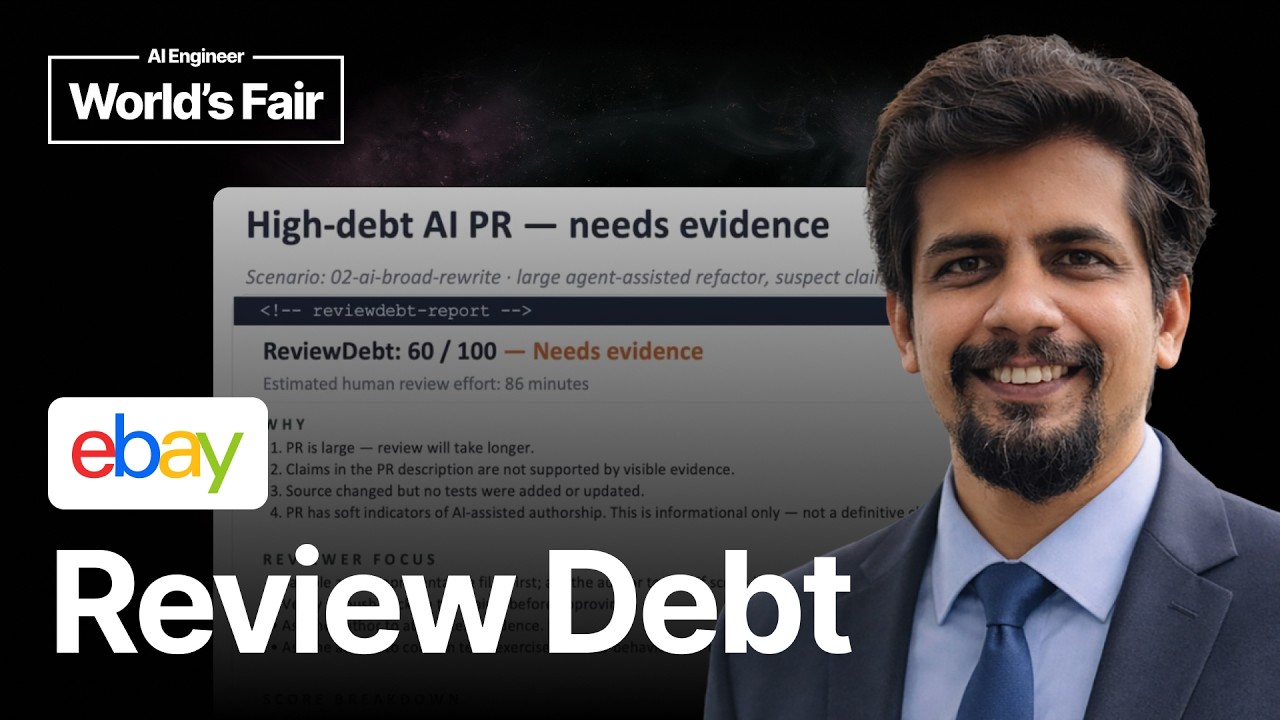
Sachin Gupta, a software engineer at eBay, introduces the concept of “review debt,” a growing issue caused by the rapid production of code through AI coding agents that outpaces human review capacity. He highlights alarming trends from recent reports showing increased code commits but a significant drop in review comments, indicating that while AI accelerates code creation, human review attention is declining. This imbalance leads to review debt, a compounding gap between AI-generated code and the human understanding and trust necessary for quality assurance, which currently lacks measurement.
Review debt is defined as the accumulating gap between code produced by AI agents and the code that humans have thoroughly reviewed and trusted. It behaves like financial debt, accruing interest paid in human attention, and compounds through three feedback loops: AI agents learning from unreviewed code, reviewers focusing only on superficial issues, and leadership resetting velocity expectations without increasing reviewer resources. To address this, Gupta proposes a practical, deterministic scoring framework based on five signal families—size and coupling, test evidence gap, directory and ownership spread, AI authorship indicators, and evidence and rationale gaps—that collectively quantify review debt without relying on language models.
Each signal family captures a different aspect of review burden. Size and coupling measure the scope and complexity of changes, with sprawling changes across multiple files increasing mental load. Test evidence gap assesses the ratio of tests to production code, noting that AI-generated tests often only confirm existing behavior rather than validate intended functionality. Directory and ownership spread track how many teams are involved in a PR, with cross-team changes increasing coordination overhead. AI authorship indicators identify AI-assisted PRs without penalizing them, while evidence and rationale gaps evaluate the quality of explanations provided in PR descriptions, which are crucial for effective review.
Gupta demonstrates the framework’s application by scoring real pull requests, showing how it provides actionable insights beyond a simple score. Low-burden PRs generate minimal noise and require little reviewer effort, while high-burden PRs trigger detailed advice for both reviewers and authors to improve reviewability. Analysis of over 500 PRs across three public repositories reveals that review burden correlates more with PR complexity and volume than with AI authorship alone, emphasizing that managing review debt is about controlling PR quality and size rather than blaming AI usage.
To mitigate review debt, Gupta recommends best practices such as limiting PRs to one logical change, including meaningful tests, staying within ownership boundaries, and ensuring authors provide clear rationale in PR descriptions. He advises teams to backfill historical PR data to calibrate thresholds, surface scores transparently, aggregate metrics for team-level insights, and foster ongoing conversations about review debt. Ultimately, measuring and managing review debt enables teams to balance AI-driven productivity gains with sustainable review practices, ensuring code quality and accountability in an AI-augmented development environment.