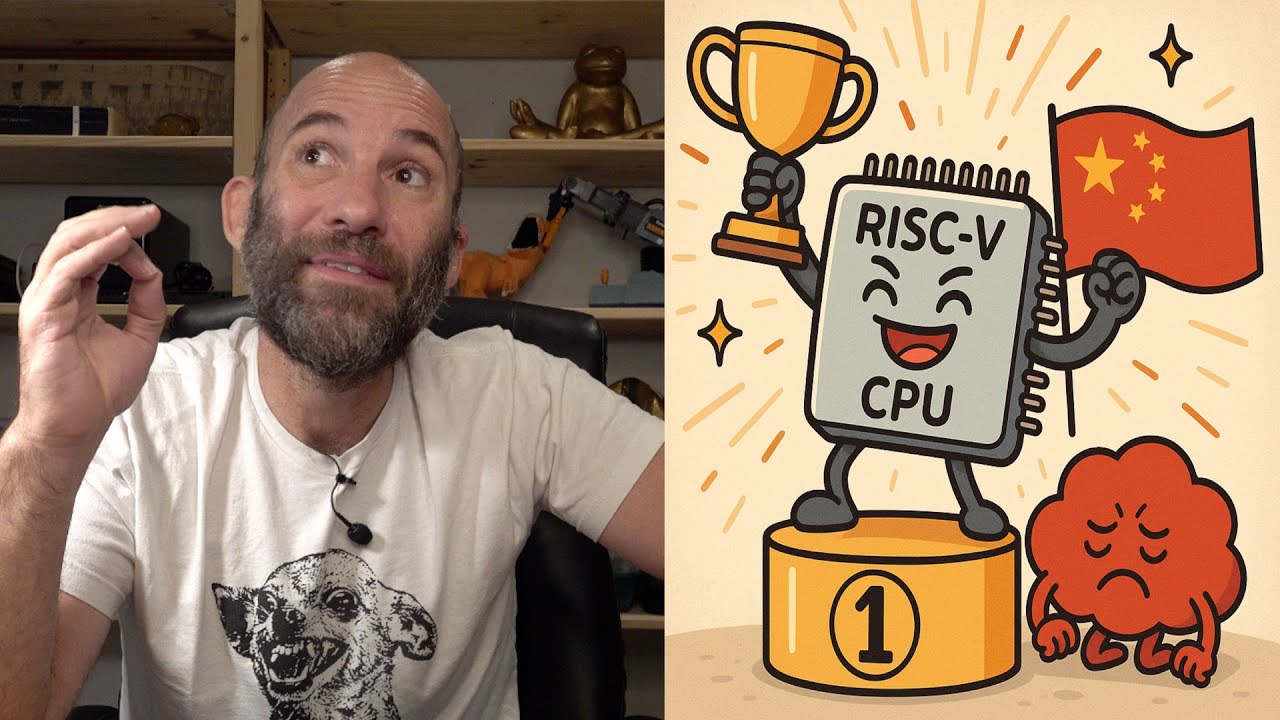
In this video, Eli the Computer Guy discusses the growing significance of RISC-V, an open-source processor architecture, particularly in the context of Chinese advancements in AI and the broader geopolitical landscape. He explains that unlike proprietary architectures like Intel’s x86 or ARM, RISC-V is an open standard that allows anyone with manufacturing capability to produce and modify chips. While historically RISC-V was seen as a niche or “cute” technology without much practical impact, recent developments, especially in China, have pushed it into the spotlight as a viable alternative for various applications, including AI.
Eli highlights how political tensions and trade restrictions between the United States and China have inadvertently accelerated China’s adoption of RISC-V. With limited access to Western proprietary hardware due to sanctions and export controls, China has embraced open-source hardware standards like RISC-V to build its own semiconductor ecosystem. This shift aligns well with China’s preference for open-source solutions, contrasting with the Western model that emphasizes proprietary control and licensing. As a result, RISC-V is gaining traction not only in China but also in other regions seeking to develop independent chip manufacturing capabilities.
The video also touches on the broader global chip manufacturing landscape, noting efforts by countries like Japan, Europe, Brazil, and South Africa to establish or revitalize their semiconductor industries. Eli suggests that RISC-V’s open nature could enable these countries to create localized chip ecosystems, unlike ARM or x86, which are tightly controlled by a few companies. This fragmentation could lead to a more diverse and decentralized technology environment, moving away from the current dominance of a few major players and potentially reshaping the global tech industry.
Eli further discusses the specific applications of RISC-V in AI, particularly at the edge rather than in large data centers. He notes that RISC-V’s customizable architecture and ability to support heterogeneous systems make it well-suited for AI workloads that require specialized processing cores. Companies like Nvidia are already incorporating RISC-V cores into their chips, and AI chip designers are considering RISC-V alongside ARM. The automotive industry in China is also a significant driver of RISC-V adoption, seeking low-cost, efficient compute solutions for various embedded systems.
In conclusion, Eli reflects on the implications of RISC-V’s rise amid shifting geopolitical and technological trends. He invites viewers to consider how the open-source hardware movement might transform the industry, especially as globalization wanes and more countries seek technological independence. The video underscores the complex interplay between politics, technology, and market forces, suggesting that RISC-V’s growing role could have far-reaching consequences for the future of computing and AI deployment worldwide.