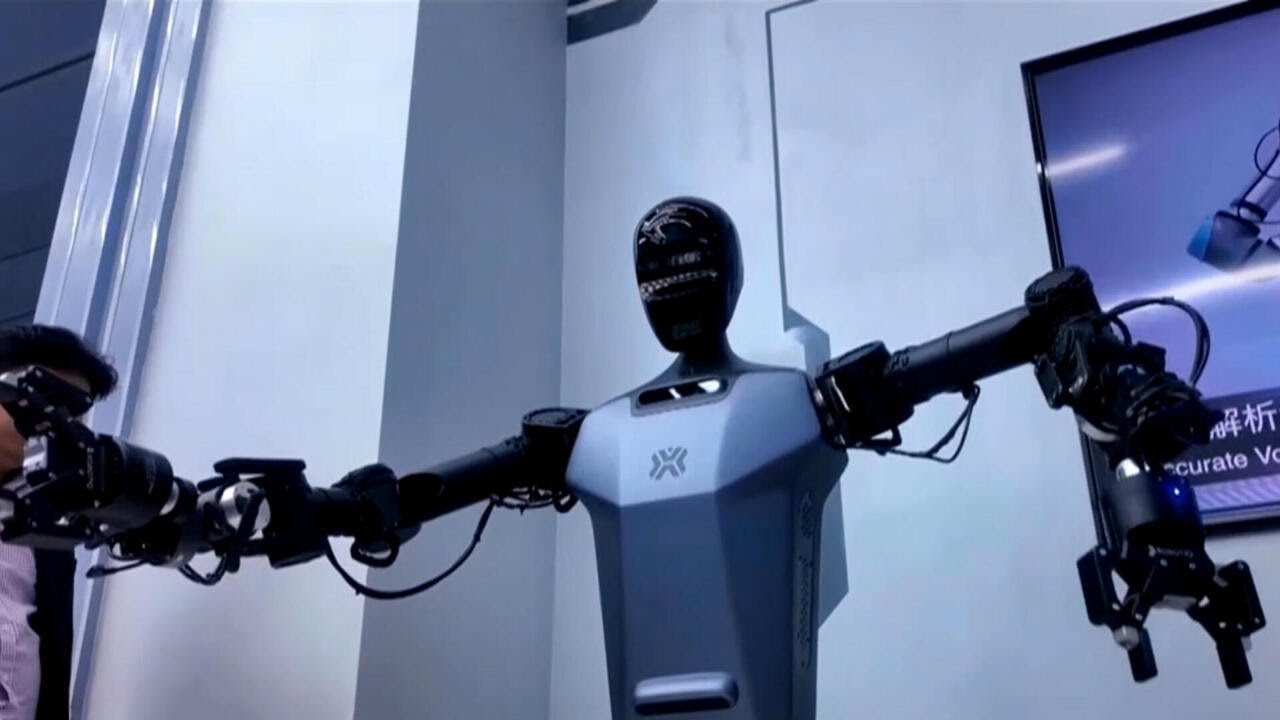
The video discusses the advancements and challenges of integrating AI-powered robots into daily life, highlighting MIT Professor Daniela Roose’s work on developing robots capable of performing and reliably repeating everyday tasks in dynamic environments. While emphasizing the current limitations and engineering complexities, Roose envisions robots as tools to enhance human abilities responsibly, reassuring that safety measures are in place and dystopian fears remain far from reality.
The video explores the emerging role of AI-powered robots in daily life, highlighting predictions that by 2030, 80% of people will interact with autonomous robots regularly. While artificial intelligence has already made significant strides on digital platforms, its application in the physical world remains a complex challenge. At MIT, Professor Daniela Roose and her team are at the forefront of developing robots capable of performing everyday tasks, but they emphasize that current robots are mostly demonstrations rather than fully autonomous helpers.
Professor Roose explains that teaching robots to perform tasks once is relatively straightforward, but enabling them to repeat those tasks reliably in dynamic, human-centered environments is much harder. Robots like Ruby, a humanoid robot trained to perform simple actions such as pouring lemonade, showcase progress but also reveal the limitations and messiness involved. The AI learns by collecting data on how humans perform tasks, using sensors to understand physical forces and movements, which helps the robot mimic human-like actions.
The video also contrasts the capabilities of industrial robots, which typically perform repetitive tasks, with the more ambitious goal of creating robots that can assist with household chores or medical procedures. Roose points out that even with AI assistance, designing robotic hands that match the dexterity and complexity of human hands is a significant engineering challenge. The robot arm demonstrated in the lab, with its multiple degrees of freedom, illustrates the intricate mechanics needed to replicate human precision.
Looking ahead, Roose envisions AI and robots as tools that can grant humans “superpowers,” enhancing cognitive abilities like speed and creativity, as well as physical capabilities such as reach and strength. She stresses that robots are tools created by people and are neither inherently good nor bad; their impact depends on how humans choose to use them. This perspective underscores a responsible approach to AI development, focusing on augmenting human potential rather than replacing it.
Addressing common fears about autonomous robots, Roose reassures viewers by highlighting safety measures like the “red button” that can immediately stop a robot if needed. While acknowledging that technology is not perfect and sometimes malfunctions, she emphasizes that we are still far from the dystopian scenarios portrayed in movies like “I, Robot” or “Ex Machina.” The video concludes with a sense of cautious optimism, recognizing the complexity of the physical world for robots but also the exciting possibilities ahead.