The speaker begins by explaining their approach to improving the interface between the Roo Code platform and cloud agents. They describe the current architecture, where the interface and backend are connected within the same process for maximum speed and power. However, when the interface operates outside the process and communicates via interprocess communication (IPC) over a socket, some bugs arise—particularly issues with stopping tasks reliably. The situation becomes even more complex and unreliable when additional layers, such as a web client and websocket interface, are introduced.
To address these issues, the speaker has restructured the model so that starting a session on a container now launches a server acting as an orchestrator. This orchestrator manages the Roo Code instance and connects using IPC, eliminating the problematic websocket extension bridge layer. By removing this extra layer of indirection, the system becomes more reliable and easier to manage. The orchestrator also enables advanced features, such as running multiple Roo instances simultaneously, swapping out Roo for other agentic coding harnesses, and starting containers without immediately running a task.
The demonstration showcases how a session can be started without an initial task, allowing the orchestrator to wait for further instructions. This new model supports greater flexibility, such as stopping a task entirely, switching to a new one, and returning to the original task later—similar to how an integrated development environment (IDE) operates. The speaker notes that while not all these features may be necessary, the new architecture supports them if needed.
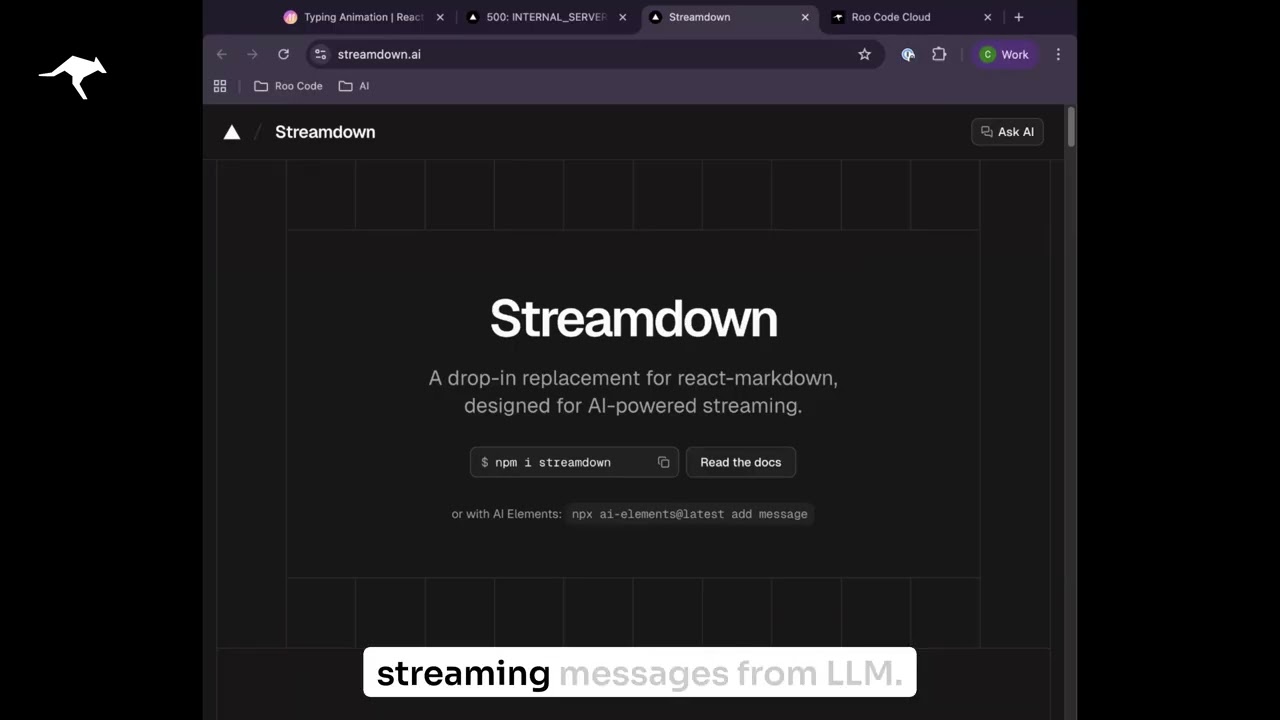
A key improvement is the integration of Streamdown, a React Markdown implementation optimized for streaming messages from large language models (LLMs). The speaker demonstrates how markdown content streams smoothly without flickering, and how scrolling is now handled by a library rather than custom code, resulting in a much better user experience. Additional features include a question-and-answer interface, reliable task stopping, and an event debugger that allows users to inspect and debug events from the coding harness in real time.
Other enhancements include the ability to tail log files for detached tasks, making it easier to monitor background processes. To-do lists are now treated as first-class objects, allowing users to interact with and track tasks more effectively. Full file search is supported, enabling users to quickly access documentation like the README. The terminal interface, provided by AI Elements, offers a robust out-of-the-box experience for running commands directly. Overall, these improvements result in a more powerful, performant, and reliable way to interact with containers and Roo Code, addressing many previous pain points.