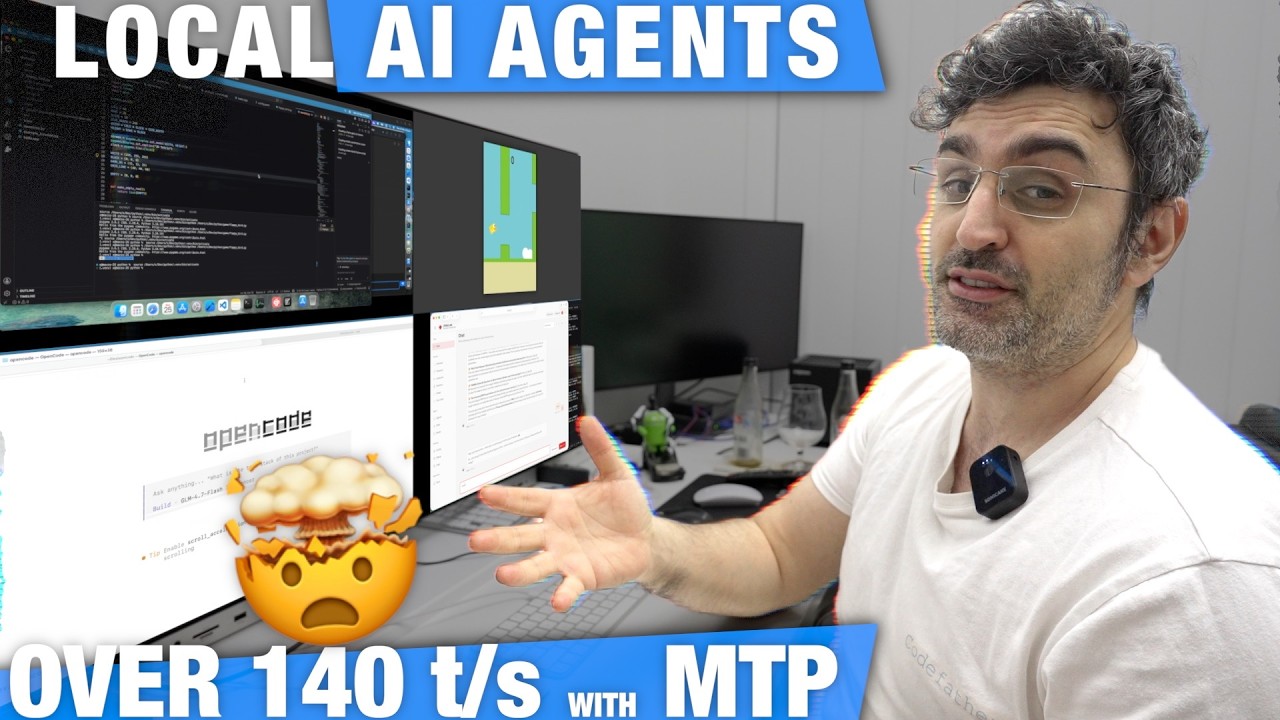
The video demonstrates how enabling MTP (speculative decoding) with 4-bit quantized models can nearly double local AI model token generation speeds, significantly improving performance in AI agent harnesses like OpenCode and OpenClaw for tasks such as code generation and interactive prompts. It provides a practical guide on setting up MTP-enabled models, highlights their speed and quality benefits, and showcases their flexibility and effectiveness across different AI clients and complex workflows.
In this video, the presenter explores how to significantly speed up local AI model inference using MTP (speculative decoding) within various AI agent harnesses like OpenCode, OpenClaw, and OpenAI-compatible APIs. MTP acts as a co-model that runs ahead of the main model, effectively doubling the token generation speed by quickly predicting tokens and reducing wasted computation. The presenter demonstrates this with Qwen 3.6 27B and Gemma 4 models, showing that enabling MTP with 4-bit quantization nearly doubles the tokens per second from around 28-50 to over 100 tokens per second, making AI code generation and interaction much faster.
The video provides a practical walkthrough on how to enable MTP versions of models by downloading the specific MTP quantized models from the model repository and activating the speculative decoder option. The presenter emphasizes that the 4-bit quantized MTP models offer the best balance of speed and quality, especially when running inside harnesses that perform continuous code checking and correction. This setup is shown to work well with coding prompts like generating Flappy Bird or Tetris HTML games, achieving token generation speeds exceeding 130 tokens per second, which is a substantial improvement over traditional quantization methods.
Next, the presenter demonstrates integrating these fast MTP models into OpenCode, a popular AI agent harness. They explain how to configure the OpenCode JSON provider file to point to the local server running the AI model with MTP enabled. The persistent prompt caching feature in the server further boosts performance by caching large system prompts to disk, avoiding repeated processing. The presenter tests the setup by generating code and interacting with the model, confirming that the token generation speed remains high (around 130-140 tokens per second) even when running through the harness, which typically adds overhead.
The video also covers switching models dynamically using server overrides without manually editing JSON files, showcasing flexibility in testing different models and quantization levels. The presenter compares performance across different AI clients, including VBS Studio, and confirms that the MTP-enabled models maintain their speed advantage. Despite some minor hiccups with file saving and prompt handling in OpenCode, the overall experience demonstrates that MTP can be effectively used to accelerate AI agents and local inference workflows, making them more practical for real-time coding and conversational tasks.
Finally, the presenter highlights that MTP’s benefits extend beyond simple one-shot prompts to more complex AI agent interactions, including joke generation and tool calls within OpenClaw. The video concludes by emphasizing that MTP speculative decoding is a powerful technique to enhance local AI model performance across various harnesses and use cases, encouraging viewers to try it out for faster and more efficient AI inference on their own machines.