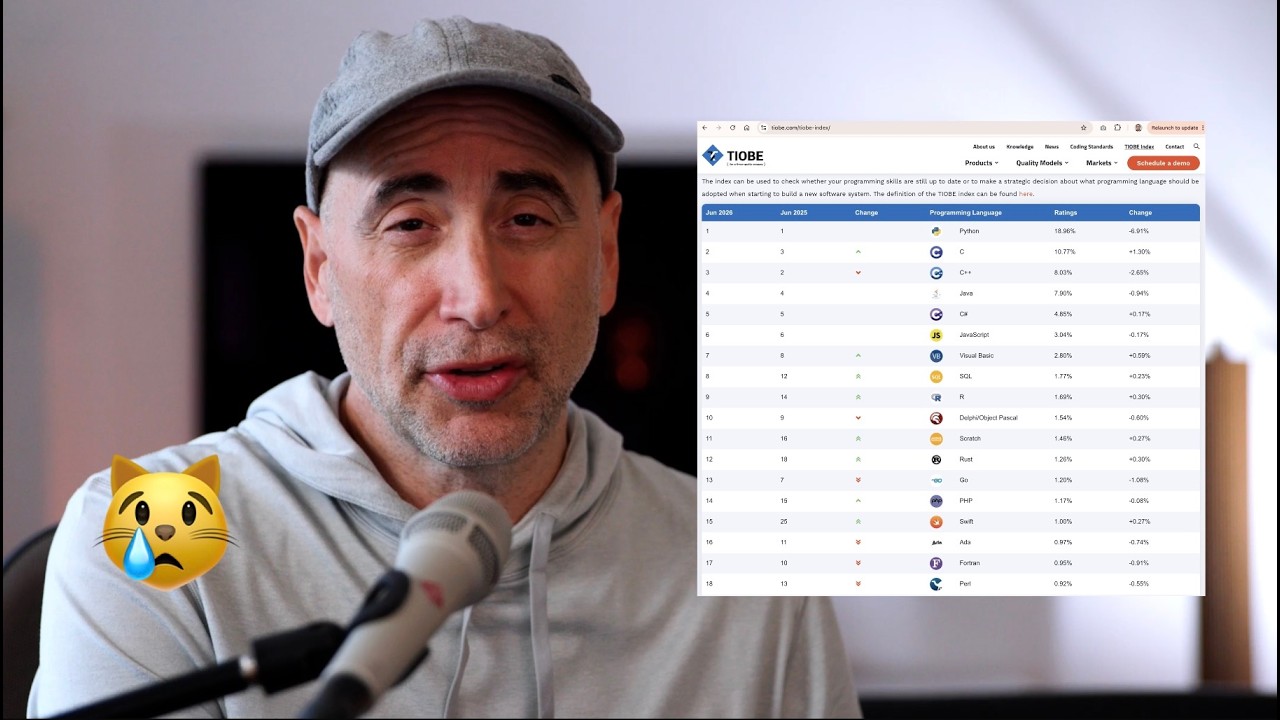
The June 2026 TIOBE index shows minor shifts in programming language popularity, with Rust rising and Python still leading, but such rankings are less relevant today due to the growing influence of AI in software development. Instead of focusing on language popularity or deep algorithmic expertise, developers should prioritize job market demand, adaptability to AI workflows, and broader software design skills to succeed in the evolving industry.
The June 2026 TIOBE index shows some shifts in programming language popularity: Python has slipped below 19%, Rust has reached a new high at 12%, and C++ has moved back ahead of Java to reclaim the third spot. However, these changes are minor—often just fractions of a percent—and should be considered noise rather than significant trends. The index is based on search engine queries, which raises questions about its relevance in the current AI-driven era where developers increasingly rely on AI models for answers instead of traditional search engines or forums like Stack Overflow.
The speaker advises against placing too much importance on language rankings when deciding what to learn or use professionally. Instead, the key factor should be job opportunities. Regardless of how much one might like a particular language, if there are no jobs available for it, its practical value is limited. Therefore, monitoring the job market is a more reliable way to guide learning and career decisions than following fluctuating popularity indexes.
A broader point emphasized is that programming languages themselves are largely irrelevant in the grand scheme of software development. Experienced developers often switch between multiple languages depending on the task at hand, much like a carpenter uses different tools for different jobs. Arguments over which language is “best” are typically a sign of inexperience. The speaker shares personal experience working with nine different languages and stresses that the choice of language depends on the project requirements rather than personal preference.
The rise of AI is transforming software development, making traditional language rankings even less relevant. Mastery of AI workflows, including setting up and deploying AI agents, understanding various AI models, and optimizing token usage, is becoming the new frontier. Developers who adapt to these changes and learn to harness AI effectively will be better positioned for the future, as AI is becoming the dominant “language” and framework in the industry.
Finally, while learning the basics of data structures and algorithms (DSA) is useful, the speaker argues that deep expertise in DSA is often unnecessary for most developers today. Modern hardware and infrastructure have reduced the importance of runtime optimization for typical applications, where database access is usually the main bottleneck. Instead, developers should focus on broader skills such as design patterns, refactoring, databases, and system-level thinking to succeed in modern software development.