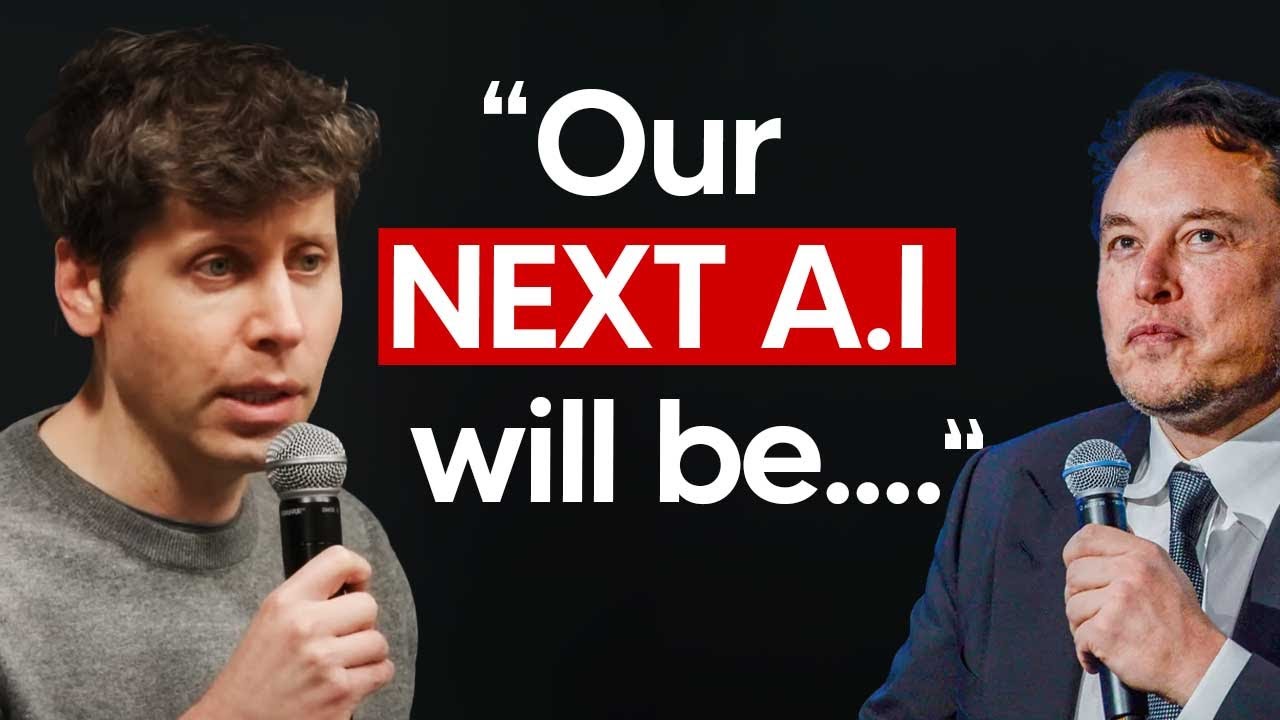
The video discusses the upcoming AI models revealed by two influential tech leaders, Elon Musk and Sam Altman. Elon Musk shared details about Grok 3.5, emphasizing its design to reason from first principles, similar to physics. This approach aims to ground the AI’s reasoning in fundamental truths, minimizing errors and enhancing safety. Musk highlighted the importance of grounding AI in reality, such as obeying the laws of physics, to ensure truthful and accurate predictions, especially in applications like autonomous vehicles and robots. He also mentioned Grok’s current success in customer service and its potential to improve safety and reliability across various industries.
Musk elaborated on the significance of applying physics-based reasoning to AI, suggesting that understanding and adhering to fundamental laws is crucial for true intelligence. He pointed out that while humans often break laws created by humans, no one breaks the laws of physics, underscoring the importance of grounding AI in reality. This grounding helps ensure that AI models make predictions aligned with the physical world, which is vital for safety and effectiveness in real-world applications like driving and robotics. Musk expressed optimism that Grok 3.5 will be a major step forward in creating more truthful and reliable AI systems.
The video then shifts focus to Sam Altman, who discussed advancements in software engineering driven by AI. Altman highlighted the rapid development of tools like CodeX, which now enable developers to delegate tasks to AI agents that can work autonomously on coding projects. He described this as a transformative change in programming, where AI acts as a virtual teammate capable of handling bug fixes, feature implementation, and answering questions. Altman emphasized that this evolution allows for more efficient and collaborative software development, with deep integration into platforms like GitHub.
Altman also shared insights into the future of AI models, noting that they will become simpler to use, more reliable, and feature-rich. He predicted that the number of models available will decrease as they become more streamlined and capable of automatically selecting the best approach for a given task. These models will incorporate multimodal capabilities, better tool use, and seamless integration, making AI more accessible and trustworthy for users. He expressed confidence that progress in these areas will accelerate rapidly, transforming how people interact with AI in various domains.
Finally, Altman offered advice for developers building high-scale, agent-based AI applications. He stressed the importance of adapting quickly to the rapid pace of technological change, encouraging early adoption and experimentation with new tools and workflows. He noted that the rate of progress in AI is unprecedented and that those who lean into these innovations early will be rewarded. The video concludes with a call for viewers to share what excites them most about the future of AI models, emphasizing the ongoing evolution and potential of AI-driven software and applications.