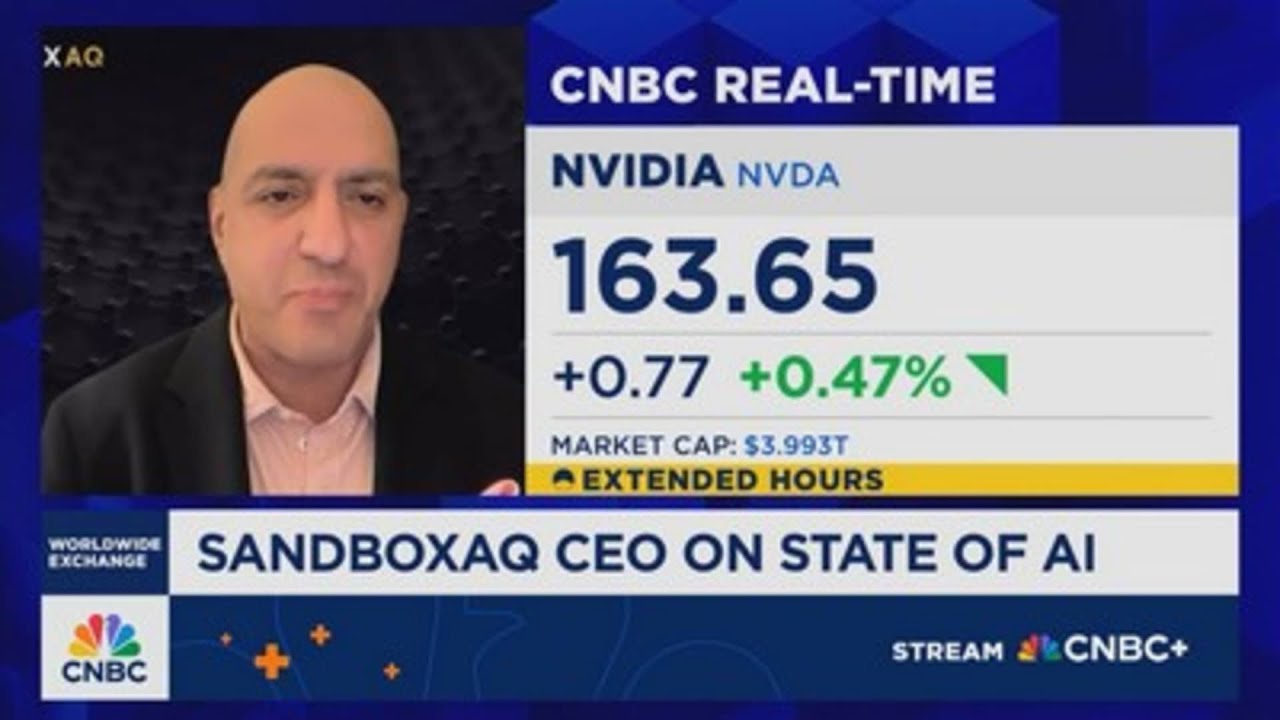
In the interview, SandboxAQ CEO Jack discusses the rapid growth of Nvidia, which is nearing a $4 trillion market capitalization, highlighting the soaring demand for AI technologies in the US. He points to recent strong earnings from TSMC, a major chip manufacturer, as evidence of the robust AI market, with demand coming from both large corporations and sovereign entities. Jack predicts that Nvidia and Microsoft could each reach a $5 trillion market cap within the next 12 to 18 months, reflecting the significant momentum in the AI sector. He also notes that TSMC has joined the $1 trillion club, bringing the total number of trillion-dollar companies worldwide to ten.
Jack confirms that SandboxAQ is an Nvidia partner and utilizes Nvidia’s DGX cloud platform, which provides access to the latest AI chips such as Hopper, Blackwell, and the upcoming Vera Rubin. He highlights a recent collaboration with Nvidia that produced the largest biopharma dataset ever, characterizing over 5 million molecules using SandboxAQ’s software on Nvidia hardware. This breakthrough is significant for drug development targeting diseases like cancer and Alzheimer’s, showcasing the practical impact of AI in healthcare.
The conversation then shifts to the broader AI investment landscape, referencing a Bank of America analyst’s view on an impending capital expenditure boom driven by AI infrastructure, robotics, automation, and data center expansion. Jack agrees and expands the discussion beyond Nvidia, emphasizing the role of the “Magnificent Seven” tech companies, which currently represent 34% of the S&P 500 market cap but only 11% of the US GDP. He explains that while AI is central to these companies’ core revenues, many other sectors have yet to fully integrate AI into their fundamental business operations.
Jack predicts that the market cap share of the Magnificent Seven will increase to 40% before the rest of the economy catches up in AI adoption. He points out that industries like pharma, energy, and automotive are still in early stages of leveraging AI beyond customer service improvements, with more advanced quantitative AI expected to drive future transformation. This divergence highlights the uneven pace of AI integration across different sectors.
Looking ahead, Jack outlines SandboxAQ’s plans for the second half of the year, focusing on releasing additional high-quality datasets and models that support drug development, new materials, and other applications including autonomous navigation without GPS. He also signals a growing emphasis on AI in cybersecurity, anticipating increased enterprise demand for AI-driven defense solutions as cyber threats escalate. Overall, SandboxAQ aims to leverage quantitative AI and quantum technologies to address diverse challenges across industries.