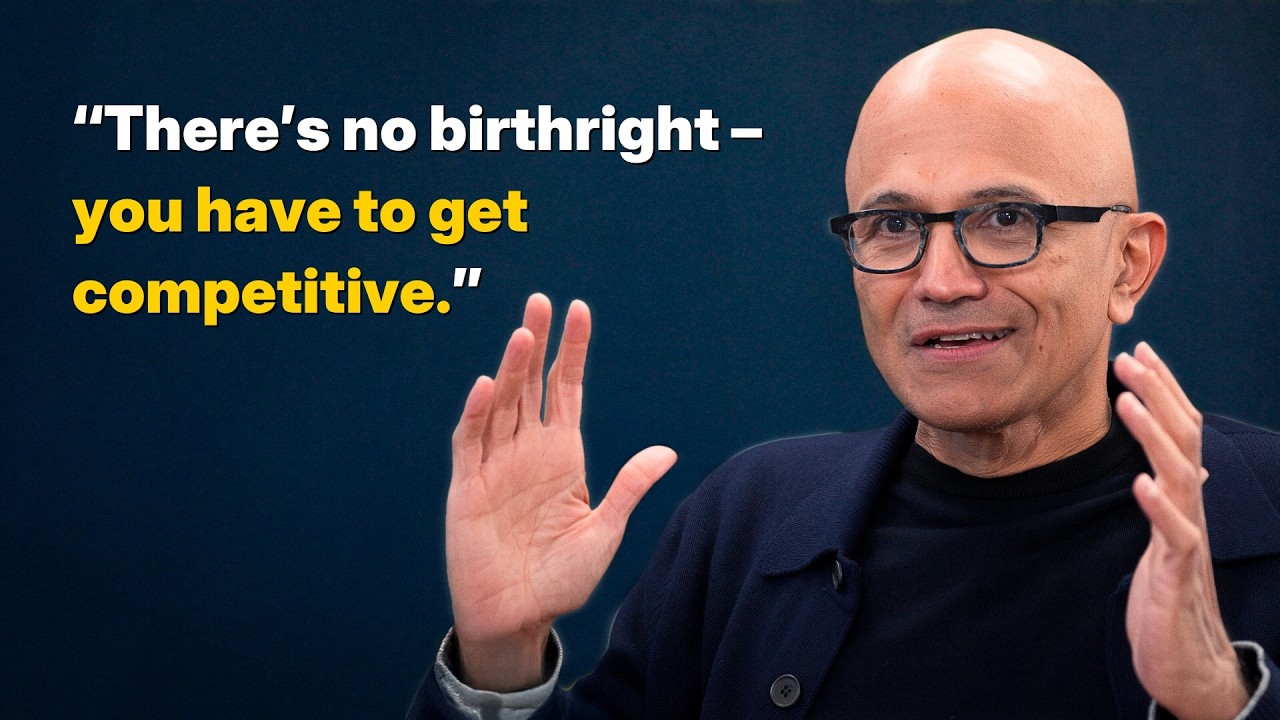
In this in-depth interview, Satya Nadella, CEO of Microsoft, discusses how the company is preparing for the era of Artificial General Intelligence (AGI) through massive investments in data center infrastructure and AI research. Microsoft has built the Fairwater 2 data center, currently the most powerful in the world, designed to scale AI training capacity by 10x every 18 to 24 months. This facility, along with upcoming centers like Fairwater 4, is interconnected with high-bandwidth networks to support large-scale distributed AI training and inference workloads. Nadella emphasizes the importance of building flexible, fungible infrastructure that can adapt to evolving AI hardware requirements and diverse workloads, rather than committing to a single generation of technology.
Nadella frames AI as a cognitive amplifier and guardian angel for humans, highlighting its role as a powerful tool that enhances human productivity rather than a mystical or immediate replacement for human intelligence. He acknowledges that while AGI may be the biggest technological revolution since the Industrial Revolution, it is still in the early stages, requiring both scientific breakthroughs and extensive engineering. Microsoft is focused on integrating AI deeply into its software products, such as Office 365 and GitHub Copilot, to expand markets and create new value. Nadella also discusses the evolving business models around AI, including subscriptions, consumption-based pricing, and device margins, and how Microsoft’s diverse portfolio positions it well to adapt to these changes.
On the competitive landscape, Nadella acknowledges the rapid growth of AI coding assistants and the emergence of new players like Anthropic, Claude, and Cursor. He stresses that Microsoft’s strength lies in its ecosystem, particularly GitHub, which remains the dominant platform for developers regardless of which AI coding agent they use. Microsoft is innovating with concepts like Agent HQ and Mission Control to enable users to manage multiple AI agents simultaneously, enhancing productivity and collaboration. Nadella also highlights the importance of building AI applications that integrate models with domain-specific knowledge, such as Excel Agent, which understands Excel’s native functions to provide more sophisticated assistance.
Regarding AI model development, Nadella explains Microsoft’s dual approach: leveraging OpenAI’s GPT family models under a long-term partnership while simultaneously building its own models through the Microsoft AI (MAI) initiative. He emphasizes the need for a world-class AI research team and infrastructure capable of supporting multiple model families to avoid being locked into a single architecture. Nadella also discusses the challenges of continuous learning and data liquidity, noting that no single model will dominate all domains or geographies, and that open-source models will play a critical role in maintaining competition and sovereignty.
Finally, Nadella addresses the geopolitical and industrial challenges of AI development, including data sovereignty, regulatory compliance, and global competition, particularly with China. He underscores the importance of building trust with governments and customers worldwide by respecting data residency and privacy requirements and investing in sovereign cloud infrastructure. Microsoft aims to be a global hyperscaler supporting diverse AI workloads and models, balancing capital-intensive infrastructure investments with software innovation to optimize total cost of ownership. Nadella concludes by emphasizing that trust in American technology and institutions will be a decisive factor in global AI leadership, alongside the ability to deliver reliable, scalable, and sovereign AI services.