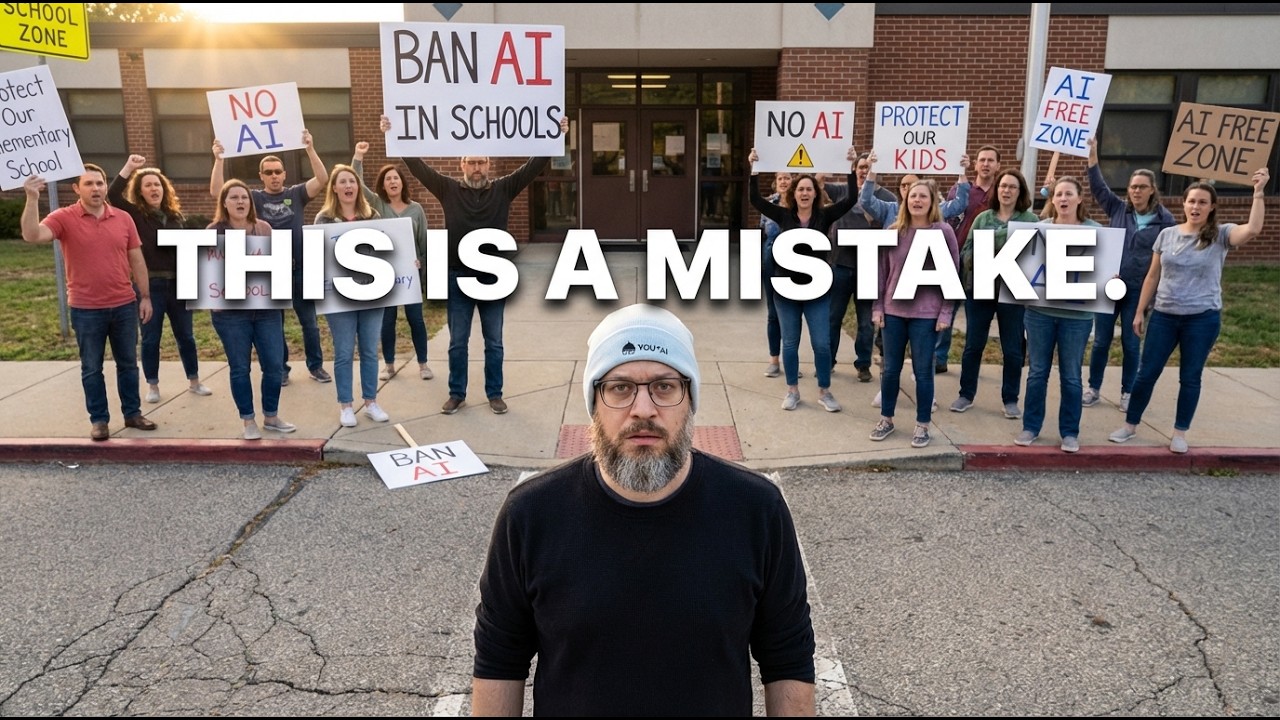
The video draws a parallel between the calculator bans of the 1970s and current parental and educational resistance to AI in schools. When calculators first became affordable, schools and parents feared they would undermine students’ mathematical abilities, leading to widespread bans. However, calculators ultimately changed the nature of mathematical thinking, freeing students from rote calculation and allowing them to focus on deeper concepts. The key lesson was that calculators were most beneficial when students first built a strong foundation in math before using the tool. The same principle, the speaker argues, should guide our approach to AI in education today.
AI is already transforming learning at an unprecedented pace. Studies show that AI tutors can double learning outcomes compared to traditional methods, and tools like Khan Academy’s AI tutor have seen explosive growth. Children as young as eight can now build video games or personalized tutors using natural language prompts, and teenagers are launching successful AI-powered businesses. Despite this, most schools and parents are unprepared for the scale and speed of these changes, clinging to outdated educational philosophies that do not reflect the realities of the AI-driven world students will inherit.
The speaker, a parent and AI professional, advocates for a balanced approach: children should first develop foundational skills—reading physical books, doing math by hand, and writing with pencils—before leveraging AI tools. This foundation is crucial because the effectiveness of AI depends on the user’s ability to specify tasks clearly, evaluate outputs critically, and understand underlying concepts. Without this base, students risk becoming passive consumers of AI-generated content, unable to judge its quality or correctness, and susceptible to cognitive offloading, where reliance on technology erodes essential skills.
The video warns against both extremes: banning AI outright or allowing unrestricted use without guidance. Instead, the speaker proposes a progression—build cognitive foundations, introduce AI tools with supervision, practice directing AI with increasingly precise specifications, and eventually graduate to more autonomous use as judgment develops. This approach fosters metacognition, the ability to think about one’s own thinking, which is seen as the defining competence of the AI age. It also emphasizes active creation over passive consumption, encouraging children to build, iterate, and refine their ideas with AI as a partner rather than a crutch.
Finally, the speaker offers seven guiding principles for parents and educators: foundation before leverage, specification as the new literacy, being a director not a passenger, sequencing autonomy, teaching kids to catch machine errors, prioritizing building over browsing, and attempting tasks before augmenting with AI. The ultimate goal is to raise children who are both proficient with AI and capable of independent thought, able to thrive in a rapidly changing world. The responsibility to guide the next generation through this transition, the speaker concludes, falls on all adults—not just parents, but anyone involved in children’s lives.